Weaviate vs Graph-Native Memory: Choose the Right Architecture for AI Agents
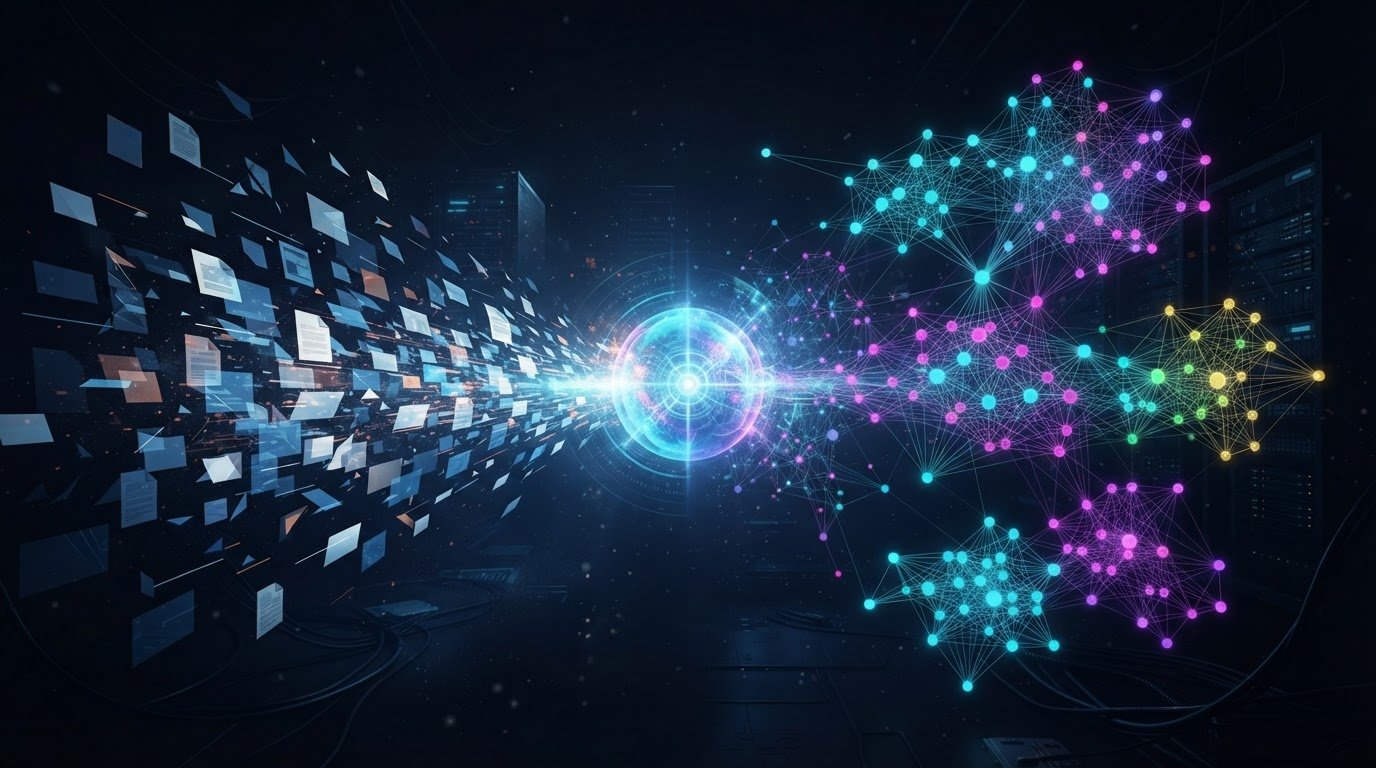
The strongest vector search may still leave an AI agent without the memory it needs. That’s the key distinction in Weaviate vs graph-native memory: one architecture centers on finding similar information, while the other organizes persistent context around entities, relationships, and memory types.
If vector databases, GraphRAG, and agent memory seem interchangeable, the confusion is understandable. They can work together, but they solve different problems. A vector database such as Weaviate can support semantic retrieval; graph-native memory adds a way to connect facts and preserve context over time. It doesn’t automatically replace vector search.
This guide explains where Weaviate fits, what graph-native memory adds, and how to choose based on your agent’s relationships, context, and memory lifecycle. You’ll learn when retrieval infrastructure is enough, when persistent memory matters, and how to evaluate a hybrid or graph-native approach without treating either architecture as a universal fix. The goal is useful context at query time, not a full knowledge base dumped into every prompt.
Key Takeaways
- Weaviate centers on vector retrieval, while graph-native memory organizes persistent agent context through typed memories and relationships.
- Weaviate vs graph-native memory isn’t always an either-or decision: use semantic search to find relevant candidates and graph relationships when context depends on connections.
- Choose your architecture by defining the context your agent needs, mapping its relationships, setting persistence requirements, and testing retrieval quality.
- Separate document search from persistent agent state to determine whether your system needs retrieval infrastructure, a memory layer, or both.
- NovaCortex provides self-hosted, Apache-2.0-licensed graph-native memory with four memory types, semantic and text retrieval, and a native MCP server exposing 15 tools.
Weaviate vs Graph-Native Memory: Two Different Architectural Jobs
Weaviate and graph-native memory can both support AI applications, but they address different architectural needs. Weaviate represents the vector-search side of this comparison: it helps an application retrieve content that is semantically similar to a query. Graph-native memory represents persistent agent knowledge through typed memories and explicit relations. Those jobs can complement each other; choosing one doesn’t automatically rule out the other.
Vector similarity search ranks content by how closely its embedding matches a query, while graph-linked agent memory stores knowledge as related, typed information that can persist and be recalled in context. This distinction also separates GraphRAG from memory: GraphRAG is a retrieval approach that uses graph relationships to gather context, while agent memory includes decisions about what knowledge persists, how it’s organized, and how the agent recalls it later.
What Weaviate contributes to an AI retrieval stack
An embedding represents content as a vector, allowing a system to search for items that are close in meaning even when they don’t share the query’s exact wording. In a retrieval-augmented generation (RAG) application, Weaviate can help find relevant content for a model to use. The application still determines what to index, how to form the query, and what retrieved material to place in the prompt.
Retrieval can also combine approaches. Hybrid patterns pair vector search with graph context, including GraphRAG workflows that use relationships between data points. Graph traversal follows connections through a graph; Graph traversal algorithms provide a useful foundation for understanding how those connections can be explored. A database’s retrieval capabilities are building blocks, not the complete RAG or agent architecture.
What graph-native memory means for an agent
Graph-native memory represents information as connected entities or records, with relations that show how one piece of knowledge links to another. Typed memories add another layer: an agent might distinguish an event it experienced from a stable fact, a procedure, or temporary working context. That structure gives an application a way to handle different knowledge according to its purpose and persistence needs.
Consider an assistant that remembers a user’s project, a decision made during a prior conversation, and the procedure agreed for the next review. If stored only as separate passages, each may be retrieved by similarity, but their relationship can remain implicit. Linked memories make those connections available to relation-aware retrieval. This doesn’t mean every graph database is an agent memory system; the application also needs a memory model, persistence rules, and recall logic.
The practical question in Weaviate vs graph-native memory is not which label wins. It’s whether the agent needs to locate relevant content, maintain connected state across interactions, or do both. That distinction is more useful than treating GraphRAG, vector retrieval, and persistent memory as interchangeable terms.
How Vector Retrieval and Graph-Native Memory Retrieve Context
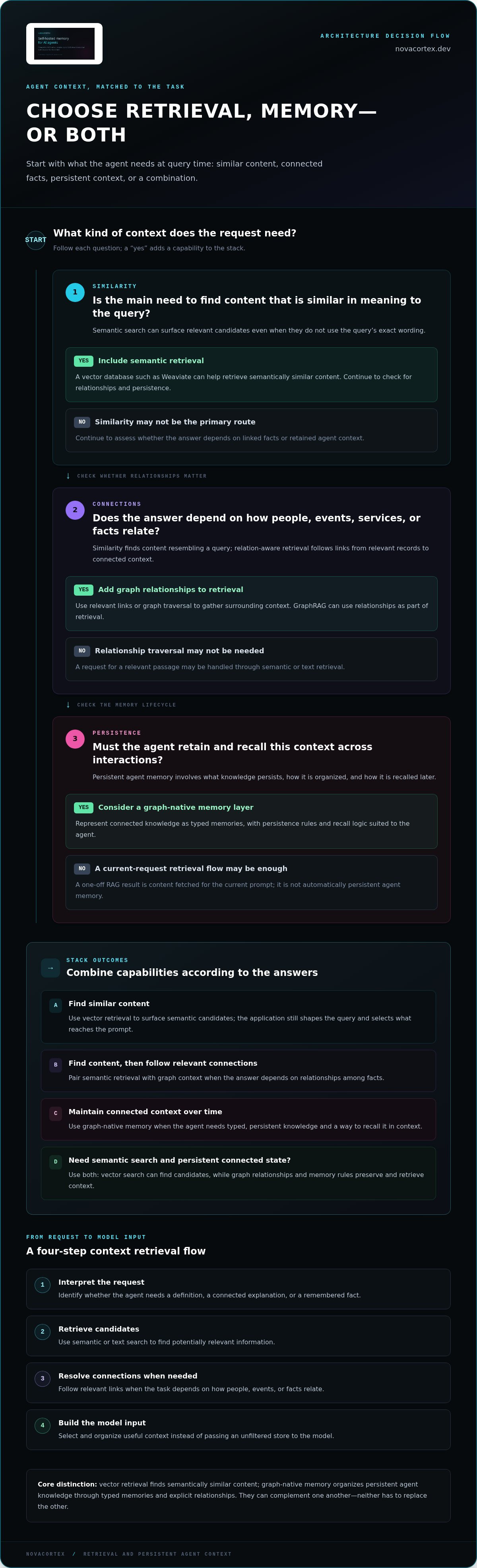
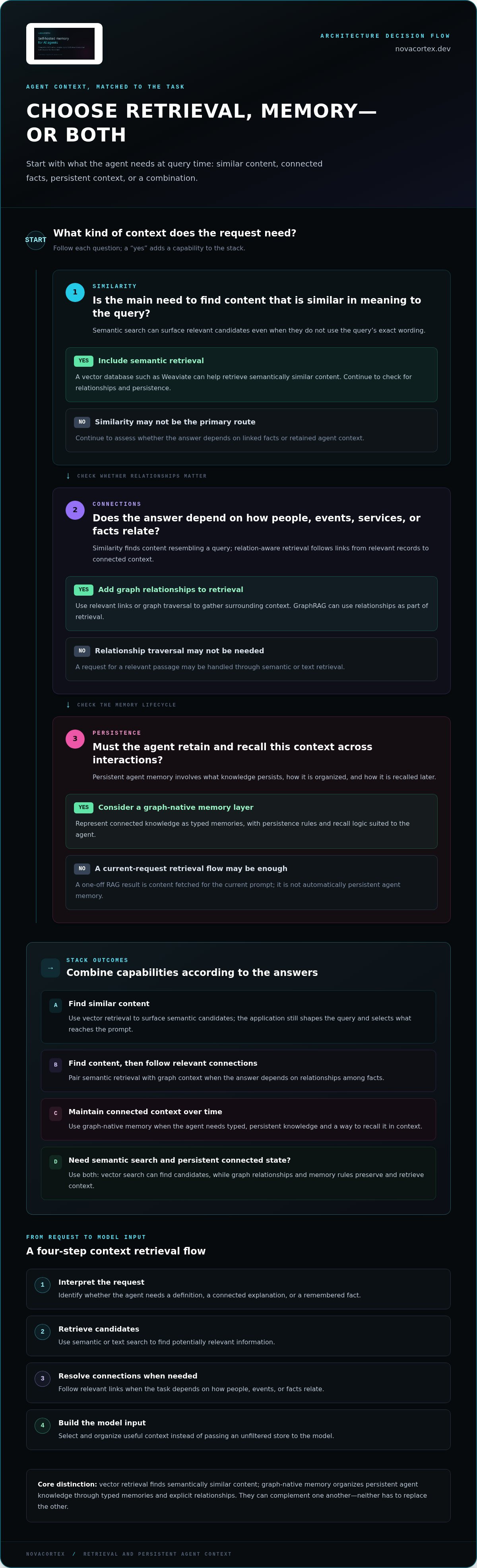
Retrieval works best when the system knows what kind of context the request needs. A query may call for a passage about a topic, connected facts about several entities, or information the agent retained from an earlier interaction. The path from query to model input changes with that intent.
Start with similarity
Vector retrieval is useful when relevant information may use different wording from the query. Embeddings represent text as vectors, so a search can surface semantically related passages without requiring an exact keyword match. That makes them useful for finding candidate content, but relevance still depends on the source data, query construction, and retrieval design.
A retrieval flow can narrow and shape those candidates before they reach the model:
- Interpret the request. Identify whether the agent needs a definition, a connected explanation, or a remembered fact.
- Retrieve candidates. Use semantic or text search to find potentially relevant information.
- Resolve connections. When the task depends on how people, events, or facts relate, follow relevant links between records.
- Build model input. Select and organize useful context rather than passing an unfiltered store to the model.
Follow the relationships
Similarity answers, “What content resembles this query?” Relation-aware retrieval asks, “What else is connected to the relevant result?” Relationship context adds value to similarity search when the answer depends on links among facts, not just on finding a passage with similar meaning.
Imagine an operations agent asked which service may be affected by a reported system failure. A relevant incident note is a useful starting point; links from that incident to dependent services and recent changes can supply surrounding context. Graph traversal can complement vector search here, but it doesn’t guarantee a more accurate answer or make embeddings unnecessary. The right retrieval path depends on the question.
Retrieve, then remember
A one-off RAG result is usually content fetched for the current prompt. Persistent agent memory serves a different lifecycle: it can retain experiences and knowledge across interactions, then make them available when later queries call for them. A retrieved document chunk may inform an answer without becoming enduring agent state.
NovaCortex separates memory into Episodic, Semantic, Procedural, and Working kinds. It supports semantic and text retrieval using OpenAI-compatible embeddings, with optional recency weighting and strict namespace isolation. These capabilities let an implementation shape recall around meaning and context without treating every stored item as the same kind of memory.
In practice, Weaviate vs graph-native memory is a question of retrieval needs and memory lifecycle, not a contest with one universal winner. To examine a graph-native agent memory implementation, explore the NovaCortex source code.
Weaviate vs Graph-Native Memory: Compare the Architecture That Fits
Compare systems by responsibility, not by database label. Weaviate represents the vector-retrieval side of the decision; graph-native memory represents an approach to preserving connected agent knowledge. Neither label dictates an entire application architecture. Your system can use vector search for candidate discovery and a separate memory layer to manage durable, related context.
| Decision axis | Weaviate as vector retrieval | Graph-native memory |
|---|---|---|
| Primary job | Find semantically similar content for retrieval workflows. | Represent persistent agent knowledge as typed, connected memories. |
| Data relationships | Similarity ranks candidates; relationship context may come from a hybrid design. | Explicit relations connect facts, events, and other memory records. |
| Persistence needs | Useful for retrieving stored content; agent-state policy belongs to the wider application. | Designed for retaining and recalling context across interactions. |
| Integration boundary | Retrieval infrastructure supplies candidate content to an application or model. | A memory layer manages how agent knowledge is organized and recalled. |
Choose vector retrieval for search
Prioritize vector retrieval when the main task is finding relevant passages across text or other embedded content. A support assistant searching product documentation, for example, may need to locate the best-matching answer rather than preserve a history of agent experiences as typed state. This doesn’t rule out graph techniques: add relationship-aware context if the task depends on connections between retrieved items.
Choose memory for continuity
Graph-native memory becomes relevant when an agent must connect facts, episodes, and procedures over time. Ask whether separating those memory kinds improves how your application stores or recalls knowledge, rather than assuming a graph is automatically better for every dataset. NovaCortex organizes memory as Episodic, Semantic, Procedural, and Working, and supports semantic and text retrieval with strict namespace isolation.
Combine distinct responsibilities
Use a combined architecture when document discovery and persistent agent context are separate requirements. Ingestion prepares source content; storage retains documents or memory records; retrieval selects candidates and relevant relations; the application then shapes model-facing context. Define these boundaries explicitly so you can see what becomes durable memory and what is fetched only for a particular request.
Decision rule: choose according to the context an agent must retain and retrieve. If it mainly needs semantically relevant documents, start with vector retrieval. If it must preserve connected knowledge across interactions, evaluate a memory layer. If it needs both, test each component against its own job. For another storage comparison, the article on Redis versus graph memory for AI agents offers a related perspective.
A Practical Decision Framework for Your Agent’s Memory Stack
Choose architecture based on the agent’s actual workload, not labels such as “vector,” “graph,” or “memory.” The Weaviate vs graph-native memory decision becomes clearer when you define the context the agent must retain, test how it retrieves that context, and account for deployment boundaries.
Map tasks to memory needs
Start with recurring agent tasks. For each one, write down what information it needs to answer and what must remain useful across later interactions. Separate durable facts from prior episodes, procedures, and short-lived working context. Then check whether the answer depends on links between stored items or whether finding a relevant document is enough.
A support agent may need documentation for one-off troubleshooting, while a project assistant may need to recall decisions, related people, and the process agreed for the next milestone. These are different context requirements. Make them explicit before selecting storage.
Evaluate in sequence
- Define the context. List the information each task needs and distinguish document search from persistent agent state. Decide whether the application needs either capability or both.
- Inspect relationships. Identify questions that require connecting facts, episodes, entities, or procedures across records. If those links affect the answer, include relation-aware retrieval in your evaluation.
- Set persistence needs. Specify what should be retained, for how long, and which memory type it represents. Treat temporary working context differently from knowledge intended for later recall.
- Test retrieval. Run representative queries, including varied wording, distractor content, and multi-step questions that rely on relationships. Review whether the returned context is relevant and useful to the model.
Check operational boundaries
Test the architecture against real deployment constraints. Map where source documents and agent memories are stored, which application components can access them, and how retrieved context reaches the model. If data locality matters, verify that the deployment keeps data within the intended infrastructure. NovaCortex is self-hosted, and its data stays on the customer’s infrastructure.
Check whether the agent needs standardized tool access, such as MCP, and whether memory must be separated by namespace. Consider migration early: portable export and import can help preserve options if the surrounding stack changes. NovaCortex’s capabilities are product-specific; don’t treat them as universal features of graph-native memory or use its benchmark results as a proxy for Weaviate or another system.
Record the test cases and compare architectures against the same tasks. A self-hosted AI memory layer engineering guide can provide additional implementation context as you map requirements to deployment choices.
Where NovaCortex Fits: Self-Hosted Graph-Native Memory for Agents
NovaCortex fits the memory-layer side of the architecture. It’s an open-source, Apache-2.0-licensed system for persistent agent context, not a claim that vector databases are obsolete or that every retrieval workload needs a graph. In a Weaviate vs graph-native memory design, vector retrieval can remain useful for finding semantically similar content while NovaCortex handles typed, linked agent memory.
A self-hosted layer for typed context
NovaCortex runs on the customer’s infrastructure, and data never leaves that infrastructure. Its graph-native storage organizes information into four memory kinds: Episodic for experiences, Semantic for knowledge, Procedural for instructions or methods, and Working for active context. The types distinguish what an agent remembers, while relations connect records that matter together.
NovaCortex also supports semantic and text retrieval. Graph-native storage doesn’t force every query into relation traversal: an implementation can retrieve by meaning or text, then use linked context where the task calls for it. Strict namespace isolation separates namespaces. These are product capabilities, not guarantees that graph structure alone improves every answer.
Interoperability and measured results
The native MCP server exposes 15 tools to Claude, Cursor, and other MCP-compatible clients, giving agents a standardized interface for interacting with memory. Teams can assess that integration alongside their existing retrieval path rather than treating the memory layer as a replacement for every data component.
Measured. Published. Reproducible. NovaCortex reports 99.2% recall@10 and an 80.0% overall score on LongMemEval_S. Typical token savings are 85-95% fewer input tokens, with up to 98.8% fewer input tokens versus a full-context dump. These figures describe NovaCortex, not Weaviate or another system.
Portable, local deployment
NovaCortex is self-hostable through Docker Compose, so deployment can remain within your infrastructure rather than depending on a cloud-hosted memory service. Deployment instructions:
docker compose up -d
# Web:  http://localhost:3000
# API:  http://localhost:3001
# Docs: http://localhost:3000/docs
For portability, the Portable Memory Format (PMF) is an open RFC-001 standard; export/import as JSON, binary MessagePack (~60% smaller), or AES-256-GCM encrypted bundles; Merkle-verified. It is versioned and vendor-neutral, supporting migration planning and zero lock-in.
The architectural fit is specific: use NovaCortex when an agent needs persistent, queryable context organized by memory type and relationships, and retain vector retrieval where semantic document search is useful. Evaluate the integration against your own agent tasks and deployment boundaries.
Turn Your Memory Requirements Into a Test
Make the next step concrete: choose a small set of real agent tasks and define what useful context looks like for each. Then test whether your architecture retrieves the right information, preserves what should persist, and keeps irrelevant context out of the model input. That gives your team evidence for the Weaviate vs graph-native memory decision, grounded in your workload rather than a database label.
For teams evaluating persistent memory, NovaCortex is open-source under the Apache-2.0 license and self-hosted, with zero data egress. Measured. Published. Reproducible. Its LongMemEval_S results include 99.2% recall@10 and an 80.0% overall score. Use those details to examine the implementation and shape your own evaluation plan.
Build around the context your agent genuinely needs. A clear test will show you where retrieval ends, where persistent memory begins, and how the two can work together.
Frequently Asked Questions
Is Weaviate a graph database?
No. In this comparison, Weaviate is the vector search system used to find semantically related content. A graph-aware design can still pair vector retrieval with a graph database or graph-based retrieval step. For example, a system might find relevant incident records through vector search, then use graph relationships to identify connected services. That combination doesn’t make vector search and graph storage the same component.
Can Weaviate be used for AI agent memory?
Yes, Weaviate can contribute semantic retrieval to an AI agent system, but that alone doesn’t define how the agent stores and recalls persistent state. In the Weaviate vs graph-native memory decision, check whether the application needs to remember prior interactions, distinguish knowledge types, or connect facts over time. An agent answering questions from a document collection may need retrieval; an assistant continuing a project may also need persistent memory.
Does graph-native memory replace vector search?
No, not by definition. Vector search can locate content that’s relevant in meaning, while graph retrieval can follow explicit connections among facts, people, events, or procedures. A research assistant, for instance, might retrieve matching papers and then trace links between authors and findings. Use either approach or combine them according to real query needs. Graph structure doesn’t guarantee better answers, and vector search isn’t obsolete.
When should an AI agent use graph-native memory?
Consider it when the agent needs to retain context between interactions and answer questions that depend on connected information. A project assistant may need to relate a previous decision to the people involved and the procedure for the next review. Identify those recurring tasks, then test representative queries against the stored context. Graph structure is useful when relationships matter, not simply because the data can be represented as a graph.
Can NovaCortex run without sending data to a cloud service?
Yes. NovaCortex is self-hosted, and its knowledge base remains on the customer’s infrastructure. When using an external model, only the few relevant snippets for a query are sent to that model, not the full knowledge base. NovaCortex also supports fully offline operation with a local 8B reader and local embeddings. This distinguishes where stored memory lives from the model-inference setup.
How does NovaCortex retrieve memories for an AI agent?
NovaCortex supports semantic and text retrieval using OpenAI-compatible embeddings, with optional recency weighting and strict namespace isolation. Its memory records can use Episodic, Semantic, Procedural, or Working types, with relations connecting them. Agents can access the system through its native MCP server, REST API, SDKs, or CLI. For example, an integration can retrieve a procedure alongside a related prior episode when a task needs both.
What is Portable Memory Format (PMF)?
Portable Memory Format (PMF) is an open RFC-001 standard; export/import as JSON, binary MessagePack (~60% smaller), or AES-256-GCM encrypted bundles; Merkle-verified. It is versioned and vendor-neutral, supporting migration planning and control over memory data.
Build and evaluate your agent’s memory stack around its real context needs. Explore NovaCortex on GitHub to see how its self-hosted memory layer can fit into your architecture.
FAQ
Is Weaviate a graph database?
No. In this comparison, Weaviate is the vector search system used to find semantically related content. A graph-aware design can still pair vector retrieval with a graph database or graph-based retrieval step. For example, a system might find relevant incident records through vector search, then use graph relationships to identify connected services. That combination doesn’t make vector search and graph storage the same component.
Can Weaviate be used for AI agent memory?
Yes, Weaviate can contribute semantic retrieval to an AI agent system, but that alone doesn’t define how the agent stores and recalls persistent state. In the Weaviate vs graph-native memory decision, check whether the application needs to remember prior interactions, distinguish knowledge types, or connect facts over time. An agent answering questions from a document collection may need retrieval; an assistant continuing a project may also need persistent memory.
Does graph-native memory replace vector search?
No, not by definition. Vector search can locate content that’s relevant in meaning, while graph retrieval can follow explicit connections among facts, people, events, or procedures. A research assistant, for instance, might retrieve matching papers and then trace links between authors and findings. Use either approach or combine them according to real query needs. Graph structure doesn’t guarantee better answers, and vector search isn’t obsolete.
When should an AI agent use graph-native memory?
Consider it when the agent needs to retain context between interactions and answer questions that depend on connected information. A project assistant may need to relate a previous decision to the people involved and the procedure for the next review. Identify those recurring tasks, then test representative queries against the stored context. Graph structure is useful when relationships matter, not simply because the data can be represented as a graph.
Can NovaCortex run without sending data to a cloud service?
Yes. NovaCortex is self-hosted, and its knowledge base remains on the customer’s infrastructure. When using an external model, only the few relevant snippets for a query are sent to that model, not the full knowledge base. NovaCortex also supports fully offline operation with a local 8B reader and local embeddings. This distinguishes where stored memory lives from the model-inference setup.
How does NovaCortex retrieve memories for an AI agent?
NovaCortex supports semantic and text retrieval using OpenAI-compatible embeddings, with optional recency weighting and strict namespace isolation. Its memory records can use Episodic, Semantic, Procedural, or Working types, with relations connecting them. Agents can access the system through its native MCP server, REST API, SDKs, or CLI. For example, an integration can retrieve a procedure alongside a related prior episode when a task needs both.
What is Portable Memory Format (PMF)?
Portable Memory Format (PMF) is an open RFC-001 standard; export/import as JSON, binary MessagePack (~60% smaller), or AES-256-GCM encrypted bundles; Merkle-verified. It is versioned and vendor-neutral, supporting migration planning and control over memory data. Build and evaluate your agent’s memory stack around its real context needs. Explore NovaCortex on GitHub to see how its self-hosted memory layer can fit into your architecture.