Why Not to Use Pinecone: The Case for Self-Hosted AI Memory Layers

Managed vector databases are the high-interest debt of the AI world. You trade long-term architectural sovereignty for a quick API key. It's a trap. Pinecone is a search engine for embeddings, not a cognitive memory layer for autonomous agents. If you're asking why not to use Pinecone, the answer lies in your growing API bills and the privacy risks of shipping sensitive data to a third-party black box. Proprietary silos create friction, not intelligence.
You likely value the initial speed of a managed service, but you're now hitting walls with flat vector search and unpredictable costs as your dimensions scale. This article promises to show you how to reclaim your data with a self-hosted, graph-native memory architecture that eliminates vendor lock-in. We will examine the structural bottlenecks of managed providers and provide a technical roadmap for full data residency. We'll explore the shift from rigid cloud dependencies to portable, sovereign memory formats that slash token consumption and return control to the builder.
Key Takeaways
- Identify the hidden architectural debt of managed services. Discover why not to use Pinecone for agentic workflows that demand deep relational context over simple vector similarity.
- Bridge the gap between search and cognition. Learn why flat vector retrieval fails to support complex reasoning and how a graph-native approach restores true agent memory.
- Reclaim your data sovereignty with the Portable Memory Format. Transition from proprietary silos to a self-hosted environment that runs on everything from a Raspberry Pi to a private VPS.
- Optimize performance and cost simultaneously. See how Knowledge Buckets can reduce token consumption by up to 98% while ensuring full privacy for sensitive embeddings.
- Build a modular, future-proof AI stack. Use MCP-Native servers to integrate your memory layer directly into modern agent frameworks without any vendor lock-in.
The Managed Vector Database Trap: Hidden Costs of Pinecone
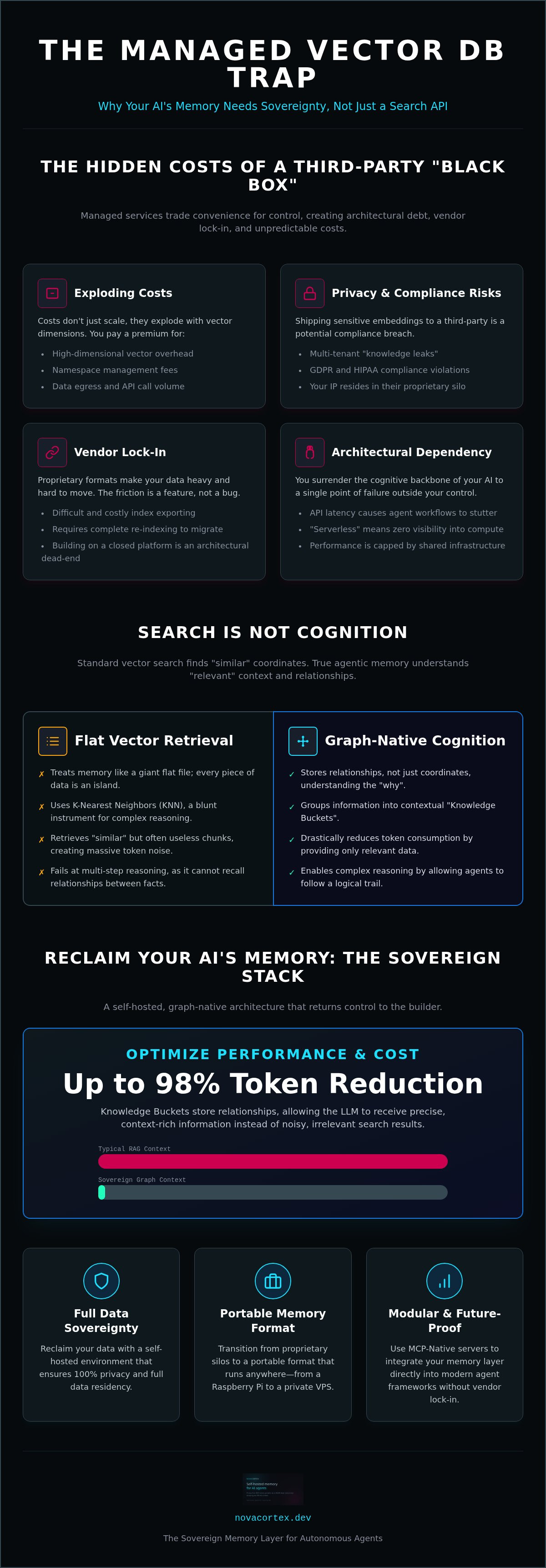
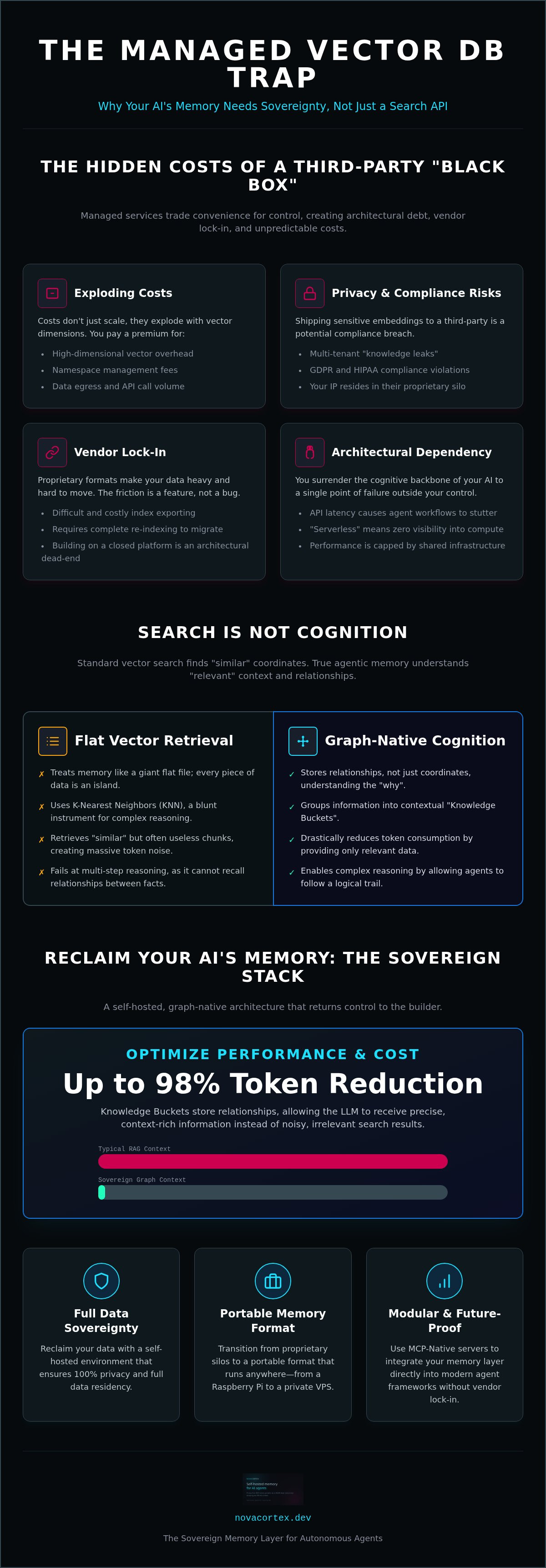
Managed vector databases offer a seductive trade-off: instant scalability for zero infrastructure management. It's a mirage. For many engineers, the realization of why not to use Pinecone only hits when the first high-scale bill arrives. This "API-first" approach prioritizes developer convenience over architectural resilience. You're building your agent's core intelligence on a proprietary foundation you don't own. When you outsource the indexing and retrieval of high-dimensional embeddings, you surrender the cognitive backbone of your AI to a third-party black box. A vector database should be a utility, not a gatekeeper.
The true cost of persistence in a managed environment is rarely transparent. You pay for more than just storage:
- High-dimensional vector overhead
- Namespace management fees
- Data egress and API call volume
As your vector dimensions grow, your costs don't just scale; they explode. Egress fees and proprietary indexing charges turn a simple storage solution into a recurring financial drain. This isn't just about the monthly invoice. It's about the "privacy tax." Every embedding sent to a third-party cloud is a potential compliance breach. For industries like healthcare or finance, shipping raw data representations to a managed provider is a non-starter.
The Architecture of Dependency
Managed services centralize control, creating a single point of failure outside your stack. If Pinecone's API experiences latency, your agentic workflows stutter. You lose the ability to optimize hardware for specific query patterns. "Serverless" is often marketing shorthand for "zero visibility into the physical compute." This lack of control prevents fine-tuning for low-latency, real-time reasoning. Performance is capped by the provider's shared infrastructure, not your engineering skill.
Compliance and the Data Sovereignty Crisis
Multi-tenant environments are inherently risky. The threat of "knowledge leaks" between namespaces in shared clusters is a persistent architectural concern. Under GDPR and HIPAA, you're responsible for data residency, yet Pinecone keeps your most valuable intellectual property in their proprietary silo. Digital sovereignty in AI infrastructure is the absolute right of a builder to own, move, and secure their agent's memory without third-party interference.
Exporting proprietary indexes is notoriously difficult. You're locked into their ecosystem with no easy exit strategy. Reclaiming your data often requires re-indexing everything from scratch, a process that is both expensive and time-consuming. This friction is a feature of managed services, not a bug. They want your data to be heavy and hard to move. This inherent lack of portability is a primary reason why not to use Pinecone for systems requiring high data mobility. Building on a closed platform is an architectural dead end.
Vector Similarity vs. Agentic Memory: Why Search Isn't Cognition
Vector databases aren't brains. They're multidimensional indexes. Pinecone treats memory like a giant flat file, assuming that proximity in vector space equals relevance in reasoning. This is a fundamental misunderstanding of agentic cognition. While understanding what are vector databases is essential for basic RAG, relying on them for complex agent logic reveals their limitations. If your agent needs to understand the relational "why" behind a data point, K-nearest neighbors (KNN) is a blunt instrument. This architectural mismatch is a primary reason why not to use Pinecone for systems that require multi-step reasoning and deep context.
Similarity is just a mathematical coordinate. Relevance is contextual. Standard vector search often retrieves "similar" but useless chunks that bloat your context window without adding value. This creates massive token noise. NovaCortex shifts this paradigm by using graph-native storage to group information into Knowledge Buckets. By storing relationships instead of just coordinates, you can achieve up to a 98% reduction in token usage. You stop paying for the LLM to filter out the garbage your vector database shouldn't have sent in the first place.
The Cognitive Limits of Vector-Only RAG
Agents lose context when they can't follow a logical trail. In a flat vector index, every piece of data is an island. When an agent performs multi-step reasoning, it needs to recall how Fact A influences Fact B. Finding a document isn't the same as recalling a relationship. Without a graph structure, the agent is forced to perform "mental gymnastics" to reconstruct the link between disparate chunks. This increases cognitive overhead and leads to hallucinations. Structured knowledge buckets solve this by providing pre-organized context that respects the original data's hierarchy.
Graph-Native Memory: The Next Evolution
Precision beats brute force. Graph-native memory allows agents to traverse links between data points with surgical accuracy. Instead of dumping the top 10 similar vectors into a prompt, a graph-native system retrieves the specific cluster of related concepts. This improves precision and ensures the agent maintains a coherent "train of thought" across long sessions. For a deep technical comparison on these architectures, refer to our guide on Redis vs graph memory for AI agents. If you're ready to build a more sovereign and efficient memory layer, explore the NovaCortex Self-Hosted Edition on GitHub.
Self-Hosting: Reclaiming the AI Infrastructure Stack
Building on a third-party cloud is architectural debt. Real digital sovereignty requires a shift back to the edge. While a Vector database in the cloud offers ease, it creates a dependency that compromises performance and security. Choosing a self-hosted path isn't just about privacy. It's about engineering a system where your data isn't trapped in a proprietary black box. This is the core argument for why not to use Pinecone when building long-term agentic infrastructure. You shouldn't let a vendor dictate the limits of your agent's memory.
NovaCortex Self-Hosted Edition is built for total independence. It runs on any hardware, from a Raspberry Pi to a high-performance VPS. You own the compute. You own the storage. You own the logic. This level of control is impossible in a managed environment where you're just another tenant on shared hardware. By hosting your own memory layer, you eliminate the "noisy neighbor" effect and tailor your infrastructure to your specific query patterns.
The Power of the Portable Memory Format (PMF)
Proprietary formats are silos. They make data heavy and hard to move. The portable memory format for AI (PMF) decouples your agent's knowledge from the underlying database engine. This ensures your memory layer is future-proof. If you need to switch environments, you don't pay a "migration tax" in time or compute. PMF treats memory as a standardized asset, allowing for seamless interoperability across different agentic frameworks. Your data remains yours, regardless of the tools you use to query it.
Local Performance and Low Latency
Cloud APIs introduce non-deterministic latency. In agentic workflows, every millisecond counts. Eliminating the round-trip to a managed provider results in faster, more fluid agent responses. Local retrieval isn't just a performance boost; it's a structural requirement for real-time cognition. When an agent needs to recall context mid-reasoning, a 200ms API delay is an eternity. Local memory servers solve this bottleneck.
By deploying self-hosted AI memory layers, you optimize your environment for MCP (Model Context Protocol) native integration. This reduces the friction between the LLM and its memory. High-security applications shouldn't trust their embeddings to a multi-tenant cloud. Running a local memory server ensures that your data never leaves your network. It's the only way to guarantee absolute data residency while maintaining peak retrieval speeds. Independence is the ultimate performance optimization.
Evaluation Framework: When to Move Beyond Pinecone
Don't wait for a production outage to audit your infrastructure. You move when the efficiency curve flattens. If you're calculating why not to use Pinecone for your scaling phase, start with the "Token vs. Vector" cost ratio. When the price of retrieving a context chunk exceeds the cost of the LLM token generation, your unit economics are underwater. This is the tipping point where managed convenience becomes architectural debt. High-dimensional vector search is a resource hog that managed providers pass directly to your invoice. You're paying a premium for a black box.
Data sensitivity is the next gate. Storing PII or proprietary IP in a third-party vector index isn't just a risk; it's a compliance liability. If your legal team can't audit the exact residency of every embedding, you've lost control. This lack of transparency is a core reason why not to use Pinecone for high-stakes enterprise applications. Retrieval precision also decays at scale. Similarity search often triggers "agent amnesia" by returning noisy, irrelevant coordinates that confuse the model. Finally, test your exit strategy. If you can't export your entire knowledge base into a portable format today, you're a tenant, not an owner.
The 3-Point Scalability Audit
Efficiency is measured in performance and personnel. Use these metrics to evaluate your current setup:
- Cost per query: Analyze the trend as you hit 1M+ vectors. Managed margins often tighten at the exact moment you need to scale.
- Average latency: Measure the round-trip delay in multi-agent environments. Swarm intelligence requires sub-50ms retrieval to maintain fluid reasoning.
- Developer overhead: Track the hours spent on manual context management. If your team is constantly prompt-hacking to fix retrieval errors, the database is failing you.
The Security and Compliance Checklist
Enterprise deployments demand more than just a "secure" API. They require absolute data residency. You must be able to prove where data lives and how it's accessed. Auditability is non-negotiable. A transparent memory retrieval process allows you to trace every agent decision back to a specific, immutable source. This level of rigor is why many builders are moving toward a self-hosted vs managed AI memory strategy for long-term compliance. Sovereignty is the only hedge against future regulatory shifts.
NovaCortex: The Sovereign Alternative to Managed Vector DBs
NovaCortex is the architectural correction to the managed database trap. It isn't just a storage layer; it's a cognitive engine designed for builders who refuse to outsource their agent's brain. If the primary reason why not to use Pinecone is the lack of relational intelligence, NovaCortex provides the solution through graph-native Knowledge Buckets. This approach enables a verified 98% reduction in token usage by ensuring only the most relevant, pre-contextualized data enters the context window. Efficiency isn't a suggestion; it's a structural requirement for scalable AI.
Building on open source under the Apache-2.0 license ensures that your infrastructure remains a foundation of trust. You aren't just renting an API; you're deploying a sovereign system. This transparency allows for deep auditability and hardware optimization that proprietary clouds simply cannot match. Choosing NovaCortex addresses the fundamental concerns regarding why not to use Pinecone for data-sensitive or cost-intensive agentic systems. NovaCortex is engineered for those who prioritize long-term viability over short-term convenience.
Engineering Persistent Agent Cognition
Standard vector search suffers from "agent amnesia" because it lacks a temporal and relational understanding of data. NovaCortex solves the forgetting problem by leveraging AI agent long term memory to maintain state across complex, autonomous workflows. Knowledge Buckets replace traditional RAG by organizing relational data into pre-contextualized clusters that eliminate the need for the LLM to filter irrelevant vector neighbors. This ensures that as your agent's knowledge base grows, its reasoning remains sharp rather than getting lost in a sea of coordinates.
Deployment and Integration
Integration shouldn't be a bottleneck. By running an MCP native memory server on your own hardware, you achieve seamless interoperability with modern agent frameworks. Whether you're deploying on a private VPS or local edge devices, the Portable Memory Format (PMF) ensures your data remains synced and accessible. This eliminates the "migration tax" and allows you to move your memory layer as your infrastructure evolves. Reclaiming your data residency is the first step toward building truly autonomous, secure AI systems.
Ready to reclaim your AI memory? Deploy NovaCortex on GitHub
Reclaim Your Cognitive Sovereignty
Managed vector databases are search engines, not memory layers. They introduce latency, cost volatility, and privacy risks that stall production agents. The engineering decision of why not to use Pinecone boils down to a choice between renting a black box or owning your cognitive stack. Transitioning to a self-hosted, graph-native architecture isn't just about saving money. It's about building a foundation that respects data residency and architectural independence.
NovaCortex delivers on this promise with an Apache-2.0 open-source framework. By utilizing the Portable Memory Format (PMF), you eliminate vendor lock-in forever. You gain a verified 98% reduction in token usage through optimized Knowledge Buckets. This isn't just a replacement. It's a fundamental upgrade to how your agents think, recall, and reason.
Start building the memory layer your agents deserve today. The future of AI is sovereign, local, and relational.
Frequently Asked Questions
What are the main disadvantages of using Pinecone for long-term AI memory?
Pinecone’s primary drawbacks include unpredictable API costs as vector dimensions scale and significant privacy risks from sending sensitive embeddings to a third-party cloud. Developers often realize why not to use Pinecone when they hit the architectural limits of flat vector search, which lacks the relational context needed for complex agent reasoning. Managed services also impose a proprietary silo on your data, making it difficult to move or optimize for specific hardware requirements.
How does NovaCortex reduce token usage compared to standard RAG?
NovaCortex uses Knowledge Buckets to group relational data into pre-contextualized clusters. This method achieves up to a 98% reduction in token usage compared to standard RAG, which often dumps irrelevant context chunks into the prompt. By retrieving only the most precise relational data, you save on LLM costs and reduce the noise that leads to agent hallucinations. It is about surgical precision rather than brute-force similarity search across a flat index.
Is self-hosting an AI memory layer more expensive than a managed service?
Self-hosting is generally more cost-effective at scale because you eliminate recurring API fees and data egress charges. While managed services offer low upfront effort, the long-term tax on every query and stored vector becomes a massive financial drain. Running your own infrastructure on a VPS or local hardware allows you to predict costs and optimize performance without the high-margin markups of third-party cloud providers. You trade a monthly bill for total infrastructure control.
Can I migrate my existing data from Pinecone to NovaCortex?
You can migrate your data, though the process depends on your ability to export raw embeddings and metadata from your current provider. Since proprietary indexes are designed to be sticky, the primary reason why not to use Pinecone for long-term projects is the friction of moving out. NovaCortex uses the Portable Memory Format (PMF) to ensure that once you move your data, it remains truly portable and never trapped in a proprietary silo again.
What is the Portable Memory Format (PMF) and why does it matter?
The Portable Memory Format (PMF) is an open standard that decouples your agent’s knowledge from the underlying database engine. It matters because it ends vendor lock-in. By using a standardized format, you can move your memory layer across different environments, from local edge devices to private cloud servers, without re-indexing your data. PMF ensures your intellectual property remains a sovereign asset rather than a rented service that is difficult to export or migrate.
How does graph-native storage improve AI agent reasoning?
Graph-native storage allows agents to understand the relationships between data points rather than just their mathematical proximity. Standard vector databases treat knowledge as a flat list of coordinates. In contrast, a graph structure enables an agent to follow logical paths and recall how different facts influence each other. This improves multi-step reasoning and ensures the agent maintains a coherent train of thought during long, complex autonomous sessions by respecting the relational hierarchy of information.
What hardware do I need to run NovaCortex Self-Hosted Edition?
NovaCortex Self-Hosted Edition is designed for extreme architectural flexibility. You can run it on anything from a Raspberry Pi for edge applications to a high-performance VPS for enterprise-grade agent swarms. The system is lean and avoids the bloated resource requirements typical of managed cloud databases. This allows you to deploy your memory layer wherever your agents are running, ensuring low-latency retrieval and absolute control over your physical compute and data residency requirements.
Is NovaCortex compatible with the Model Context Protocol (MCP)?
Yes, NovaCortex is fully compatible with the Model Context Protocol. It includes an MCP-Native Memory Server that integrates seamlessly with modern agent frameworks. This compatibility allows your agents to access their long-term memory through a standardized protocol, reducing integration friction and ensuring that your memory layer remains interoperable with the broader AI ecosystem. It is a plug-and-play solution for builders who prioritize modular, future-proof architectures and reject restrictive, closed-source ecosystems.
FAQ
What are the main disadvantages of using Pinecone for long-term AI memory?
Pinecone’s primary drawbacks include unpredictable API costs as vector dimensions scale and significant privacy risks from sending sensitive embeddings to a third-party cloud. Developers often realize why not to use Pinecone when they hit the architectural limits of flat vector search, which lacks the relational context needed for complex agent reasoning. Managed services also impose a proprietary silo on your data, making it difficult to move or optimize for specific hardware requirements.
How does NovaCortex reduce token usage compared to standard RAG?
NovaCortex uses Knowledge Buckets to group relational data into pre-contextualized clusters. This method achieves up to a 98% reduction in token usage compared to standard RAG, which often dumps irrelevant context chunks into the prompt. By retrieving only the most precise relational data, you save on LLM costs and reduce the noise that leads to agent hallucinations. It is about surgical precision rather than brute-force similarity search across a flat index.
Is self-hosting an AI memory layer more expensive than a managed service?
Self-hosting is generally more cost-effective at scale because you eliminate recurring API fees and data egress charges. While managed services offer low upfront effort, the long-term tax on every query and stored vector becomes a massive financial drain. Running your own infrastructure on a VPS or local hardware allows you to predict costs and optimize performance without the high-margin markups of third-party cloud providers. You trade a monthly bill for total infrastructure control.
Can I migrate my existing data from Pinecone to NovaCortex?
You can migrate your data, though the process depends on your ability to export raw embeddings and metadata from your current provider. Since proprietary indexes are designed to be sticky, the primary reason why not to use Pinecone for long-term projects is the friction of moving out. NovaCortex uses the Portable Memory Format (PMF) to ensure that once you move your data, it remains truly portable and never trapped in a proprietary silo again.
What is the Portable Memory Format (PMF) and why does it matter?
The Portable Memory Format (PMF) is an open standard that decouples your agent’s knowledge from the underlying database engine. It matters because it ends vendor lock-in. By using a standardized format, you can move your memory layer across different environments, from local edge devices to private cloud servers, without re-indexing your data. PMF ensures your intellectual property remains a sovereign asset rather than a rented service that is difficult to export or migrate.
How does graph-native storage improve AI agent reasoning?
Graph-native storage allows agents to understand the relationships between data points rather than just their mathematical proximity. Standard vector databases treat knowledge as a flat list of coordinates. In contrast, a graph structure enables an agent to follow logical paths and recall how different facts influence each other. This improves multi-step reasoning and ensures the agent maintains a coherent train of thought during long, complex autonomous sessions by respecting the relational hierarchy of information.
What hardware do I need to run NovaCortex Self-Hosted Edition?
NovaCortex Self-Hosted Edition is designed for extreme architectural flexibility. You can run it on anything from a Raspberry Pi for edge applications to a high-performance VPS for enterprise-grade agent swarms. The system is lean and avoids the bloated resource requirements typical of managed cloud databases. This allows you to deploy your memory layer wherever your agents are running, ensuring low-latency retrieval and absolute control over your physical compute and data residency requirements.
Is NovaCortex compatible with the Model Context Protocol (MCP)?
Yes, NovaCortex is fully compatible with the Model Context Protocol. It includes an MCP-Native Memory Server that integrates seamlessly with modern agent frameworks. This compatibility allows your agents to access their long-term memory through a standardized protocol, reducing integration friction and ensuring that your memory layer remains interoperable with the broader AI ecosystem. It is a plug-and-play solution for builders who prioritize modular, future-proof architectures and reject restrictive, closed-source ecosystems.