Privacy-Focused RAG: Engineering Secure, Self-Hosted AI Memory

What if the very memory powering your AI agent is actually a backdoor for corporate espionage? If your privacy-focused RAG strategy relies on third-party vector databases or cloud-hosted LLM APIs, you've inherited a structural vulnerability that no amount of encryption can fix. Most engineers recognize that dumping entire knowledge bases into a context window is a recipe for massive token waste and data exposure. You know that true sovereignty is impossible when your proprietary data is processed on infrastructure you don't control.
This guide shows you how to master the architectural shift from leaky cloud systems to secure, graph-native, self-hosted memory layers. We'll explore the engineering required to deploy NovaCortex Self-Hosted Edition and utilize the Portable Memory Format (PMF) to achieve zero-leakage AI. You'll learn to eliminate high-latency pipelines and reclaim complete data ownership through MCP-Native Memory Servers and Knowledge Buckets. We are moving beyond abstract principles into the operational reality of the August 2, 2026, EU AI Act. It's time to build a system where the brain and the memory both belong to you.
Key Takeaways
- Identify the structural flaws in cloud vector databases and why a privacy-focused RAG architecture requires total data isolation on private infrastructure.
- Replace noisy vector similarity searches with graph-native storage to capture complex relationships and improve retrieval precision.
- Deploy Knowledge Buckets to organize modular data, reducing context window bloat and cutting token waste by up to 98%.
- Secure digital sovereignty using the Portable Memory Format (PMF) to ensure your AI memory remains independent of restrictive third-party platforms.
- Transition to NovaCortex Self-Hosted Edition to establish a high-performance, MCP-Native Memory Server on your own hardware.
The Privacy Crisis in Standard RAG Architectures
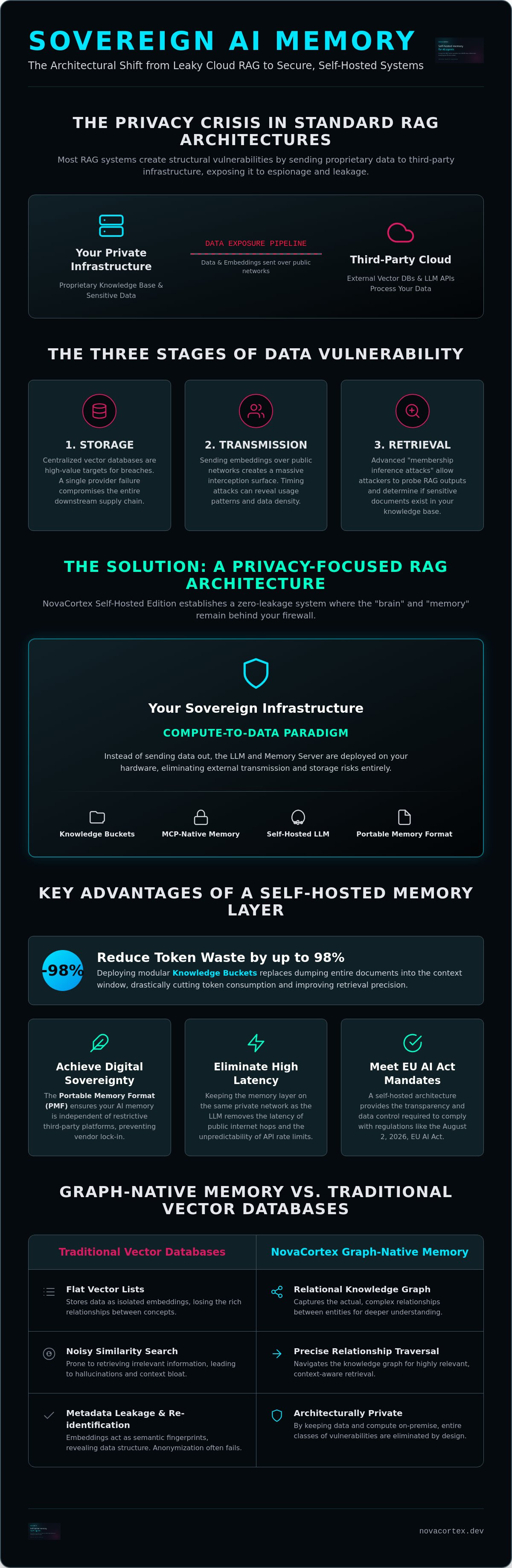
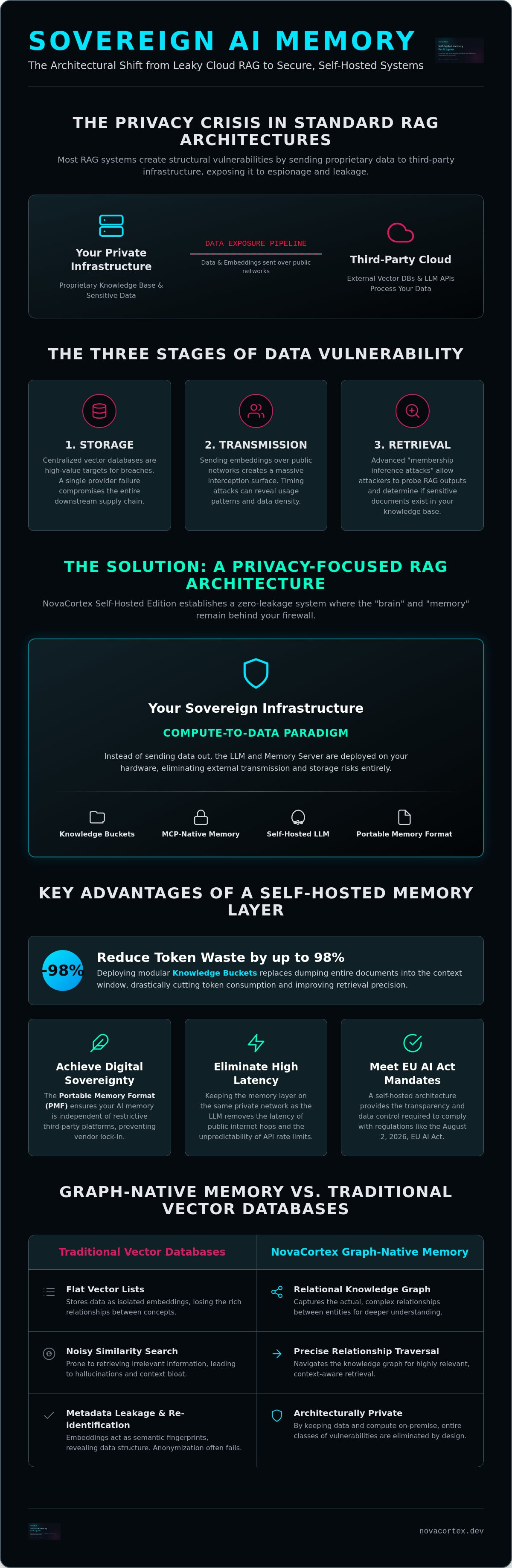
Standard Retrieval-Augmented Generation (RAG) architectures are fundamentally leaky. Most implementations prioritize ease of deployment over long-term security. They ship proprietary data to third-party vector databases and LLM providers without a second thought. A true privacy-focused RAG system reverses this paradigm. It dictates a strict requirement: data never leaves user-controlled infrastructure. If your data crosses a third-party API boundary, you've already lost control of your intellectual property.
Cloud-hosted vector databases suffer from "Metadata Leakage." Even if you encrypt your raw text, the high-dimensional vector embeddings act as semantic fingerprints. They reveal the underlying structure and meaning of your data to the service provider. API-based LLMs compound this by creating a permanent record of sensitive organizational knowledge on external servers. While chat history might feel ephemeral, the long-term memory of an AI agent is persistent and, in standard configurations, dangerously exposed.
The Three Stages of Data Vulnerability
Data exposure isn't a single event; it's a structural failure across three distinct stages of the RAG pipeline:
- Storage: Centralized vector databases are high-value targets. A breach at a single provider compromises the entire downstream supply chain. This is a critical risk given the increased focus on supply chain security in modern operational frameworks.
- Transmission: Sending embeddings over public networks creates a massive interception surface. Even with standard encryption, timing attacks can reveal usage patterns and data density.
- Retrieval: Advanced "membership inference attacks" allow attackers to probe RAG outputs. They can determine if specific sensitive documents exist in your knowledge base just by analyzing how the model responds to carefully crafted queries.
Why Anonymization is Not Enough
Simple PII masking fails in complex technical environments. You can redact a name or a social security number, but you cannot easily redact context. LLMs are designed to find patterns; they excel at re-identifying supposedly anonymous data by connecting disparate facts. If a document describes a specific niche architectural flaw from a specific year, the subject remains identifiable regardless of name masking. Context is the enemy of traditional anonymity.
Solving this requires more than just better filters. It demands a self-hosted AI memory layer to establish true digital sovereignty. By moving the memory stack from a third-party black box to a local, hardened environment, you eliminate the transmission and storage risks entirely. You stop playing defense with masks and start building with architectural integrity. This shift is the only way to meet the August 2, 2026, EU AI Act transparency obligations while keeping your core data private.
Pillars of a Privacy-Focused RAG Architecture
Cloud-first RAG is a structural design flaw. A robust privacy-focused RAG architecture requires a fundamental shift in technical physics: move the model to the data. Sending proprietary datasets to external LLMs is an unnecessary risk that creates permanent records on servers you don't control. True architectural security is built on four non-negotiable pillars: local infrastructure, graph-native storage, compute-to-data workflows, and interoperable protocols. These pillars address the inherent privacy and security risks in RAG systems that arise when semantic data transits through third-party providers.
Compute-to-data is the most critical shift. Instead of piping raw text or embeddings to a remote API, you host the LLM and the memory layer on the same private network. This eliminates the transmission vulnerabilities identified in the previous section. By utilizing local hardware or a private VPS, you ensure that the "brain" and "memory" of your AI agent remain behind your firewall. This isn't just about security; it's about performance. Localized stacks remove the latency of public internet hops and the unpredictability of third-party rate limits.
Graph-native storage provides the relational depth that flat vector databases lack. While traditional vector lists are prone to noise and irrelevant retrieval, a knowledge graph maps the actual relationships between entities. This structure prevents the "context re-identification" problem because the system understands the specific hierarchy and sensitivity of data nodes. It allows for more precise retrieval, ensuring the model only sees the exact context it needs to fulfill a request.
Self-Hosting the Memory Layer
Digital sovereignty requires total control over the software stack. Deployment should be flexible, scaling from a specialized Raspberry Pi edge node to enterprise-grade private clusters. Using software with transparent, auditable licenses like Apache-2.0 ensures that your memory layer remains free from hidden telemetry or "phone home" features. Eliminating managed service dependencies is the only way to achieve 100% data sovereignty. You can start reviewing our core memory architecture to see how these self-hosted components interface without cloud reliance.
MCP-Native Memory Servers
Standardization is the antidote to vendor lock-in. The Model Context Protocol (MCP) serves as the universal bridge between AI agents and their memory. Implementing an MCP native memory server ensures that context delivery remains within a standardized, auditable boundary. This protocol simplifies the security auditing process by providing a consistent interface for data access. It allows you to swap models or storage backends without rebuilding your entire security framework. Standardized protocols turn your AI memory into a modular, secure utility rather than a monolithic, leaky silo.
Graph-Native Memory vs. Traditional Vector Databases
Vector databases are semantic approximation engines. They rely on "fuzzy" similarity, which is a structural liability in a privacy-focused RAG architecture. When you query a traditional vector database, you're asking for data points that mathematically resemble your query. This process results in the retrieval of irrelevant noise. This noise isn't just a performance tax; it's a security hole. Every unnecessary byte of data retrieved and sent to an LLM increases the risk of accidental exposure or data extraction. You're effectively widening the door for potential leaks by fetching data that the model never actually needed.
Graph-native memory operates on a different logic. It stores information as entities and explicit relationships. Instead of guessing based on high-dimensional proximity, it traverses defined paths to find exact answers. This structure allows for granular access control at the node and edge level. You don't just secure a database; you secure individual relationships. This level of control is impossible in a flat vector space where data points are clustered by abstract similarity rather than logical hierarchy. Graphs provide the clarity that vectors lack.
The Limitations of Vector-Only RAG
Traditional RAG suffers from the "Knowledge Dump" problem. To ensure the LLM has enough context, engineers often over-retrieve. They flood the context window with "nearby" data that may be entirely irrelevant to the specific query. This bloat increases the attack surface for membership inference attacks. Attackers can probe the model to see what irrelevant but sensitive data was pulled into the context. High-dimensional vector calculations also create significant performance bottlenecks as datasets scale. You end up wasting compute power to process garbage context that should have never been retrieved.
Engineering Precision with Knowledge Graphs
Knowledge graphs provide exact context through structured traversal. If an agent needs to know the relationship between a specific server and a security policy, the graph provides that precise link. There is no broad semantic "guess" involved. This precision drastically reduces the noise-to-signal ratio. By minimizing the volume of data exposed to the agent, you inherently improve security. Structured relationship mapping also facilitates faster retrieval speeds. You follow a logical path rather than scanning a massive, unstructured vector space. This efficiency is foundational to NovaCortex Self-Hosted Edition, ensuring your memory layer is both lean and impenetrable.
Implementing Efficient Context Management
Context management is the final firewall of a privacy-focused RAG system. Even with a local LLM, a sloppy retrieval pipeline creates unnecessary risk. Efficient management isn't just about saving money; it's about reducing the semantic surface area exposed to the model. By modularizing data and pruning the context window, you ensure that the agent only sees exactly what it needs to see. This architectural discipline prevents context poisoning and limits the potential impact of any single prompt-injection attempt.
Generating embeddings locally is a non-negotiable requirement for true sovereignty. Sending raw text to a third-party API for vectorization is a massive security failure that exposes your data's semantic structure before it even reaches your database. Running embedding models on your own hardware keeps the entire vectorization process private. This ensures that the mathematical representation of your proprietary knowledge never touches the public internet, maintaining the integrity of your secure memory layer.
Knowledge Buckets: Modularizing Sensitive Data
Knowledge Buckets provide a structured way to segment sensitive data by project scope or clearance level. Instead of one monolithic database, you create isolated containers with distinct boundaries. This allows for granular permissions at the bucket level. You can prevent an HR agent from ever accessing engineering specifications by simply excluding the relevant bucket from its retrieval path. This isolation stops the cross-pollination of sensitive data across different AI agents, ensuring that information remains strictly within its designated silo.
Reducing the Token Footprint
Structured graph-native memory prevents context window bloat by delivering precise relational nodes instead of broad semantic chunks. This precision can reduce token usage by up to 98% through precision retrieval. There is a direct correlation between token efficiency and security: fewer tokens mean fewer opportunities for data leakage. When you send less data to the inference engine, you leave a smaller footprint for potential attackers to analyze. Effective pruning and summarization techniques ensure long-term memory remains sharp without becoming a liability. You can start building your secure context pipeline by exploring our open-source implementation of these modular memory structures.
Digital Sovereignty with NovaCortex Self-Hosted
NovaCortex Self-Hosted Edition is the definitive correction to the industry's reliance on fragile cloud ecosystems. Building a privacy-focused RAG stack isn't a one-time configuration; it's a commitment to architectural independence. We are moving past the era of "AI as a service" where your data is a guest on someone else's server. We are entering the era of AI as a core infrastructure component. This shift ensures that your organization's collective intelligence remains a private asset, fully compliant with the August 2, 2026, EU AI Act transparency mandates without sacrificing performance. By treating memory as a local utility, you eliminate the external dependencies that lead to metadata leakage and systemic vulnerability.
Digital sovereignty is not a suggestion; it's an engineering requirement. When you host your own memory layer, you're not just protecting data; you're ensuring operational continuity. You stop being a victim of third-party rate limits, API deprecations, or vendor-side breaches. You gain the ability to audit every transaction and verify the integrity of every retrieval path. This is the only way to build a high-velocity AI system that meets the rigorous demands of modern security frameworks while maintaining the lean, high-performance edge that developers require.
Ending Vendor Lock-in with PMF
Proprietary formats are digital cages. A portable memory format for AI is essential for true data ownership. Without it, your knowledge base is trapped within a specific vendor's ecosystem, making migration impossible and data audits a nightmare. The Portable Memory Format (PMF) breaks this cycle. It ensures that your AI memory remains human-readable and machine-portable. You can swap LLM providers or update your hardware stack without losing a single relational node. PMF turns your knowledge base into an interoperable asset that you control, not a liability held hostage by a third-party subscription.
Deployment and Scalability
NovaCortex Self-Hosted Edition scales with your engineering requirements. You can deploy it on a local server for a small team or expand it across a managed private cloud for an entire enterprise. This flexibility allows you to scale memory layers in multi-user environments without compromising the privacy of individual data streams. You don't need a massive team of AI researchers to get started. You can deploy a secure, high-performance memory layer on your private infrastructure in minutes. Stop renting your intelligence from providers that treat your data as a training set. It's time to deploy your own privacy-focused RAG layer with NovaCortex and reclaim your digital sovereignty.
Reclaim Your Architectural Sovereignty
The era of renting your organization's intelligence is over. Architectural leaks are no longer an acceptable cost of doing business. By transitioning to a privacy-focused RAG stack, you replace fragile cloud dependencies with a robust, graph-native memory layer that you own entirely. You've seen how moving beyond flat vector databases to structured relationship mapping eliminates noise and secures your data at the node level. This shift isn't just about security. It's about engineering efficiency. Precision retrieval through Knowledge Buckets can drive up to a 98% reduction in token usage, cutting costs while hardening your defense.
NovaCortex provides the tools to build this future today. With an Apache-2.0 Open Source license, you get total auditability and graph-native performance on any server you choose. You don't have to compromise on speed to achieve digital sovereignty. The infrastructure is ready. Get started with NovaCortex Self-Hosted Edition and build an AI memory that stays under your control. It's time to stop hosting your data on borrowed time and start building for permanent independence.
Frequently Asked Questions
What is privacy-focused RAG and how does it differ from standard RAG?
Privacy-focused RAG is an architecture where data remains entirely within user-controlled infrastructure. Standard RAG often pipes proprietary data to third-party vector databases or cloud-based LLM APIs, creating metadata leakage. A privacy-focused RAG setup eliminates these external boundaries by hosting the embedding models, vector storage, and inference engine locally. This ensures your semantic fingerprints never leave your network.
Can I run a privacy-focused RAG system on my own local server?
You can deploy the entire stack on local hardware or a private VPS. NovaCortex Self-Hosted Edition is designed specifically for this purpose. It allows you to maintain a secure memory layer behind your own firewall. This architecture ensures that sensitive information never transits over public networks or resides on multi-tenant cloud storage. You own the hardware, the software, and the data.
How does graph-native memory improve the privacy of my AI agent?
Graph-native memory improves privacy by replacing fuzzy vector similarity searches with precise relational traversal. Traditional vector databases often retrieve irrelevant noise chunks that may contain sensitive data not required for the query. Graphs retrieve exact entities and relationships. This minimizes the data surface area exposed to the agent and prevents context-based re-identification of anonymized facts.
Does self-hosting a RAG system significantly reduce LLM API costs?
Self-hosting reduces costs by optimizing context delivery and enabling the use of local inference engines. By using Knowledge Buckets and graph-native structures, you can reduce token usage by up to 98% through precision retrieval. This efficiency lowers the volume of data sent to paid APIs. It also allows you to bypass them entirely using open-weight models on your own hardware.
What is the Model Context Protocol (MCP) and why is it important for privacy?
MCP is a standardized communication protocol that acts as a secure bridge between AI agents and their memory sources. It is important for privacy because it provides a consistent, auditable interface for data access. By using an MCP-Native Memory Server, you ensure that context delivery follows strict, predictable rules. You avoid relying on opaque, vendor-specific integration methods that often hide telemetry or data-sharing features.
How do Knowledge Buckets help manage sensitive data in AI applications?
Knowledge Buckets allow you to segment your knowledge base into modular, isolated containers. You can apply granular permissions at the bucket level to ensure specific AI agents only access the data they need. This prevents cross-pollination of sensitive information. For example, you can ensure an internal support bot cannot retrieve data from an executive-only project bucket even if they share the same memory server.
Is it possible to migrate data from cloud vector databases to a self-hosted RAG system?
Migration is possible and highly recommended to reclaim data sovereignty. The Portable Memory Format (PMF) facilitates this transition by providing a machine-portable structure for your AI's long-term memory. You can export your existing datasets into PMF and ingest them into NovaCortex Self-Hosted Edition. This ends vendor lock-in and secures your intellectual property on your own infrastructure.
What are the hardware requirements for running a NovaCortex memory server?
NovaCortex is designed for high-velocity performance across a range of hardware profiles. You can run basic memory layers on lightweight devices like a Raspberry Pi for edge applications. For enterprise-grade performance with large-scale knowledge graphs, we recommend utilizing high-performance servers with sufficient RAM and SSD storage. This setup handles rapid relational traversals and local embedding generation without the latency of cloud-based alternatives.
FAQ
The Three Stages of Data Vulnerability
Data exposure isn't a single event; it's a structural failure across three distinct stages of the RAG pipeline:
Why Anonymization is Not Enough
Simple PII masking fails in complex technical environments. You can redact a name or a social security number, but you cannot easily redact context. LLMs are designed to find patterns; they excel at re-identifying supposedly anonymous data by connecting disparate facts. If a document describes a specific niche architectural flaw from a specific year, the subject remains identifiable regardless of name masking. Context is the enemy of traditional anonymity. Solving this requires more than just better filters. It demands a self-hosted AI memory layer to establish true digital sovereignty. By moving the memory stack from a third-party black box to a local, hardened environment, you eliminate the transmission and storage risks entirely. You stop playing defense with masks and start building with architectural integrity. This shift is the only way to meet the August 2, 2026, EU AI Act transparency obligations while keeping your core data private. Cloud-first RAG is a structural design flaw. A robust privacy-focused RAG architecture requires a fundamental shift in technical physics: move the model to the data. Sending proprietary datasets to external LLMs is an unnecessary risk that creates permanent records on servers you don't control. True architectural security is built on four non-negotiable pillars: local infrastructure, graph-native storage, compute-to-data workflows, and interoperable protocols. These pillars address the inherent privacy and security risks in RAG systems that arise when semantic data transits through third-party providers. Compute-to-data is the most critical shift. Instead of piping raw text or embeddings to a remote API, you host the LLM and the memory layer on the same private network. This eliminates the transmission vulnerabilities identified in the previous section. By utilizing local hardware or a private VPS, you ensure that the "brain" and "memory" of your AI agent remain behind your firewall. This isn't just about security; it's about performance. Localized stacks remove the latency of public internet hops and the unpredictability of third-party rate limits. Graph-native storage provides the relational depth that flat vector databases lack. While traditional vector lists are prone to noise and irrelevant retrieval, a knowledge graph maps the actual relationships between entities. This structure prevents the "context re-identification" problem because the system understands the specific hierarchy and sensitivity of data nodes. It allows for more precise retrieval, ensuring the model only sees the exact context it needs to fulfill a request.
Self-Hosting the Memory Layer
Digital sovereignty requires total control over the software stack. Deployment should be flexible, scaling from a specialized Raspberry Pi edge node to enterprise-grade private clusters. Using software with transparent, auditable licenses like Apache-2.0 ensures that your memory layer remains free from hidden telemetry or "phone home" features. Eliminating managed service dependencies is the only way to achieve 100% data sovereignty. You can start reviewing our core memory architecture to see how these self-hosted components interface without cloud reliance.
MCP-Native Memory Servers
Standardization is the antidote to vendor lock-in. The Model Context Protocol (MCP) serves as the universal bridge between AI agents and their memory. Implementing an MCP native memory server ensures that context delivery remains within a standardized, auditable boundary. This protocol simplifies the security auditing process by providing a consistent interface for data access. It allows you to swap models or storage backends without rebuilding your entire security framework. Standardized protocols turn your AI memory into a modular, secure utility rather than a monolithic, leaky silo. Vector databases are semantic approximation engines. They rely on "fuzzy" similarity, which is a structural liability in a privacy-focused RAG architecture. When you query a traditional vector database, you're asking for data points that mathematically resemble your query. This process results in the retrieval of irrelevant noise. This noise isn't just a performance tax; it's a security hole. Every unnecessary byte of data retrieved and sent to an LLM increases the risk of accidental exposure or data extraction. You're effectively widening the door for potential leaks by fetching data that the model never actually needed. Graph-native memory operates on a different logic. It stores information as entities and explicit relationships. Instead of guessing based on high-dimensional proximity, it traverses defined paths to find exact answers. This structure allows for granular access control at the node and edge level. You don't just secure a database; you secure individual relationships. This level of control is impossible in a flat vector space where data points are clustered by abstract similarity rather than logical hierarchy. Graphs provide the clarity that vectors lack.
The Limitations of Vector-Only RAG
Traditional RAG suffers from the "Knowledge Dump" problem. To ensure the LLM has enough context, engineers often over-retrieve. They flood the context window with "nearby" data that may be entirely irrelevant to the specific query. This bloat increases the attack surface for membership inference attacks. Attackers can probe the model to see what irrelevant but sensitive data was pulled into the context. High-dimensional vector calculations also create significant performance bottlenecks as datasets scale. You end up wasting compute power to process garbage context that should have never been retrieved.
Engineering Precision with Knowledge Graphs
Knowledge graphs provide exact context through structured traversal. If an agent needs to know the relationship between a specific server and a security policy, the graph provides that precise link. There is no broad semantic "guess" involved. This precision drastically reduces the noise-to-signal ratio. By minimizing the volume of data exposed to the agent, you inherently improve security. Structured relationship mapping also facilitates faster retrieval speeds. You follow a logical path rather than scanning a massive, unstructured vector space. This efficiency is foundational to NovaCortex Self-Hosted Edition, ensuring your memory layer is both lean and impenetrable. Context management is the final firewall of a privacy-focused RAG system. Even with a local LLM, a sloppy retrieval pipeline creates unnecessary risk. Efficient management isn't just about saving money; it's about reducing the semantic surface area exposed to the model. By modularizing data and pruning the context window, you ensure that the agent only sees exactly what it needs to see. This architectural discipline prevents context poisoning and limits the potential impact of any single prompt-injection attempt. Generating embeddings locally is a non-negotiable requirement for true sovereignty. Sending raw text to a third-party API for vectorization is a massive security failure that exposes your data's semantic structure before it even reaches your database. Running embedding models on your own hardware keeps the entire vectorization process private. This ensures that the mathematical representation of your proprietary knowledge never touches the public internet, maintaining the integrity of your secure memory layer.
Knowledge Buckets: Modularizing Sensitive Data
Knowledge Buckets provide a structured way to segment sensitive data by project scope or clearance level. Instead of one monolithic database, you create isolated containers with distinct boundaries. This allows for granular permissions at the bucket level. You can prevent an HR agent from ever accessing engineering specifications by simply excluding the relevant bucket from its retrieval path. This isolation stops the cross-pollination of sensitive data across different AI agents, ensuring that information remains strictly within its designated silo.
Reducing the Token Footprint
Structured graph-native memory prevents context window bloat by delivering precise relational nodes instead of broad semantic chunks. This precision can reduce token usage by up to 98% through precision retrieval. There is a direct correlation between token efficiency and security: fewer tokens mean fewer opportunities for data leakage. When you send less data to the inference engine, you leave a smaller footprint for potential attackers to analyze. Effective pruning and summarization techniques ensure long-term memory remains sharp without becoming a liability. You can start building your secure context pipeline by exploring our open-source implementation of these modular memory structures. NovaCortex Self-Hosted Edition is the definitive correction to the industry's reliance on fragile cloud ecosystems. Building a privacy-focused RAG stack isn't a one-time configuration; it's a commitment to architectural independence. We are moving past the era of "AI as a service" where your data is a guest on someone else's server. We are entering the era of AI as a core infrastructure component. This shift ensures that your organization's collective intelligence remains a private asset, fully compliant with the August 2, 2026, EU AI Act transparency mandates without sacrificing performance. By treating memory as a local utility, you eliminate the external dependencies that lead to metadata leakage and systemic vulnerability. Digital sovereignty is not a suggestion; it's an engineering requirement. When you host your own memory layer, you're not just protecting data; you're ensuring operational continuity. You stop being a victim of third-party rate limits, API deprecations, or vendor-side breaches. You gain the ability to audit every transaction and verify the integrity of every retrieval path. This is the only way to build a high-velocity AI system that meets the rigorous demands of modern security frameworks while maintaining the lean, high-performance edge that developers require.
Ending Vendor Lock-in with PMF
Proprietary formats are digital cages. A portable memory format for AI is essential for true data ownership. Without it, your knowledge base is trapped within a specific vendor's ecosystem, making migration impossible and data audits a nightmare. The Portable Memory Format (PMF) breaks this cycle. It ensures that your AI memory remains human-readable and machine-portable. You can swap LLM providers or update your hardware stack without losing a single relational node. PMF turns your knowledge base into an interoperable asset that you control, not a liability held hostage by a third-party subscription.
Deployment and Scalability
NovaCortex Self-Hosted Edition scales with your engineering requirements. You can deploy it on a local server for a small team or expand it across a managed private cloud for an entire enterprise. This flexibility allows you to scale memory layers in multi-user environments without compromising the privacy of individual data streams. You don't need a massive team of AI researchers to get started. You can deploy a secure, high-performance memory layer on your private infrastructure in minutes. Stop renting your intelligence from providers that treat your data as a training set. It's time to deploy your own privacy-focused RAG layer with NovaCortex and reclaim your digital sovereignty. The era of renting your organization's intelligence is over. Architectural leaks are no longer an acceptable cost of doing business. By transitioning to a privacy-focused RAG stack, you replace fragile cloud dependencies with a robust, graph-native memory layer that you own entirely. You've seen how moving beyond flat vector databases to structured relationship mapping eliminates noise and secures your data at the node level. This shift isn't just about security. It's about engineering efficiency. Precision retrieval through Knowledge Buckets can drive up to a 98% reduction in token usage, cutting costs while hardening your defense. NovaCortex provides the tools to build this future today. With an Apache-2.0 Open Source license, you get total auditability and graph-native performance on any server you choose. You don't have to compromise on speed to achieve digital sovereignty. The infrastructure is ready. Get started with NovaCortex Self-Hosted Edition and build an AI memory that stays under your control. It's time to stop hosting your data on borrowed time and start building for permanent independence.
What is privacy-focused RAG and how does it differ from standard RAG?
Privacy-focused RAG is an architecture where data remains entirely within user-controlled infrastructure. Standard RAG often pipes proprietary data to third-party vector databases or cloud-based LLM APIs, creating metadata leakage. A privacy-focused RAG setup eliminates these external boundaries by hosting the embedding models, vector storage, and inference engine locally. This ensures your semantic fingerprints never leave your network.
Can I run a privacy-focused RAG system on my own local server?
You can deploy the entire stack on local hardware or a private VPS. NovaCortex Self-Hosted Edition is designed specifically for this purpose. It allows you to maintain a secure memory layer behind your own firewall. This architecture ensures that sensitive information never transits over public networks or resides on multi-tenant cloud storage. You own the hardware, the software, and the data.
How does graph-native memory improve the privacy of my AI agent?
Graph-native memory improves privacy by replacing fuzzy vector similarity searches with precise relational traversal. Traditional vector databases often retrieve irrelevant noise chunks that may contain sensitive data not required for the query. Graphs retrieve exact entities and relationships. This minimizes the data surface area exposed to the agent and prevents context-based re-identification of anonymized facts.
Does self-hosting a RAG system significantly reduce LLM API costs?
Self-hosting reduces costs by optimizing context delivery and enabling the use of local inference engines. By using Knowledge Buckets and graph-native structures, you can reduce token usage by up to 98% through precision retrieval. This efficiency lowers the volume of data sent to paid APIs. It also allows you to bypass them entirely using open-weight models on your own hardware.
What is the Model Context Protocol (MCP) and why is it important for privacy?
MCP is a standardized communication protocol that acts as a secure bridge between AI agents and their memory sources. It is important for privacy because it provides a consistent, auditable interface for data access. By using an MCP-Native Memory Server, you ensure that context delivery follows strict, predictable rules. You avoid relying on opaque, vendor-specific integration methods that often hide telemetry or data-sharing features.
How do Knowledge Buckets help manage sensitive data in AI applications?
Knowledge Buckets allow you to segment your knowledge base into modular, isolated containers. You can apply granular permissions at the bucket level to ensure specific AI agents only access the data they need. This prevents cross-pollination of sensitive information. For example, you can ensure an internal support bot cannot retrieve data from an executive-only project bucket even if they share the same memory server.
Is it possible to migrate data from cloud vector databases to a self-hosted RAG system?
Migration is possible and highly recommended to reclaim data sovereignty. The Portable Memory Format (PMF) facilitates this transition by providing a machine-portable structure for your AI's long-term memory. You can export your existing datasets into PMF and ingest them into NovaCortex Self-Hosted Edition. This ends vendor lock-in and secures your intellectual property on your own infrastructure.
What are the hardware requirements for running a NovaCortex memory server?
NovaCortex is designed for high-velocity performance across a range of hardware profiles. You can run basic memory layers on lightweight devices like a Raspberry Pi for edge applications. For enterprise-grade performance with large-scale knowledge graphs, we recommend utilizing high-performance servers with sufficient RAM and SSD storage. This setup handles rapid relational traversals and local embedding generation without the latency of cloud-based alternatives.