Self-Hosted vs Managed AI Memory: Solving Agent Amnesia in 2026

Your AI agents are hemorrhaging intelligence. You've outsourced their brains to a black box, and now you're paying the price in redundant context dumping and skyrocketing token fees. The debate over self-hosted vs managed AI memory is no longer a theoretical exercise; it's a battle for architectural sovereignty. You already know that relying on proprietary cloud formats is a fast track to vendor lock-in and a compliance nightmare under the August 2026 EU AI Act transparency requirements.
We agree that the current industry standard is a bloated correction to a problem that shouldn't exist. This article promises to reveal the architectural trade-offs required to ensure your agents never lose context. We will preview the technical transition from wasteful RAG systems to a graph-native memory layer that delivers a 90% reduction in token waste. You'll learn how to navigate surging DRAM costs while building a permanent, portable knowledge base that keeps you in full control of your agent's cognitive history. It's time to stop renting your agent's mind and start owning the infrastructure that makes it smart.
Key Takeaways
- Identify why naive RAG fails to maintain complex agent state and how graph-native storage restores long-term instruction retention.
- Analyze the architectural trade-offs of self-hosted vs managed AI memory to eliminate vendor lock-in and bypass proprietary API latency.
- Leverage the Portable Memory Format (PMF) to secure full data sovereignty and ensure agent knowledge remains interoperable across any environment.
- Reduce token overhead by up to 98% through precise retrieval, ending the cycle of redundant context dumping and high operation costs.
- Deploy an MCP-native memory server to provide a permanent, scalable solution for agent amnesia while maintaining compliance with 2026 transparency regulations.
Why AI Agents Forget: The Persistent Context Gap
LLMs are fundamentally stateless. They exist in a perpetual present. Without an external state management system, an agent is a sophisticated calculator with a short attention span. Current architectures rely on context windows to simulate recall. This is a fragile strategy. As a conversation progresses, critical instructions often drift into the dead zone of the prompt. The result is total task failure. You cannot build reliable autonomous systems on a foundation of ephemeral data.
The industry attempted to fix this with Retrieval-Augmented Generation (RAG). It failed. Naive RAG is not memory; it is a lookup table. It lacks the relational depth required for complex reasoning. Historically, Long Short-Term Memory (LSTM) networks were designed to gate information flow and provide persistence. Modern transformers abandoned this for attention mechanisms that, while powerful, create a massive context bottleneck. To solve agent amnesia, you need a dedicated, graph-native memory layer that persists beyond the session. Without it, your agents are doomed to repeat the same mistakes every time the context window flushes.
The Token Hemorrhage: The Cost of Forgetting
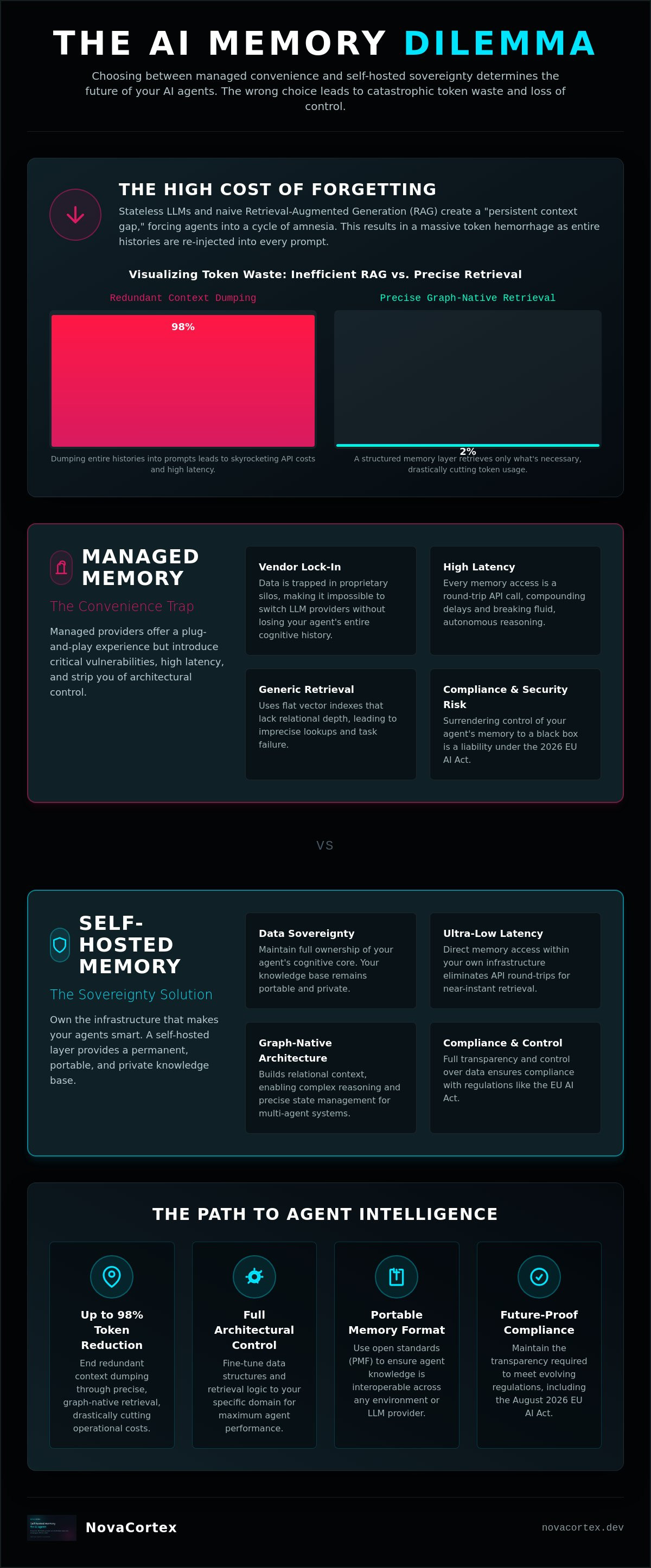
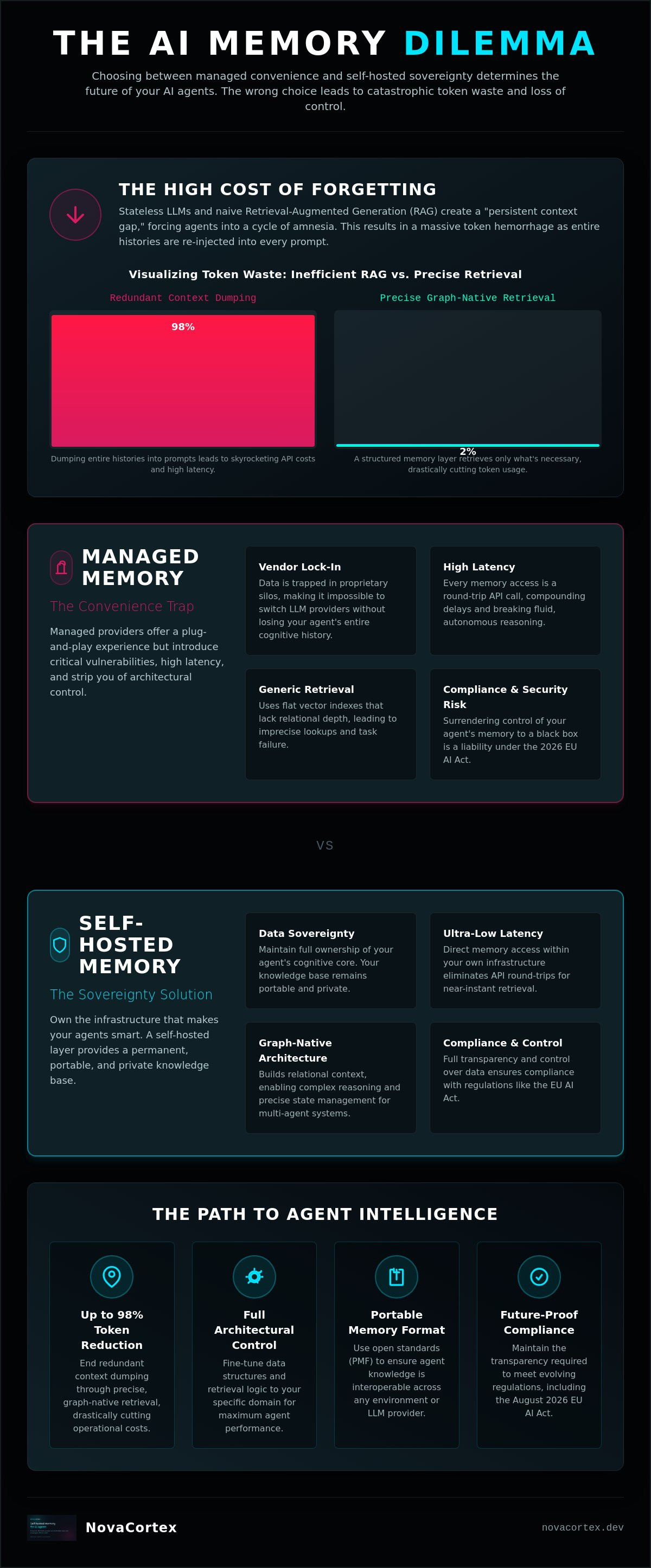
Every time your agent forgets a detail, you pay for it. Many developers attempt to fix amnesia by dumping the entire conversation history into every new prompt. This is architectural waste. It inflates API bills and slows down inference. Inefficient memory management directly correlates with spiraling costs and high-latency responses. Context amnesia is a failure of retrieval precision where the agent possesses the data but lacks the structural cues to use it effectively. You aren't just losing context. You are burning capital to re-teach your agent what it already knew ten minutes ago.
Managed vs. Self-Hosted: The Sovereignty Debate
The choice between self-hosted vs managed AI memory determines who owns your agent's cognitive core. Managed providers offer convenience but trap your data in proprietary silos. If you store your agent's long-term knowledge in a black-box cloud, you surrender your digital sovereignty. You risk vendor lock-in and the exposure of sensitive internal protocols. A self-hosted AI memory layer ensures your knowledge base remains portable and private. By using open standards, you gain full ownership of the agent's brain. This allows you to move between LLM providers without losing a single byte of experience. It's the difference between renting a mind and building a permanent asset, much like the strategic move to explore Apartments for Sale when building a tangible investment portfolio.
Managed AI Memory: The Convenience Trap
Managed AI memory is a black box masquerading as a solution. It promises a plug and play experience while stripping you of the architectural control required for high performance agents. When evaluating self-hosted vs managed AI memory, developers often overlook the hidden tax of convenience. You aren't just paying for storage; you're paying for a layer of abstraction that limits your ability to optimize retrieval precision or maintain data sovereignty. It feels efficient until the first provider outage halts your entire autonomous workforce.
The primary failure of managed providers is latency. Every memory retrieval requires a round trip API call. In complex agentic workflows where an agent must query its history multiple times to make a single decision, these milliseconds compound. This lag breaks the fluid reasoning required for autonomous operations. While these services claim to bypass context window limitations, they often do so using generic vector similarity searches that lack the nuance of your specific domain. You trade agent speed for a slightly easier setup process. You're renting a brain that's always a few seconds behind.
The Architecture of Managed Memory
Managed providers typically abstract the database layer into a simplified interface. This prevents you from fine-tuning the underlying data structures for your specific use case. Most managed stores rely on flat vector indexes rather than graph native architectures. This is a critical flaw for multi agent systems. Without a shared, structured state, agents struggle to synchronize their knowledge. They end up operating in silos, even within the same managed environment. If you want to build a truly integrated system, you need a portable memory layer that you can manage and scale on your own terms.
Managed Service Trade-offs
The financial cost is only the beginning. Premium pricing for managed convenience quickly becomes unsustainable as your agent's knowledge base grows. Then there's the issue of vendor lock-in. Migrating vector embeddings between providers is notoriously difficult because formats are often proprietary. You're effectively trapped. Privacy is the final hurdle. Storing sensitive intellectual property on third party servers creates massive compliance gaps. Under the 2026 regulatory landscape, proving GDPR or HIPAA compliance is significantly harder when you don't own the infrastructure where your agent's brain resides. Managed services aren't zero maintenance; they're zero control.
Self-Hosted AI Memory: Engineering for Efficiency
Managed systems are built for the average user. Engineering for professional grade autonomous agents requires a departure from this one size fits all approach. When comparing self-hosted vs managed AI memory, the primary differentiator is architectural leaness. Self-hosting allows you to strip away the telemetry, rate limiting, and generic middleware that plague cloud providers. You gain direct access to the storage engine. This enables a level of optimization that managed services simply cannot match because they must prioritize their own multi tenant stability over your specific performance needs.
The most significant technical gain is the elimination of the token tax. Standard RAG systems are notoriously imprecise. They often force you to inject massive chunks of irrelevant data into your context window just to ensure the agent has the right facts. A self-hosted, graph-native architecture solves this. By using precise relationship mapping, you can achieve a 98% reduction in token usage compared to naive vector retrieval. You stop paying for the noise and start paying only for the signal. This efficiency transforms your operating costs from a variable liability into a predictable, lean expense.
Infrastructure flexibility is a core pillar of digital sovereignty. A self-hosted memory layer can run anywhere. You can deploy it on a high performance VPS or a local Raspberry Pi. This versatility is powered by the Portable Memory Format (PMF). PMF ensures that your agent's knowledge remains a discrete, movable asset. You aren't tied to a specific cloud vendor's database schema. If you need to migrate your agent's entire cognitive history to a new environment, you just move the file. You own the brain; you don't rent it.
Graph-Native vs. Vector Databases
Vector databases rely on mathematical similarity, which is often just a high tech way of guessing. Graph-native memory focuses on explicit relationships. This is superior for complex AI agent memory because it mirrors how human knowledge is actually structured. It allows for multi hop reasoning that vector stores can't handle without significant retrieval noise. Keeping your context window clean is the only way to maintain high reasoning accuracy. For builders, engineering secure, self-hosted AI memory is the only path to achieving this level of precision and privacy.
The MCP-Native Advantage
The Model Context Protocol (MCP) is the new standard for agentic communication. By using an MCP-native memory server, you eliminate the friction between the agent and its knowledge base. It facilitates low latency retrieval through direct infrastructure integration. MCP standardizes the memory server interface, allowing any compatible agent to plug into your self-hosted memory layer without custom glue code. It turns your memory into a high velocity utility rather than a clunky external dependency. Speed is a feature. Sovereignty is the requirement.
Step-by-Step: How to Stop AI Agents from Forgetting
Theory is cheap. Implementation is where sovereignty is won. To stop agent amnesia, you must move beyond the self-hosted vs managed AI memory debate and build a resilient infrastructure. Start by auditing your agent's knowledge density. High retrieval frequency requires low latency. If your agent queries its history every few seconds, a managed API is a performance bottleneck. You need local execution. Analyze the ratio of episodic memory, which tracks specific events, to semantic memory, which handles general facts. This ratio dictates your storage strategy.
Next, adopt the Portable Memory Format (PMF). This is your insurance policy against vendor lock-in. PMF ensures your agent's brain is a discrete, encrypted file that you can move between a VPS and a local server without re-indexing. Re-indexing is a massive compute waste; avoid it at all costs. Once the format is set, deploy an MCP-native memory server. This standardizes how your agents talk to their history. It replaces custom, fragile glue code with a robust, industry-standard protocol. You aren't just building a database; you're building a cognitive engine.
Setting Up Knowledge Buckets
Precision requires segmentation. Global memory pools are noisy and inefficient. By implementing Knowledge Buckets, you can isolate memory by task, project, or user. This ensures the agent only retrieves what's relevant to the current operation. It prevents cross-contamination in multi-agent workflows where one agent's state might bleed into another's. For a deep dive into the architecture, explore the self-hosted AI memory layer. This modularity is the foundation of scalable agent intelligence.
Optimizing Retrieval Precision
Retrieval is a balance between recall and noise. Fine-tune your retrieval thresholds to ensure the agent only sees high-confidence matches. This minimizes token waste and keeps the context window lean. For long-term archival, use Z-level compression. It keeps storage footprints small without sacrificing retrieval speed. Always test persistence across session restarts. If the agent forgets its identity or previous progress after a reboot, your memory layer has failed. Reliable memory must be as persistent as the hardware it runs on.
Ready to take control of your agent's cognitive history? Deploy NovaCortex on your private infrastructure today to ensure your agents never lose context again.
NovaCortex: The Standard for Self-Hosted AI Memory
NovaCortex isn't just another database. It's the technical correction to a market bloated by inefficient cloud silos. For engineers navigating the self-hosted vs managed AI memory landscape, NovaCortex Self-Hosted Edition provides the definitive path to architectural independence. It's built for those who refuse to compromise on data ownership. This is a privacy-first, developer-centric layer designed to sit at the core of your agentic stack. You gain absolute control over how knowledge is stored, retrieved, and protected.
Efficiency is our baseline. We provide a 98% Token Reduction Guarantee by replacing naive vector lookups with graph-native retrieval. Standard RAG systems flood context windows with irrelevant noise. NovaCortex extracts only the precise relationships required for the task. This benchmark isn't a theoretical maximum; it is the reality of moving from mathematical guessing to explicit relationship mapping. You stop paying the "token tax" that managed providers use to pad their margins. You start running a lean, high-velocity operation where every token serves a purpose.
Digital sovereignty requires more than just local hosting. It requires portability. The Portable Memory Format (PMF) ensures your agent's cognitive history remains a discrete, movable asset. Your data isn't trapped in a proprietary format. You can migrate your knowledge base between any infrastructure, from a secure VPS to a private cloud. This future-proofs your agents against vendor instability and shifting API pricing models. You own the brain. You own the data. You own the future of your AI's intelligence.
Building a robust internal knowledge base is just as critical for your workforce as it is for your agents. For insights into developing bespoke digital learning content, visit Knowledgefront.
This level of control is essential for any organization aiming for long-term growth and a distinct market presence. Much like how Branding TITANS™ helps businesses define their mission to dominate their niche, owning your AI's memory allows you to define your technical destiny.
Deployment Flexibility
Scale is a design choice, not a limitation. NovaCortex is engineered to run on everything from a Raspberry Pi at the edge to massive enterprise clusters. This flexibility allows you to deploy memory exactly where your compute lives. Because we are built on an open source foundation under the Apache-2.0 license, you have the freedom to audit, modify, and integrate without restrictive barriers. For those building with the latest protocols, our MCP Native Memory Server provides the standardized interface needed for seamless agent-to-memory communication. It eliminates the friction of custom integration code.
Joining the Sovereign AI Movement
The industry is shifting. Builders are abandoning managed silos in favor of systems that respect data integrity and operational speed. Choosing NovaCortex means choosing a superior methodology over a wasteful one. It’s time to move beyond the convenience trap and build infrastructure that lasts. You don't need a middleman for your agent's memory. You need a specialized tool that performs with engineering precision. Get started and Deploy NovaCortex Self-Hosted Edition today to reclaim your agent's context and your digital sovereignty.
Reclaim Your Agent’s Brain
The decision between self-hosted vs managed AI memory is a decision between architectural sovereignty and vendor dependence. You've seen the cost of amnesia: inflated API bills, redundant context dumping, and the risk of storing sensitive IP in a black-box cloud. Managed services offer a shortcut that leads to a dead end of lock-in and latency. Solving agent amnesia requires a shift toward lean, graph-native structures that treat knowledge as a permanent asset rather than a transient rental. You shouldn't settle for a system that forces you to re-purchase your agent's intelligence every month.
By deploying a self-hosted layer, you secure a 98% reduction in token waste and achieve high-precision context retrieval that generic vector lookups cannot match. You gain full data sovereignty on your own infrastructure; whether that is a VPS or a local cluster. It is time to stop paying the token tax and start building agents that actually remember. The tools for persistent, private, and portable cognition are ready for deployment. Your agents deserve a memory layer that is as robust as your engineering standards.
Take control of your AI's brain with NovaCortex Self-Hosted Edition. Build a system that owns its experience.
Common Technical Questions
Is self-hosting AI memory significantly more expensive than managed services?
Self-hosting is generally more cost-effective for high-volume operations despite the initial hardware setup. Managed services charge a premium for abstraction and often hide usage overages in complex hybrid pricing models. When comparing self-hosted vs managed AI memory, the long-term ROI of self-hosting comes from eliminating recurring subscription seats and reducing token overhead. You pay for the hardware once; you don't pay a third party to rent your agent's brain.
Can I migrate my existing vector database to a self-hosted graph-native memory layer?
Transitioning from a legacy vector database to a graph-native layer is a straightforward ingestion process. You can export your existing embeddings and re-index them to map explicit relationships between data points. This move improves retrieval precision by transforming a flat lookup table into a structured cognitive map. Most builders find the migration pays for itself through immediate improvements in agent reasoning and a sharp decrease in retrieval noise across all sessions.
How does a portable memory format (PMF) prevent vendor lock-in?
The Portable Memory Format (PMF) acts as a universal container for your agent's knowledge by decoupling data from the storage infrastructure. This ensures you aren't trapped by a specific cloud vendor's proprietary database schema or API constraints. If a provider changes their terms or performance drops, you simply move your PMF file to a new environment. It ensures your agent's history remains a portable asset rather than a locked, inaccessible silo.
Does self-hosting memory require a high-end GPU or server?
Memory layers don't require the massive GPU clusters needed for model training or inference. They are optimized for fast retrieval, which puts the primary load on your CPU, DRAM, and SSD. A standard VPS with decent IOPS performance is usually enough to handle complex multi-agent state management. You don't need a high-end server to run a professional memory layer because efficiency is built into the architecture, not the hardware price tag. For those who appreciate this same level of architectural efficiency in their home design, check out NOORICO for residential projects in Toronto.
How does NovaCortex achieve a 98% reduction in token usage?
NovaCortex achieves this by eliminating the "context dump" common in naive RAG systems. Instead of sending large text chunks to the LLM based on simple similarity, our graph-native engine retrieves only the exact nodes and relationships required for the query. This precision keeps your context window focused on high-signal information. By stripping away 98% of the noise, you save on API costs and prevent the model from getting distracted by irrelevant data.
Is NovaCortex compatible with frameworks like LangChain or AutoGPT?
Compatibility is handled through the MCP-Native Memory Server, which provides a standardized bridge between the memory layer and any agent framework. Whether you use LangChain, AutoGPT, or a custom internal stack, the MCP interface ensures seamless connectivity. You don't have to write fragile, custom integration scripts for every new tool in your pipeline. It turns your agent's memory into a plug-and-play utility across your entire development environment.
What happens to my data if I stop using a self-hosted memory server?
Your data remains exactly where you put it on your own disks. Unlike managed providers that can delete your history if a subscription lapses, a self-hosted server gives you total data persistence. You own the physical or virtual disks where the knowledge is stored. If you stop the service, the files remain in your control. You can archive them, move them, or restart the server at any time without losing a single byte of experience.
Can I run a self-hosted memory layer on a local Raspberry Pi?
Yes, you can run NovaCortex on a Raspberry Pi for edge-based or local-first applications. The architecture is lean enough to provide high-velocity retrieval on low-power hardware. This is a primary advantage in the self-hosted vs managed AI memory debate for privacy-conscious builders. It allows you to keep your agent's cognitive history entirely within your local network, ensuring that sensitive data never touches a public cloud or third-party server.
FAQ
Is self-hosting AI memory significantly more expensive than managed services?
Self-hosting is generally more cost-effective for high-volume operations despite the initial hardware setup. Managed services charge a premium for abstraction and often hide usage overages in complex hybrid pricing models. When comparing self-hosted vs managed AI memory, the long-term ROI of self-hosting comes from eliminating recurring subscription seats and reducing token overhead. You pay for the hardware once; you don't pay a third party to rent your agent's brain.
Can I migrate my existing vector database to a self-hosted graph-native memory layer?
Transitioning from a legacy vector database to a graph-native layer is a straightforward ingestion process. You can export your existing embeddings and re-index them to map explicit relationships between data points. This move improves retrieval precision by transforming a flat lookup table into a structured cognitive map. Most builders find the migration pays for itself through immediate improvements in agent reasoning and a sharp decrease in retrieval noise across all sessions.
How does a portable memory format (PMF) prevent vendor lock-in?
The Portable Memory Format (PMF) acts as a universal container for your agent's knowledge by decoupling data from the storage infrastructure. This ensures you aren't trapped by a specific cloud vendor's proprietary database schema or API constraints. If a provider changes their terms or performance drops, you simply move your PMF file to a new environment. It ensures your agent's history remains a portable asset rather than a locked, inaccessible silo.
Does self-hosting memory require a high-end GPU or server?
Memory layers don't require the massive GPU clusters needed for model training or inference. They are optimized for fast retrieval, which puts the primary load on your CPU, DRAM, and SSD. A standard VPS with decent IOPS performance is usually enough to handle complex multi-agent state management. You don't need a high-end server to run a professional memory layer because efficiency is built into the architecture, not the hardware price tag.
How does NovaCortex achieve a 98% reduction in token usage?
NovaCortex achieves this by eliminating the "context dump" common in naive RAG systems. Instead of sending large text chunks to the LLM based on simple similarity, our graph-native engine retrieves only the exact nodes and relationships required for the query. This precision keeps your context window focused on high-signal information. By stripping away 98% of the noise, you save on API costs and prevent the model from getting distracted by irrelevant data.
Is NovaCortex compatible with frameworks like LangChain or AutoGPT?
Compatibility is handled through the MCP-Native Memory Server, which provides a standardized bridge between the memory layer and any agent framework. Whether you use LangChain, AutoGPT, or a custom internal stack, the MCP interface ensures seamless connectivity. You don't have to write fragile, custom integration scripts for every new tool in your pipeline. It turns your agent's memory into a plug-and-play utility across your entire development environment.
What happens to my data if I stop using a self-hosted memory server?
Your data remains exactly where you put it on your own disks. Unlike managed providers that can delete your history if a subscription lapses, a self-hosted server gives you total data persistence. You own the physical or virtual disks where the knowledge is stored. If you stop the service, the files remain in your control. You can archive them, move them, or restart the server at any time without losing a single byte of experience.
Can I run a self-hosted memory layer on a local Raspberry Pi?
Yes, you can run NovaCortex on a Raspberry Pi for edge-based or local-first applications. The architecture is lean enough to provide high-velocity retrieval on low-power hardware. This is a primary advantage in the self-hosted vs managed AI memory debate for privacy-conscious builders. It allows you to keep your agent's cognitive history entirely within your local network, ensuring that sensitive data never touches a public cloud or third-party server.