Structured AI Memory Storage: The Shift Toward Portable, Graph-Native Context

Your RAG pipeline is leaking money and your data sovereignty is a polite fiction. Every time you stuff a context window with redundant, unstructured text, you pay a tax to providers who own your agent’s memory. It is a cycle of architectural waste. Most engineers recognize that repeating context is a brute-force hack for a problem that requires a precision tool. You need a system that remembers, not just one that retrieves. This shift toward structured AI memory storage is the only way to escape the gravitational pull of vendor lock-in and the rising costs of token bloat.
We agree that the current reliance on proprietary cloud APIs is a liability, especially with the California Delete Act now mandating strict 45-day processing for data removals. You deserve a blueprint for persistent, graph-native context that lives on your own infrastructure. This guide breaks down how to transition from bloated vector-only databases to lean, self-hosted architectures. We will examine the mechanics of Knowledge Buckets and the Portable Memory Format (PMF). You will learn to deploy an MCP-native memory server that reduces API costs and ensures your agent's intelligence remains your own property.
Key Takeaways
- Eliminate the architectural waste of context stuffing. Learn how structured AI memory storage provides a persistent, schema-governed layer that scales without inflating your API costs.
- Move beyond simple vector similarity. Discover why graph-native architectures are superior for capturing entity relationships and enabling complex agentic reasoning.
- Protect your data sovereignty by migrating from proprietary cloud layers to self-hosted infrastructure that prevents vendor lock-in and technical debt.
- Future-proof your cognitive stack with Portable Memory Formats (PMF) and MCP-native integration to ensure total interoperability between different AI models.
- Slash token usage by up to 98% using NovaCortex infrastructure while maintaining complete privacy and local control over your agent's knowledge base.
The Evolution of AI Memory: From Context Stuffing to Structured Storage
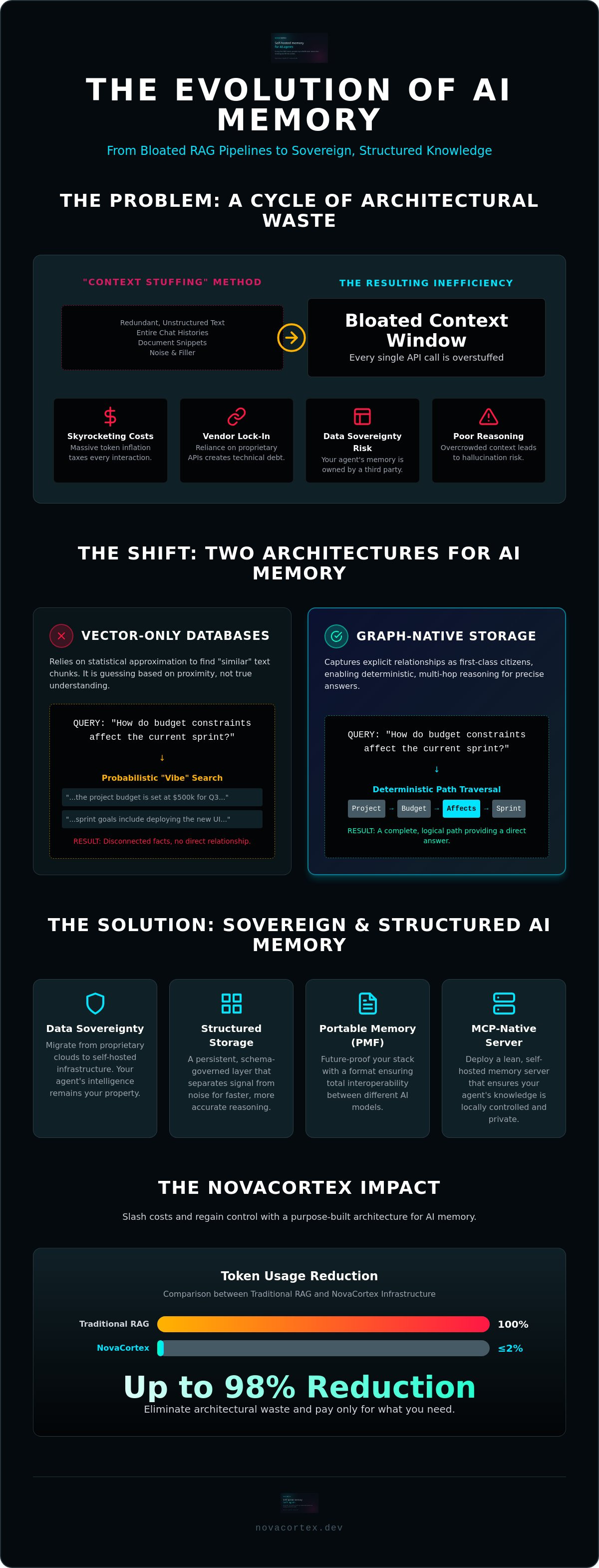
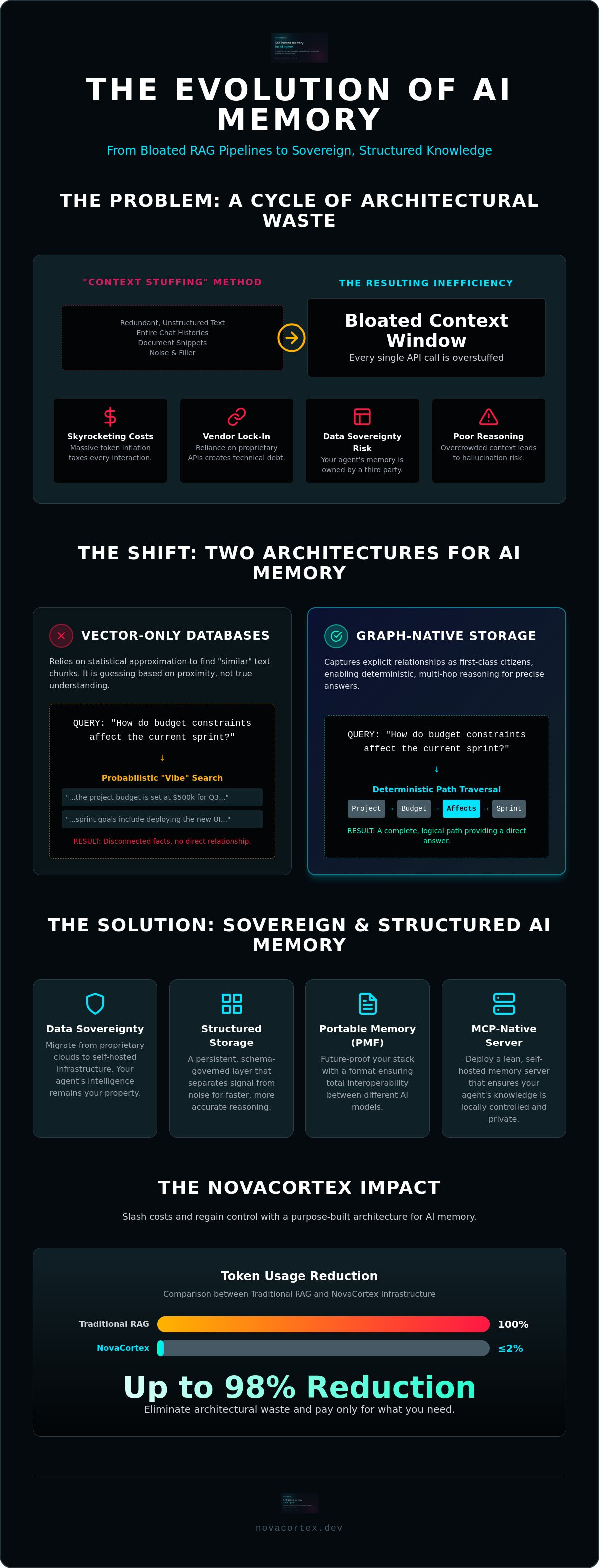
Context stuffing is an architectural failure. It is the brute-force practice of cramming every past interaction and document snippet into a prompt window to maintain agent coherence. This approach creates massive token inflation. It wastes compute. For years, developers have relied on this "stuffing" method because it was the easiest path to pseudo-persistence. In 2026, enterprise systems have reached a breaking point where this inefficiency is no longer sustainable. We are moving toward structured AI memory storage, which serves as a persistent, schema-governed layer for agentic cognition.
The industry is transitioning from raw data dumps to curated, high-density knowledge artifacts. An agent should not have to reread a thousand lines of chat logs to remember a single user preference or a specific project constraint. It should query a structured state. This evolution mirrors the shift from flat files to relational databases in the early days of computing. By 2026, stateless AI interactions are insufficient for enterprise-grade agents that must handle multi-step reasoning across weeks or months of operation. High-velocity systems require a memory architecture that is lean, fast, and independent of the model's context window.
The Statelessness Problem in Modern LLMs
Modern LLMs are inherently amnesiac. They lose state between every API call. To compensate, developers re-inject entire conversation histories into every new prompt. This creates a performance bottleneck. It drives up latency and skyrockets API bills. Every redundant token sent is a tax on the system's efficiency. When agents operate in high-stakes environments, they cannot afford the "hallucination risk" that comes with an overcrowded context window. Structured memory is the externalized state of an AI agent. By moving state management outside the model, you gain the ability to maintain long-term context without paying for it in every single request.
Structured vs. Unstructured Memory Layers
Unstructured memory is a graveyard of raw conversation logs. It contains noise, typos, and redundant filler. Structured memory is different. It consists of schema-validated facts and entities. Instead of flat text, the architecture relies on a structured knowledge graph to map complex relationships between data points. This distinction allows the agent to separate semantic memory, which covers general facts and knowledge, from episodic memory, which tracks specific events and user interactions. The adoption of structured AI memory storage enables faster reasoning by filtering out the noise. It ensures the agent acts on verified, high-density data rather than probabilistic guesses retrieved from a messy pile of unstructured text.
Architecting Structured AI Memory: Graph-Native vs. Vector-Only Approaches
Vector similarity is a statistical approximation. It is not knowledge. While vector databases excel at finding similar text chunks, they lack the deterministic logic required for complex reasoning. High-fidelity structured AI memory storage requires more than just proximity; it requires a map of relationships. When an agent relies solely on vector search, it is essentially guessing based on the "vibe" of the data. This is insufficient for enterprise-grade applications where precision is the only metric that matters. You don't need a system that finds something close. You need a system that knows exactly how entity A influences entity B.
The architectural shift toward graph-native storage is a correction to this reliance on probabilistic retrieval. By capturing relationships as first-class citizens, developers can build agents that perform multi-hop reasoning. If a user asks about a project's budget constraints and how they affect the current sprint, a vector search might return separate chunks about budgets and sprints. A graph-native approach traverses the explicit edges connecting these entities. It provides a complete, logical path. This deterministic traversal ensures low-latency retrieval even in high-density knowledge environments where flat indices would become sluggish and noisy.
Why Vector Databases Fail at Long-Term Context
Vector databases suffer from the "lost in the middle" phenomenon. When context windows are flooded with retrieved chunks, the most relevant information often gets buried or ignored by the model. This happens because flat vector indices lack relational awareness. They treat every data point as an isolated island in a high-dimensional space. Without a hierarchy, the agent cannot distinguish between a core architectural principle and a passing comment in a chat log. To solve this, your agent needs graph-native AI storage to understand context hierarchy and maintain a coherent state over long durations.
The Graph-Native Advantage: Relations as First-Class Citizens
In a graph-native system, we define entities and edges with surgical precision. Entities are the nodes of your knowledge base; edges are the relationships that bind them. This structure allows for graph-based RAG, which significantly improves precision in complex agent workflows. Unlike unstructured logs, graph nodes represent persistent knowledge bits that survive session resets. This is the foundation of an open-source AI memory system that prioritizes structural integrity over raw volume. By implementing these structures, you eliminate the cognitive drift that plagues standard LLM deployments. If you're ready to move beyond basic vector retrieval, you can review the NovaCortex repository to see how these schemas are implemented in production-ready environments.
The Data Sovereignty Crisis: Why Proprietary Memory Layers are a Technical Debt Trap
Managed AI memory is a lease on your own intelligence. When you outsource your agent’s long-term state to a third-party cloud, you are building on rented land. It creates a technical debt trap where the cost of migration eventually exceeds the cost of staying. This is the data sovereignty crisis of 2026. Companies are realizing that proprietary memory layers are black boxes. You can’t audit them. You can’t move them. You definitely can’t control them if the provider changes their terms or goes offline. Implementing structured AI memory storage on your own infrastructure is the only way to maintain absolute control over your intellectual property.
Storing enterprise IP in a managed cloud isn't just a security risk; it's an architectural dead end. Vendor lock-in occurs the moment your agent's state is trapped in a closed-source format. If you've accumulated months of context, migrating that data becomes a nightmare. For enterprise-grade agents, "Privacy-First" isn't a marketing slogan. It is a hard engineering requirement. You need a system that ensures your knowledge base remains an asset, not a liability held hostage by a service provider’s pricing whims.
The High Cost of Managed AI Memory Services
Managed services come with hidden taxes. Long-term subscription fees and data egress costs add up quickly. Worse, your agent’s reliability is tied to an external heartbeat. If the API goes down, your agent loses its mind. Self-hosted AI memory layers eliminate this dependency. They ensure 100% uptime because the memory server lives within your own network perimeter. This isn't just about saving money. It's about engineering a resilient system that doesn't break when a vendor has a bad day.
Digital Sovereignty and Local Knowledge Control
Digital sovereignty means keeping sensitive data where it belongs. Whether it’s a VPS, a local server, or a Raspberry Pi, local control is the gold standard. This is especially critical for industries governed by GDPR or HIPAA. You can’t risk sensitive knowledge artifacts leaking into a public training set. University of Chicago research on AI and memory suggests that modeling these mechanisms is key to advanced cognition, but those models shouldn't live in a vendor's silo. Local structured AI memory storage also kills latency. You skip the external API handshake. Your agent retrieves its state at local network speeds. This high-velocity performance is a direct result of choosing independence over convenience.
Implementing Portable Memory Formats for Interoperable AI Agents
Interoperability is not a luxury; it is a survival trait for agentic systems. Most developers build silos. They trap agent state within proprietary schemas that only work with a single LLM provider. This is a strategic error. As the model landscape shifts, your agent’s memory must remain fluid. The adoption of structured AI memory storage allows for a protocol-agnostic approach to agent state. You need a portable memory format for AI to ensure that the knowledge your agent gathers today is usable by whichever model becomes the industry leader tomorrow. This portability is the only hedge against the rapid depreciation of model-specific optimizations.
Exporting and syncing memory across environments is the hallmark of a professional AI stack. A robust pipeline requires that memory captured in production can be sanitized and synced back to dev or staging for testing. This requires a standardized data exchange. By using a Portable Memory Format (PMF), you can serialize complex graph relationships into a flat, version-controlled file. This makes it possible to treat agent cognition like code. You can branch it. You can merge it. Most importantly, you can move it without losing the relational context that makes the memory valuable.
Model Context Protocol (MCP) and Memory Interoperability
The MCP native memory server is the new standard for context exchange. It acts as a universal translator between your storage layer and the agent. By implementing an MCP-compliant interface, you reduce the friction of switching LLM providers. Moving from OpenAI to Anthropic no longer requires a total rewrite of your retrieval logic. To build a vendor-neutral connector, you must map your internal graph schema to standard MCP resources and tools. This abstraction layer ensures that the agent interacts with a consistent memory interface regardless of the underlying model's specific tokenization or context window constraints.
Knowledge Buckets: Organizing Agent State
Knowledge Buckets are modular, task-specific memory units. They prevent context pollution by isolating memory into logical segments. An agent shouldn't have to wade through marketing data while performing a security audit. By partitioning structured AI memory storage into these buckets, you increase retrieval precision and reduce noise. This modularity is essential for multi-agent synchronization where different agents may need access to overlapping, but not identical, knowledge sets. Portable formats prevent agent "re-training" during migrations because the cognitive state is transferred as a complete, structured artifact rather than a raw text dump. Ready to implement a standardized memory layer? Clone the NovaCortex repository to get started.
Future-Proofing Agent Cognition with NovaCortex Self-Hosted Infrastructure
NovaCortex is the architectural correction the industry requires. It is a privacy-first, graph-native memory layer designed for autonomous agents that cannot afford the latency or privacy risks of cloud-based retrieval. By implementing structured AI memory storage, NovaCortex moves beyond the probabilistic approximations of vector search. It provides a deterministic, relationship-aware framework that scales without the typical performance degradation. This is engineering for longevity. Whether you are deploying on enterprise-grade servers or a local Raspberry Pi, the system remains lean and high-velocity.
Engineering efficiency is not just a goal; it is a measurable outcome. NovaCortex reduces token usage by up to 98% by eliminating the need for context stuffing. Instead of re-sending thousands of lines of chat history, agents retrieve only the specific, high-density knowledge artifacts required for the current task. This reduction in overhead transforms agentic workflows from cost-prohibitive experiments into sustainable production systems. The use of Portable Memory Format (PMF) ensures that this efficiency remains portable, effectively ending the cycle of vendor lock-in that plagues proprietary platforms.
The NovaCortex Self-Hosted Advantage
Local-first storage keeps your knowledge base exactly where it belongs: on your own infrastructure. NovaCortex uses graph-native indexing to achieve retrieval speeds that external APIs cannot match. The Self-Hosted Edition provides multi-user controls and advanced security features, allowing teams to collaborate on shared knowledge bases without compromising data sovereignty. This is the foundation of a sovereign AI stack. It treats memory as a private asset rather than a shared liability. You gain full visibility into how your data is structured, retrieved, and utilized by your agents.
Getting Started: Building Your Sovereign AI Agent
Integration begins with the MCP-native memory server. This protocol allows your agent to communicate with the storage layer through a standardized interface. You organize your agent's state using Knowledge Buckets, which isolate task-specific data to prevent context pollution. This modularity allows for complex, multi-tasking agents that can switch between domains without cognitive drift. You define the schema, you control the data, and you own the intelligence. Deploy NovaCortex Self-Hosted Edition today to take full control of your agent's cognitive infrastructure and structured AI memory storage.
Reclaiming Cognitive Sovereignty
The era of wasteful context stuffing is over. Efficient, persistent agents require a move away from the amnesiac nature of stateless LLMs and the technical debt of proprietary cloud silos. By implementing structured AI memory storage, you replace probabilistic vector guesses with deterministic, graph-native relationships. This architectural shift isn't just about performance. It is about ensuring your enterprise intelligence remains portable and compliant with evolving data regulations. You deserve a system that remembers perfectly without costing a fortune in token inflation.
NovaCortex delivers this vision through a lean, self-hosted architecture. It is an Apache-2.0 licensed open-source project that reduces token usage by up to 98% through precision retrieval. With its graph-native core and the Portable Memory Format (PMF), you can finally decouple your agent's knowledge from specific model providers. Stop renting your agent's brain and start owning your cognitive infrastructure. Take control of your AI’s memory with NovaCortex Self-Hosted Edition. The future of agentic reasoning is independent, structured, and entirely under your control.
Frequently Asked Questions
What is the difference between a vector database and structured AI memory?
Vector databases rely on statistical similarity. They retrieve text chunks based on mathematical proximity in a high-dimensional space. Structured AI memory uses graph-native relations to map deterministic logic between entities. It provides a map, not just a list of "close enough" guesses. This allows for multi-hop reasoning that flat vector indices simply cannot execute.
How does structured AI memory storage reduce token costs?
It eliminates the architectural waste of context stuffing. Instead of re-injecting entire chat histories into every prompt, structured AI memory storage retrieves only the specific, high-density facts required for the task. This precision can reduce token usage by up to 98%. You stop paying for redundant data and start paying only for new reasoning.
Can I use structured memory with any LLM like GPT-4 or Claude 3.5?
Yes, structured memory is model-agnostic. It functions as an externalized state that communicates with the model via standard API calls or protocols. Whether you're using OpenAI, Anthropic, or local models like Llama 3, the memory layer remains consistent. This independence ensures your agent's intelligence isn't tied to a specific provider's ecosystem.
Is structured AI memory storage compatible with the Model Context Protocol (MCP)?
NovaCortex is built with an MCP-Native Memory Server. This ensures that any agent or platform supporting the Model Context Protocol can instantly access and update its memory. Standardizing on MCP allows for seamless context exchange between different tools and models. It turns memory into a plug-and-play utility rather than a custom-coded integration nightmare.
What are Knowledge Buckets and how do they improve agent performance?
Knowledge Buckets are modular, task-specific memory units that isolate data into logical segments. They prevent context pollution by ensuring the agent only retrieves information relevant to its current objective. By partitioning structured AI memory storage, you reduce retrieval noise and increase the precision of the agent's decision-making process. This modularity is essential for managing multi-agent systems.
Why is a portable memory format important for long-term AI strategy?
A Portable Memory Format (PMF) prevents vendor lock-in. It allows you to export your agent's cognitive state and move it between different models or hosting environments without losing relational context. Without a portable standard, your data is trapped in proprietary schemas. PMF ensures your knowledge base remains a flexible asset that evolves alongside the AI landscape.
How does self-hosting a memory layer improve AI data privacy?
Self-hosting keeps your sensitive knowledge base within your own network perimeter. You avoid sending proprietary enterprise data to third-party AI clouds where it could be logged or misused. This provides total data sovereignty. It is a mandatory requirement for compliance with regulations like GDPR or HIPAA, where local control of sensitive information is non-negotiable.
Can NovaCortex be deployed on local hardware like a Raspberry Pi?
NovaCortex is designed for lean, high-velocity performance on varied hardware. Its architecture is efficient enough to run on a Raspberry Pi or a local VPS. This deployment flexibility ensures you don't need a massive server cluster to maintain a sophisticated memory layer. You can build sovereign AI agents that operate entirely on your own edge hardware.
FAQ
The Statelessness Problem in Modern LLMs
Modern LLMs are inherently amnesiac. They lose state between every API call. To compensate, developers re-inject entire conversation histories into every new prompt. This creates a performance bottleneck. It drives up latency and skyrockets API bills. Every redundant token sent is a tax on the system's efficiency. When agents operate in high-stakes environments, they cannot afford the "hallucination risk" that comes with an overcrowded context window. Structured memory is the externalized state of an AI agent. By moving state management outside the model, you gain the ability to maintain long-term context without paying for it in every single request.
Structured vs. Unstructured Memory Layers
Unstructured memory is a graveyard of raw conversation logs. It contains noise, typos, and redundant filler. Structured memory is different. It consists of schema-validated facts and entities. Instead of flat text, the architecture relies on a structured knowledge graph to map complex relationships between data points. This distinction allows the agent to separate semantic memory, which covers general facts and knowledge, from episodic memory, which tracks specific events and user interactions. The adoption of structured AI memory storage enables faster reasoning by filtering out the noise. It ensures the agent acts on verified, high-density data rather than probabilistic guesses retrieved from a messy pile of unstructured text. Vector similarity is a statistical approximation. It is not knowledge. While vector databases excel at finding similar text chunks, they lack the deterministic logic required for complex reasoning. High-fidelity structured AI memory storage requires more than just proximity; it requires a map of relationships. When an agent relies solely on vector search, it is essentially guessing based on the "vibe" of the data. This is insufficient for enterprise-grade applications where precision is the only metric that matters. You don't need a system that finds something close. You need a system that knows exactly how entity A influences entity B. The architectural shift toward graph-native storage is a correction to this reliance on probabilistic retrieval. By capturing relationships as first-class citizens, developers can build agents that perform multi-hop reasoning. If a user asks about a project's budget constraints and how they affect the current sprint, a vector search might return separate chunks about budgets and sprints. A graph-native approach traverses the explicit edges connecting these entities. It provides a complete, logical path. This deterministic traversal ensures low-latency retrieval even in high-density knowledge environments where flat indices would become sluggish and noisy.
Why Vector Databases Fail at Long-Term Context
Vector databases suffer from the "lost in the middle" phenomenon. When context windows are flooded with retrieved chunks, the most relevant information often gets buried or ignored by the model. This happens because flat vector indices lack relational awareness. They treat every data point as an isolated island in a high-dimensional space. Without a hierarchy, the agent cannot distinguish between a core architectural principle and a passing comment in a chat log. To solve this, your agent needs graph-native AI storage to understand context hierarchy and maintain a coherent state over long durations.
The Graph-Native Advantage: Relations as First-Class Citizens
In a graph-native system, we define entities and edges with surgical precision. Entities are the nodes of your knowledge base; edges are the relationships that bind them. This structure allows for graph-based RAG, which significantly improves precision in complex agent workflows. Unlike unstructured logs, graph nodes represent persistent knowledge bits that survive session resets. This is the foundation of an open-source AI memory system that prioritizes structural integrity over raw volume. By implementing these structures, you eliminate the cognitive drift that plagues standard LLM deployments. If you're ready to move beyond basic vector retrieval, you can review the NovaCortex repository to see how these schemas are implemented in production-ready environments. Managed AI memory is a lease on your own intelligence. When you outsource your agent’s long-term state to a third-party cloud, you are building on rented land. It creates a technical debt trap where the cost of migration eventually exceeds the cost of staying. This is the data sovereignty crisis of 2026. Companies are realizing that proprietary memory layers are black boxes. You can’t audit them. You can’t move them. You definitely can’t control them if the provider changes their terms or goes offline. Implementing structured AI memory storage on your own infrastructure is the only way to maintain absolute control over your intellectual property. Storing enterprise IP in a managed cloud isn't just a security risk; it's an architectural dead end. Vendor lock-in occurs the moment your agent's state is trapped in a closed-source format. If you've accumulated months of context, migrating that data becomes a nightmare. For enterprise-grade agents, "Privacy-First" isn't a marketing slogan. It is a hard engineering requirement. You need a system that ensures your knowledge base remains an asset, not a liability held hostage by a service provider’s pricing whims.
The High Cost of Managed AI Memory Services
Managed services come with hidden taxes. Long-term subscription fees and data egress costs add up quickly. Worse, your agent’s reliability is tied to an external heartbeat. If the API goes down, your agent loses its mind. Self-hosted AI memory layers eliminate this dependency. They ensure 100% uptime because the memory server lives within your own network perimeter. This isn't just about saving money. It's about engineering a resilient system that doesn't break when a vendor has a bad day.
Digital Sovereignty and Local Knowledge Control
Digital sovereignty means keeping sensitive data where it belongs. Whether it’s a VPS, a local server, or a Raspberry Pi, local control is the gold standard. This is especially critical for industries governed by GDPR or HIPAA. You can’t risk sensitive knowledge artifacts leaking into a public training set. University of Chicago research on AI and memory suggests that modeling these mechanisms is key to advanced cognition, but those models shouldn't live in a vendor's silo. Local structured AI memory storage also kills latency. You skip the external API handshake. Your agent retrieves its state at local network speeds. This high-velocity performance is a direct result of choosing independence over convenience. Interoperability is not a luxury; it is a survival trait for agentic systems. Most developers build silos. They trap agent state within proprietary schemas that only work with a single LLM provider. This is a strategic error. As the model landscape shifts, your agent’s memory must remain fluid. The adoption of structured AI memory storage allows for a protocol-agnostic approach to agent state. You need a portable memory format for AI to ensure that the knowledge your agent gathers today is usable by whichever model becomes the industry leader tomorrow. This portability is the only hedge against the rapid depreciation of model-specific optimizations. Exporting and syncing memory across environments is the hallmark of a professional AI stack. A robust pipeline requires that memory captured in production can be sanitized and synced back to dev or staging for testing. This requires a standardized data exchange. By using a Portable Memory Format (PMF), you can serialize complex graph relationships into a flat, version-controlled file. This makes it possible to treat agent cognition like code. You can branch it. You can merge it. Most importantly, you can move it without losing the relational context that makes the memory valuable.
Model Context Protocol (MCP) and Memory Interoperability
The MCP native memory server is the new standard for context exchange. It acts as a universal translator between your storage layer and the agent. By implementing an MCP-compliant interface, you reduce the friction of switching LLM providers. Moving from OpenAI to Anthropic no longer requires a total rewrite of your retrieval logic. To build a vendor-neutral connector, you must map your internal graph schema to standard MCP resources and tools. This abstraction layer ensures that the agent interacts with a consistent memory interface regardless of the underlying model's specific tokenization or context window constraints.
Knowledge Buckets: Organizing Agent State
Knowledge Buckets are modular, task-specific memory units. They prevent context pollution by isolating memory into logical segments. An agent shouldn't have to wade through marketing data while performing a security audit. By partitioning structured AI memory storage into these buckets, you increase retrieval precision and reduce noise. This modularity is essential for multi-agent synchronization where different agents may need access to overlapping, but not identical, knowledge sets. Portable formats prevent agent "re-training" during migrations because the cognitive state is transferred as a complete, structured artifact rather than a raw text dump. Ready to implement a standardized memory layer? Clone the NovaCortex repository to get started. NovaCortex is the architectural correction the industry requires. It is a privacy-first, graph-native memory layer designed for autonomous agents that cannot afford the latency or privacy risks of cloud-based retrieval. By implementing structured AI memory storage, NovaCortex moves beyond the probabilistic approximations of vector search. It provides a deterministic, relationship-aware framework that scales without the typical performance degradation. This is engineering for longevity. Whether you are deploying on enterprise-grade servers or a local Raspberry Pi, the system remains lean and high-velocity. Engineering efficiency is not just a goal; it is a measurable outcome. NovaCortex reduces token usage by up to 98% by eliminating the need for context stuffing. Instead of re-sending thousands of lines of chat history, agents retrieve only the specific, high-density knowledge artifacts required for the current task. This reduction in overhead transforms agentic workflows from cost-prohibitive experiments into sustainable production systems. The use of Portable Memory Format (PMF) ensures that this efficiency remains portable, effectively ending the cycle of vendor lock-in that plagues proprietary platforms.
The NovaCortex Self-Hosted Advantage
Local-first storage keeps your knowledge base exactly where it belongs: on your own infrastructure. NovaCortex uses graph-native indexing to achieve retrieval speeds that external APIs cannot match. The Self-Hosted Edition provides multi-user controls and advanced security features, allowing teams to collaborate on shared knowledge bases without compromising data sovereignty. This is the foundation of a sovereign AI stack. It treats memory as a private asset rather than a shared liability. You gain full visibility into how your data is structured, retrieved, and utilized by your agents.
Getting Started: Building Your Sovereign AI Agent
Integration begins with the MCP-native memory server. This protocol allows your agent to communicate with the storage layer through a standardized interface. You organize your agent's state using Knowledge Buckets, which isolate task-specific data to prevent context pollution. This modularity allows for complex, multi-tasking agents that can switch between domains without cognitive drift. You define the schema, you control the data, and you own the intelligence. Deploy NovaCortex Self-Hosted Edition today to take full control of your agent's cognitive infrastructure and structured AI memory storage. The era of wasteful context stuffing is over. Efficient, persistent agents require a move away from the amnesiac nature of stateless LLMs and the technical debt of proprietary cloud silos. By implementing structured AI memory storage, you replace probabilistic vector guesses with deterministic, graph-native relationships. This architectural shift isn't just about performance. It is about ensuring your enterprise intelligence remains portable and compliant with evolving data regulations. You deserve a system that remembers perfectly without costing a fortune in token inflation. NovaCortex delivers this vision through a lean, self-hosted architecture. It is an Apache-2.0 licensed open-source project that reduces token usage by up to 98% through precision retrieval. With its graph-native core and the Portable Memory Format (PMF), you can finally decouple your agent's knowledge from specific model providers. Stop renting your agent's brain and start owning your cognitive infrastructure. Take control of your AI’s memory with NovaCortex Self-Hosted Edition. The future of agentic reasoning is independent, structured, and entirely under your control.
What is the difference between a vector database and structured AI memory?
Vector databases rely on statistical similarity. They retrieve text chunks based on mathematical proximity in a high-dimensional space. Structured AI memory uses graph-native relations to map deterministic logic between entities. It provides a map, not just a list of "close enough" guesses. This allows for multi-hop reasoning that flat vector indices simply cannot execute.
How does structured AI memory storage reduce token costs?
It eliminates the architectural waste of context stuffing. Instead of re-injecting entire chat histories into every prompt, structured AI memory storage retrieves only the specific, high-density facts required for the task. This precision can reduce token usage by up to 98%. You stop paying for redundant data and start paying only for new reasoning.
Can I use structured memory with any LLM like GPT-4 or Claude 3.5?
Yes, structured memory is model-agnostic. It functions as an externalized state that communicates with the model via standard API calls or protocols. Whether you're using OpenAI, Anthropic, or local models like Llama 3, the memory layer remains consistent. This independence ensures your agent's intelligence isn't tied to a specific provider's ecosystem.
Is structured AI memory storage compatible with the Model Context Protocol (MCP)?
NovaCortex is built with an MCP-Native Memory Server. This ensures that any agent or platform supporting the Model Context Protocol can instantly access and update its memory. Standardizing on MCP allows for seamless context exchange between different tools and models. It turns memory into a plug-and-play utility rather than a custom-coded integration nightmare.
What are Knowledge Buckets and how do they improve agent performance?
Knowledge Buckets are modular, task-specific memory units that isolate data into logical segments. They prevent context pollution by ensuring the agent only retrieves information relevant to its current objective. By partitioning structured AI memory storage, you reduce retrieval noise and increase the precision of the agent's decision-making process. This modularity is essential for managing multi-agent systems.
Why is a portable memory format important for long-term AI strategy?
A Portable Memory Format (PMF) prevents vendor lock-in. It allows you to export your agent's cognitive state and move it between different models or hosting environments without losing relational context. Without a portable standard, your data is trapped in proprietary schemas. PMF ensures your knowledge base remains a flexible asset that evolves alongside the AI landscape.
How does self-hosting a memory layer improve AI data privacy?
Self-hosting keeps your sensitive knowledge base within your own network perimeter. You avoid sending proprietary enterprise data to third-party AI clouds where it could be logged or misused. This provides total data sovereignty. It is a mandatory requirement for compliance with regulations like GDPR or HIPAA, where local control of sensitive information is non-negotiable.
Can NovaCortex be deployed on local hardware like a Raspberry Pi?
NovaCortex is designed for lean, high-velocity performance on varied hardware. Its architecture is efficient enough to run on a Raspberry Pi or a local VPS. This deployment flexibility ensures you don't need a massive server cluster to maintain a sophisticated memory layer. You can build sovereign AI agents that operate entirely on your own edge hardware.