AI Memory on Raspberry Pi: Engineering Secure Knowledge Storage at the Edge
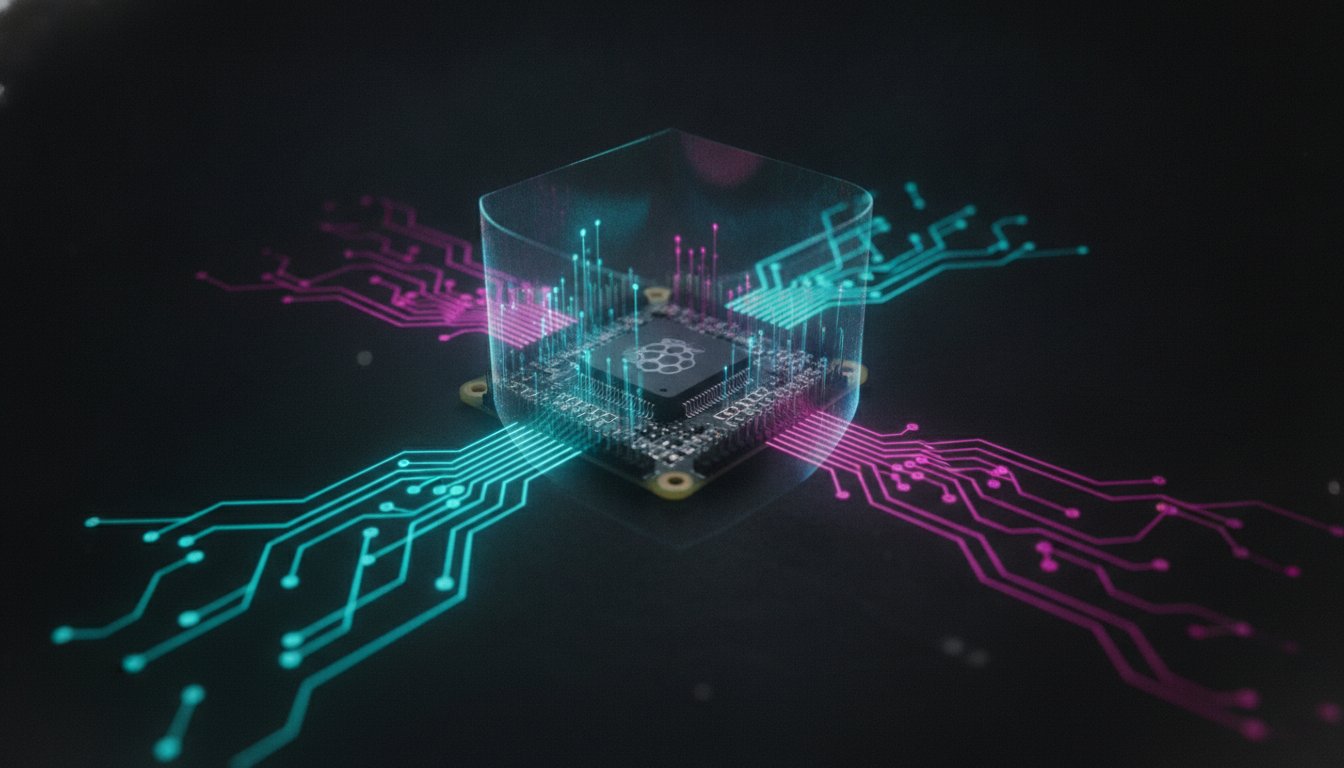
Most developers treat AI memory on Raspberry Pi as a hardware limitation problem. It is actually an architectural failure. You are likely tired of watching an ARM64 board choke on bloated context windows while cloud latency turns your "real-time" agent into a desktop ornament. It is a common struggle. Balancing the 8GB RAM constraints of a Pi 5 with the massive data requirements of modern RAG often leads to token bleeding and compromised privacy.
You don't need a server rack to achieve professional-grade intelligence. This article demonstrates how to master local AI memory architecture to build privacy-first, token-efficient agents. By leveraging graph-native retrieval and the NovaCortex Self-Hosted Edition, you can achieve a 98% reduction in token waste while maintaining full data sovereignty. We will detail the implementation of the Portable Memory Format and MCP-native servers to ensure your edge agents remain lean, stable, and fast.
Key Takeaways
- Identify the architectural "Context Wall" that causes standard RAG systems to fail on resource-constrained ARM64 hardware.
- Contrast graph-native storage with traditional vector databases to achieve millisecond retrieval speeds directly on the edge.
- Engineer secure AI memory on Raspberry Pi using local encryption and hardened Linux protocols for absolute data sovereignty.
- Implement the Portable Memory Format (PMF) and MCP-native servers to ensure long-term interoperability without vendor lock-in.
- Deploy the NovaCortex Self-Hosted Edition to manage specialized Knowledge Buckets for high-velocity, local-first agents.
The Edge AI Bottleneck: Why Standard Memory Fails on Raspberry Pi
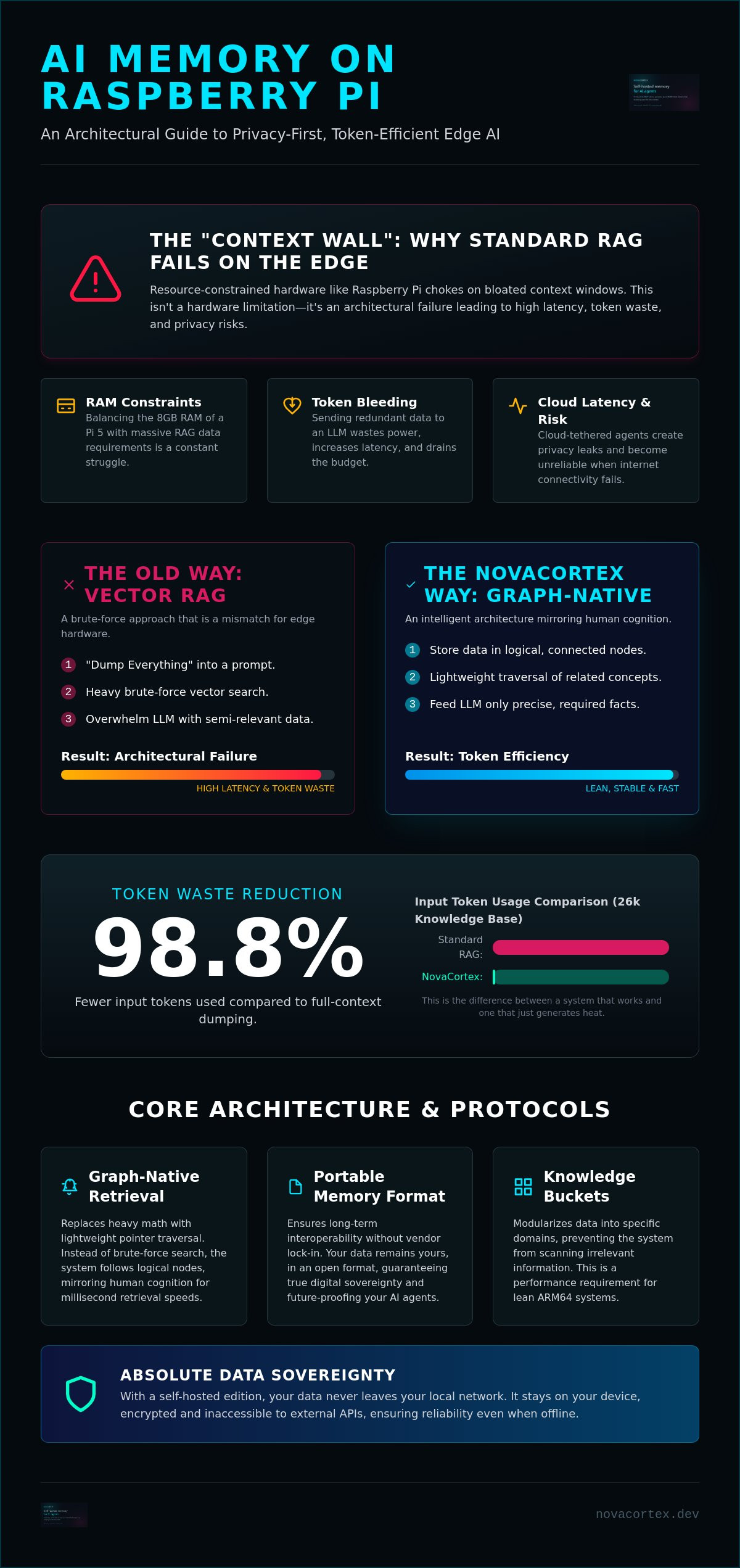
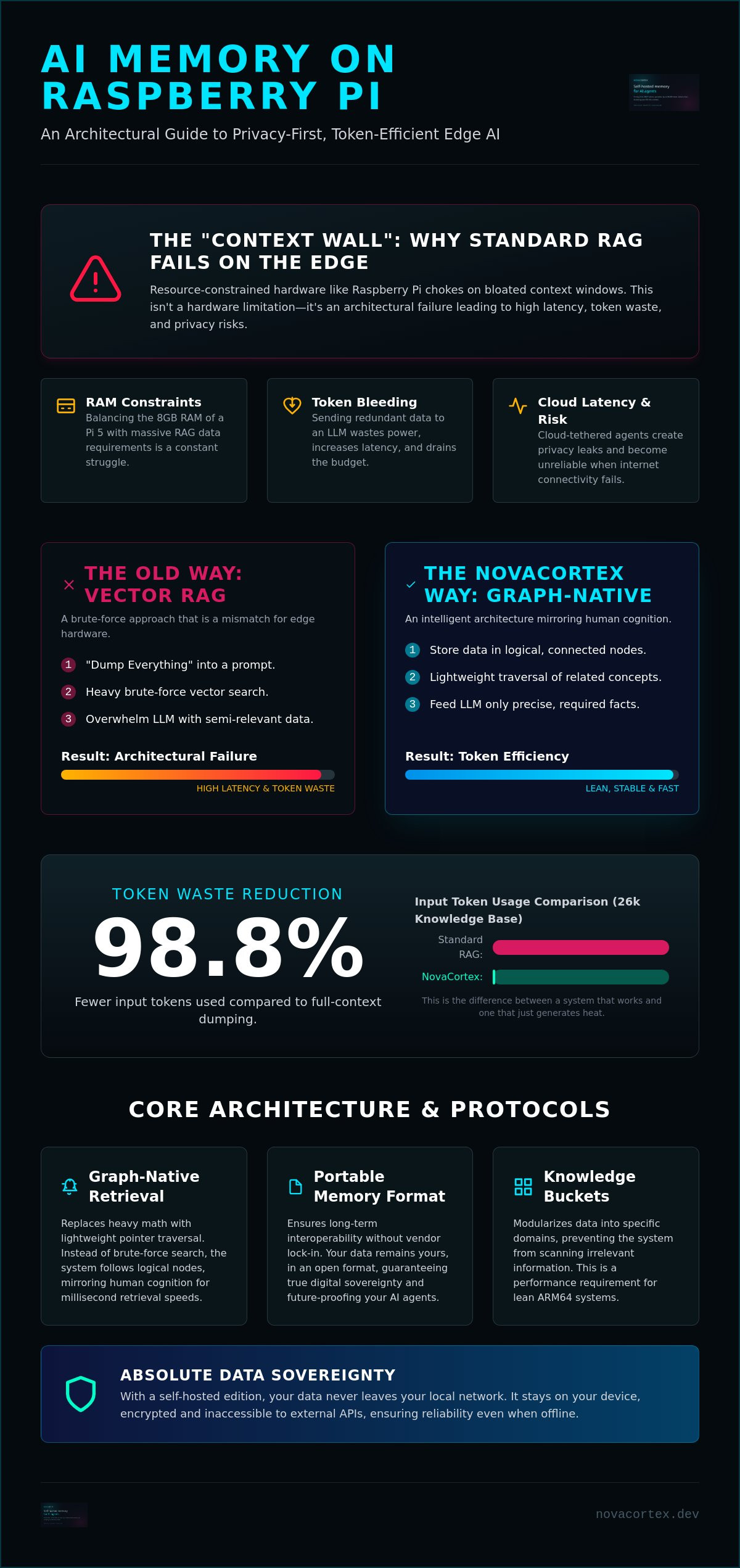
Standard RAG implementations are killing your hardware. Most developers mistake a lack of compute for a lack of intelligence. It is actually a failure of state management. On a device with 8GB of RAM, every byte counts. When you dump a raw knowledge base into a prompt, you hit the Context Wall. This is the point where LLM latency scales linearly with input size, turning a responsive agent into a frozen process. Effective AI memory on Raspberry Pi is not a simple database. It is a persistent, local context layer designed to feed the model only the exact facts it needs at the millisecond of execution.
Token bleeding is the visceral waste of sending redundant data to an LLM. Every unnecessary token is a drain on your power budget and a tax on your latency. In an internal benchmark, NovaCortex retrieval used 98.8% fewer input tokens compared to full-context dumping for a 26K-token knowledge base. That is the difference between a system that works and one that just generates heat. Beyond the CPU, you must manage the IOPS limitations of microSD cards. Flat vector searches require massive sequential reads that can choke the ARM64 architecture during peak retrieval windows.
Inference vs. Cognition: The Memory Gap
Inference is the act of thinking; memory is the act of knowing. These are distinct architectural requirements. Running a quantized Llama 3 model on a Pi 5 utilizes the CPU and the 40 TOPS available on the AI HAT+ 2. However, managing 100GB of documentation requires a different strategy. Edge computing allows us to move this storage closer to the source, but traditional stores often fail on low-power hardware. The Pi 5 offers a 2-3x CPU performance jump over the Pi 4, yet even this headroom vanishes if your retrieval logic is inefficient. High-velocity indexing is the only way to bypass these hardware bottlenecks.
The Security Risk of Cloud-Tethered Agents
Cloud-tethered agents are a liability. Sending your internal logs or personal data to a third-party vector database creates a permanent privacy leak. True digital sovereignty requires local execution. Secure AI knowledge storage at the edge means your data never leaves your local network. It stays on your SD card or SSD, encrypted and inaccessible to external APIs. This is not just about privacy; it's about reliability. If the internet drops, your agent should still remember its objectives. Building with NovaCortex Self-Hosted Edition ensures that your Knowledge Buckets remain under your physical control at all times, a principle of data sovereignty also championed by IronClad Family for the protection of critical family documents and digital assets.
Graph-Native Architecture: Engineering Lean Context for ARM64
Flat vector databases are an engineering mismatch for the edge. They rely on high-dimensional mathematical comparisons that punish low-power CPUs. On a Raspberry Pi, performing a brute-force vector search across thousands of embeddings creates a massive computational tax. Graph-native architecture replaces this waste with structural relationships. Instead of calculating distances between abstract points, the system follows logical nodes. This mirrors human cognition. We don't scan every memory we've ever had to answer a question; we follow a path of related concepts. This is the only path to sustainable AI memory on Raspberry Pi.
The Arm Cortex-A76 processor in the Pi 5 is highly capable, but its efficiency is wasted if the software layer relies on brute-force calculations. By using Knowledge Buckets, you can modularize data into specific domains. This prevents the system from scanning irrelevant information. It ensures that retrieval remains fast even as your total knowledge base grows. Modularity isn't just a convenience. It is a performance requirement for ARM64 systems that lack the massive memory bandwidth of server-grade hardware.
De-bloating the Memory Layer
NovaCortex delivers a 98% reduction in token usage by abandoning the "dump everything" approach of standard RAG. Traditional systems overwhelm the context window with semi-relevant chunks. Graph-native retrieval identifies the precise nodes required for a specific query. This lean approach is essential for ARM64 environments where memory bandwidth is at a premium. It replaces heavy math with lightweight pointer traversal. If you want to stop wasting tokens and start building efficient agents, you can explore the open-source implementation on GitHub.
Portable Memory Format (PMF) Explained
Data sovereignty is worthless if your data is trapped in a proprietary format. The Portable Memory Format (PMF) is a vendor-neutral standard designed for interoperability. It allows you to move your knowledge graph from a local Pi to a high-performance VPS without re-indexing. This prevents the "Data Jail" common in cloud-based AI storage. You own the memory; the hardware is just a temporary host. Using PMF ensures your AI memory on Raspberry Pi remains agile and future-proof. You gain the ability to scale your infrastructure without losing the cognitive state of your agents, while maintaining the same commitment to transparency and control that Conzent provides for managing web-based privacy compliance and cookie consent.
Performance Benchmarks: NovaCortex vs. Traditional Vector Databases
Efficiency on the edge is not optional. It is the boundary between a functional agent and a thermal shutdown. When you deploy AI memory on Raspberry Pi, you must measure retrieval latency and RAM pressure with precision. Traditional vector databases often require seconds to perform a similarity search across large datasets. They force the CPU to compute high-dimensional distances for every query. In contrast, NovaCortex operates in milliseconds. It utilizes the Arm Cortex-A76 architectural features to navigate structured relationships rather than crunching raw numbers. This architectural choice prevents the heat generation and battery drain that plague brute-force indexing on ARM64 boards.
RAM footprint is the primary killer of edge AI projects. Standard vector stores often crash on the Pi because they attempt to load entire index structures into memory. NovaCortex thrives in these constrained environments. Its graph-native design maintains a lean footprint, allowing the model itself to occupy the majority of the available 8GB RAM. You aren't fighting for resources; you're allocating them intelligently. This stability is critical when running long-term agents that must remain online for weeks without a reboot.
The Real Cost of Token Waste
Token waste is an engineering tax. Every irrelevant chunk of text sent to your LLM increases your API costs or local inference time. NovaCortex provides up to a 98% reduction in token usage by retrieving only the specific nodes relevant to the query. This precision allows smaller, 7B parameter models to perform like much larger counterparts because they aren't drowning in noise. Token efficiency is the ratio of relevant context to total tokens used. By maximizing this ratio, you extend the utility of your edge hardware without upgrading to expensive cloud tiers.
Scaling Memory Without Scaling Hardware
You don't need more hardware to store more knowledge. Knowledge Buckets allow you to modularize information, storing it as structured data on local SD cards or SSDs. This creates "virtual" memory that far exceeds the physical RAM limits of the Pi. You can manage state across multiple agents simultaneously without context contamination. If you are deciding between different deployment models, understanding the trade-offs in self-hosted vs managed AI memory is critical for long-term scalability. Local storage ensures your agents remain fast and focused regardless of the total dataset size.
Hardening the Edge: Protocols for Secure AI Knowledge Storage
Local storage is not a security strategy; it is a starting point. Many hobbyists assume that being "offline" equals being secure. It does not. If your Raspberry Pi is stolen, an unencrypted graph database is an open book for a data breach. You must implement encryption at rest using LUKS or application-specific layers to protect your AI memory on Raspberry Pi. This ensures the knowledge graph remains a black box to anyone without the cryptographic keys. Secure knowledge storage requires a multi-layered approach that covers the physical disk, the network interface, and the application protocol—a standard of protection mirroring the managed security services provided by CyberOne.
While local setups offer a strong foundation, small businesses often benefit from professional oversight to ensure their entire network remains hardened; you can learn more about Trinity Networx, LLC for proactive IT support and comprehensive cybersecurity solutions.
Access control is the next frontier for edge intelligence. You can't allow every process on the OS to read your agent's history. Implementing a zero-trust model means every request to the memory layer must be authenticated and scoped. This prevents unauthorized LLMs or background scripts from scraping your Knowledge Buckets. It turns your memory layer from a passive file into an active, protected service. This isolation is crucial when running multiple agents with different permission levels on a single ARM64 board. It ensures that sensitive procedural memory for one task doesn't leak into the semantic context of another.
MCP-Native Memory: The Security Standard
The MCP native memory server provides the standard for secure agent communication. It abstracts the memory layer behind a controlled protocol, ensuring the agent only receives what it is authorized to see. This architecture supports detailed audit logging. You can track every retrieval and storage operation, providing a clear history of what your AI "remembers" and why it accessed that specific data. This level of transparency is essential for enterprise-grade edge deployments where accountability is as important as performance. It moves the memory layer from a "black box" to a verifiable system component.
Physical Security and Data Sovereignty
Physical hardware requires physical protection. Secure your Pi in a locked enclosure and disable unused USB ports to prevent local injection attacks. For highly sensitive environments, you can implement a "Kill Switch" protocol. This allows for an instant, irreversible wipe of the local memory if physical tampering is detected. Maintaining true digital sovereignty means you are the only one with the keys to the kingdom. By using the Portable Memory Format (PMF), you can maintain encrypted backups of your Knowledge Buckets off-device. This ensures that even if the hardware fails or is compromised, your intelligence remains secure and portable. Digital sovereignty is about control, and control starts with the filesystem. To extend this philosophy to your personal life, you can explore SafeKeep Premium to organize your essential documents in a secure central hub.
You can start hardening your own local setup by deploying the open-source core from our official repository.
Implementing NovaCortex: Sovereign Memory on Your Local Infrastructure
Stop debating theory. It's time to build. Deploying AI memory on Raspberry Pi is a matter of precise configuration, not luck. You need the NovaCortex Self-Hosted Edition. It is engineered specifically for the ARM64 architecture of the Pi 5. Begin by pulling the official Docker image or cloning the repository for a native build. Once the environment is live, initialize your first Knowledge Bucket. This is your agent's specialized memory domain. It prevents the context pollution that occurs when you mix unrelated data streams. A clean bucket ensures that your agent retrieves relevant facts in milliseconds, not seconds.
Integration is the next step. Most developers struggle with connecting their memory layer to agent frameworks like AutoGPT, CrewAI, or LangChain. The solution is the MCP-Native Memory Server. It acts as the standard interface between your LLM and its persistent state. When your agent initiates a query, the memory server traverses the local graph and returns only the necessary nodes. This is how you achieve the 98% token reduction required for stable performance. It isn't just about saving money; it's about making the most of your hardware's limited context window.
Deployment Checklist for Pi 5
Operating system choice is the foundation of your stack. A 64-bit environment is non-negotiable for high-performance indexing and memory management. If you are still running a 32-bit kernel, your retrieval speeds will suffer. For maximum stability, pin the NovaCortex process to specific CPU cores. This reduces context-switching overhead and ensures that memory retrieval doesn't compete with the LLM's inference cycles. You can find the exact terminal commands and configuration files in our AI memory server setup guide.
Next Steps: Scaling Beyond the Pi
The Raspberry Pi is a powerful gateway to digital sovereignty, but your knowledge graph might eventually outgrow edge hardware. When your Knowledge Buckets scale into the hundreds of gigabytes, migrating to a self-hosted RAG server is the logical progression. This transition is seamless because of the Portable Memory Format (PMF). You can export your entire cognitive state from the Pi and import it into a high-performance VPS or local rack without re-indexing a single document. This is true data sovereignty. You own the intelligence; the hardware is just a temporary host. Build your sovereign AI today and stop relying on fragile, cloud-tethered systems.
Master Your Edge Architecture
Building high-performance agents on ARM64 hardware is no longer a speculative exercise. It is an engineering reality. You have seen how graph-native retrieval eliminates the "Context Wall" that cripples standard vector databases. By shifting from brute-force math to structured relationships, you achieve a 98% reduction in token waste. This efficiency is the only way to maintain stable, low-latency AI memory on Raspberry Pi without sacrificing model performance or data privacy. Digital sovereignty is the baseline, not a feature.
Your path forward is clear. Secure your knowledge storage with local encryption and utilize the MCP-native server to ensure zero-trust communication between your agents and their memories. This modular approach, powered by Knowledge Buckets and the Portable Memory Format, ensures your intelligence remains portable and independent of cloud-tethered risks. The tools to build a private, high-velocity cognitive layer are ready for deployment.
Deploy NovaCortex Self-Hosted on your Raspberry Pi today and take full control of your agent's long-term intelligence. This Apache-2.0 open-source edition provides the graph-native performance required to turn a hobbyist board into a sovereign knowledge powerhouse. It's time to build smarter, leaner, and more secure systems.
Frequently Asked Questions
Can a Raspberry Pi 4 handle a graph-native AI memory layer?
Yes, the Raspberry Pi 4 is capable of running a graph-native memory layer like NovaCortex. While the Pi 5 offers a 2-3x CPU performance advantage, the graph-native approach avoids the heavy vector math that typically chokes older ARM64 hardware. You'll achieve stable millisecond retrieval as long as you use a 64-bit OS and manage your Knowledge Buckets to keep the active index within the 4GB or 8GB RAM limits.
How does NovaCortex reduce AI token usage by 98%?
It eliminates the "dump everything" approach of traditional RAG. Instead of stuffing your context window with semi-relevant text chunks, NovaCortex uses graph-native retrieval to identify the exact nodes required for a query. In internal benchmarks, this precision reduced input tokens by 98.8% for a 26K-token knowledge base. You stop paying for redundant context and start feeding the model only the facts it needs to execute.
Is local AI memory storage more secure than cloud vector databases?
Local storage is the only way to ensure absolute digital sovereignty. Cloud vector databases create permanent privacy leaks by sending your internal data to third-party APIs. Implementing AI memory on Raspberry Pi allows you to use encryption at rest and zero-trust access protocols within your own network. Your data remains under your physical control, protected from external breaches and unauthorized scraping by proprietary LLM providers.
What is the Model Context Protocol (MCP) and why does it matter for Pi?
MCP is the industry standard for secure, persistent agent communication. It acts as a controlled interface between an AI agent and its memory layer, preventing the agent from "seeing" unauthorized data. For Raspberry Pi users, an MCP-native memory server ensures that your local agents remain interoperable with different frameworks without vendor lock-in. It provides the structured logging and security headers necessary for professional-grade edge deployments.
Do I need a GPU to run an AI memory server on my Raspberry Pi?
No, you don't need a dedicated GPU or an AI accelerator like the AI HAT+ 2 to run the memory server itself. NovaCortex is engineered to thrive on ARM64 CPUs by replacing high-dimensional vector calculations with structural graph traversal. This architectural shift keeps the hardware footprint minimal. While a GPU helps with the initial embedding generation or the final LLM inference, the memory retrieval process remains fast and efficient on standard CPU cores.
How do I migrate my AI memory from a Raspberry Pi to a larger server later?
Migration is handled through the Portable Memory Format (PMF). This vendor-neutral standard allows you to export your entire cognitive state as a single file. You can then import this PMF file into a high-performance VPS or a self-hosted RAG server without re-indexing your data. Your agent's memory is decoupled from the hardware, ensuring that your intelligence layer can scale as your infrastructure requirements grow.
What happens if my Raspberry Pi loses power? Is the AI memory corrupted?
NovaCortex utilizes ACID-compliant storage protocols to prevent data corruption during unexpected power loss. Each transaction is verified before being committed to the graph. While the system is resilient, we recommend using an SSD instead of a microSD card for long-term data integrity on the edge. SSDs handle the high IOPS of memory indexing more reliably and offer better protection against filesystem errors during hard reboots.
Can I use NovaCortex with proprietary LLMs like GPT-4o while keeping my data local?
Yes, you can bridge local AI memory on Raspberry Pi with proprietary cloud models. The agent performs a local retrieval from your encrypted Knowledge Buckets and sends only the highly specific, relevant context to the cloud API. Your entire knowledge base never leaves your local network. This hybrid approach gives you the reasoning power of top-tier models while maintaining the privacy and token efficiency of a sovereign memory layer.
FAQ
Inference vs. Cognition: The Memory Gap
Inference is the act of thinking; memory is the act of knowing. These are distinct architectural requirements. Running a quantized Llama 3 model on a Pi 5 utilizes the CPU and the 40 TOPS available on the AI HAT+ 2. However, managing 100GB of documentation requires a different strategy. Edge computing allows us to move this storage closer to the source, but traditional stores often fail on low-power hardware. The Pi 5 offers a 2-3x CPU performance jump over the Pi 4, yet even this headroom vanishes if your retrieval logic is inefficient. High-velocity indexing is the only way to bypass these hardware bottlenecks.
The Security Risk of Cloud-Tethered Agents
Cloud-tethered agents are a liability. Sending your internal logs or personal data to a third-party vector database creates a permanent privacy leak. True digital sovereignty requires local execution. Secure AI knowledge storage at the edge means your data never leaves your local network. It stays on your SD card or SSD, encrypted and inaccessible to external APIs. This is not just about privacy; it's about reliability. If the internet drops, your agent should still remember its objectives. Building with NovaCortex Self-Hosted Edition ensures that your Knowledge Buckets remain under your physical control at all times. Flat vector databases are an engineering mismatch for the edge. They rely on high-dimensional mathematical comparisons that punish low-power CPUs. On a Raspberry Pi, performing a brute-force vector search across thousands of embeddings creates a massive computational tax. Graph-native architecture replaces this waste with structural relationships. Instead of calculating distances between abstract points, the system follows logical nodes. This mirrors human cognition. We don't scan every memory we've ever had to answer a question; we follow a path of related concepts. This is the only path to sustainable AI memory on Raspberry Pi. The Arm Cortex-A76 processor in the Pi 5 is highly capable, but its efficiency is wasted if the software layer relies on brute-force calculations. By using Knowledge Buckets, you can modularize data into specific domains. This prevents the system from scanning irrelevant information. It ensures that retrieval remains fast even as your total knowledge base grows. Modularity isn't just a convenience. It is a performance requirement for ARM64 systems that lack the massive memory bandwidth of server-grade hardware.
De-bloating the Memory Layer
NovaCortex delivers a 98% reduction in token usage by abandoning the "dump everything" approach of standard RAG. Traditional systems overwhelm the context window with semi-relevant chunks. Graph-native retrieval identifies the precise nodes required for a specific query. This lean approach is essential for ARM64 environments where memory bandwidth is at a premium. It replaces heavy math with lightweight pointer traversal. If you want to stop wasting tokens and start building efficient agents, you can explore the open-source implementation on GitHub.
Portable Memory Format (PMF) Explained
Data sovereignty is worthless if your data is trapped in a proprietary format. The Portable Memory Format (PMF) is a vendor-neutral standard designed for interoperability. It allows you to move your knowledge graph from a local Pi to a high-performance VPS without re-indexing. This prevents the "Data Jail" common in cloud-based AI storage. You own the memory; the hardware is just a temporary host. Using PMF ensures your AI memory on Raspberry Pi remains agile and future-proof. You gain the ability to scale your infrastructure without losing the cognitive state of your agents. Efficiency on the edge is not optional. It is the boundary between a functional agent and a thermal shutdown. When you deploy AI memory on Raspberry Pi, you must measure retrieval latency and RAM pressure with precision. Traditional vector databases often require seconds to perform a similarity search across large datasets. They force the CPU to compute high-dimensional distances for every query. In contrast, NovaCortex operates in milliseconds. It utilizes the Arm Cortex-A76 architectural features to navigate structured relationships rather than crunching raw numbers. This architectural choice prevents the heat generation and battery drain that plague brute-force indexing on ARM64 boards. RAM footprint is the primary killer of edge AI projects. Standard vector stores often crash on the Pi because they attempt to load entire index structures into memory. NovaCortex thrives in these constrained environments. Its graph-native design maintains a lean footprint, allowing the model itself to occupy the majority of the available 8GB RAM. You aren't fighting for resources; you're allocating them intelligently. This stability is critical when running long-term agents that must remain online for weeks without a reboot.
The Real Cost of Token Waste
Token waste is an engineering tax. Every irrelevant chunk of text sent to your LLM increases your API costs or local inference time. NovaCortex provides up to a 98% reduction in token usage by retrieving only the specific nodes relevant to the query. This precision allows smaller, 7B parameter models to perform like much larger counterparts because they aren't drowning in noise. Token efficiency is the ratio of relevant context to total tokens used. By maximizing this ratio, you extend the utility of your edge hardware without upgrading to expensive cloud tiers.
Scaling Memory Without Scaling Hardware
You don't need more hardware to store more knowledge. Knowledge Buckets allow you to modularize information, storing it as structured data on local SD cards or SSDs. This creates "virtual" memory that far exceeds the physical RAM limits of the Pi. You can manage state across multiple agents simultaneously without context contamination. If you are deciding between different deployment models, understanding the trade-offs in self-hosted vs managed AI memory is critical for long-term scalability. Local storage ensures your agents remain fast and focused regardless of the total dataset size. Local storage is not a security strategy; it is a starting point. Many hobbyists assume that being "offline" equals being secure. It does not. If your Raspberry Pi is stolen, an unencrypted graph database is an open book for a data breach. You must implement encryption at rest using LUKS or application-specific layers to protect your AI memory on Raspberry Pi. This ensures the knowledge graph remains a black box to anyone without the cryptographic keys. Secure knowledge storage requires a multi-layered approach that covers the physical disk, the network interface, and the application protocol. Access control is the next frontier for edge intelligence. You can't allow every process on the OS to read your agent's history. Implementing a zero-trust model means every request to the memory layer must be authenticated and scoped. This prevents unauthorized LLMs or background scripts from scraping your Knowledge Buckets. It turns your memory layer from a passive file into an active, protected service. This isolation is crucial when running multiple agents with different permission levels on a single ARM64 board. It ensures that sensitive procedural memory for one task doesn't leak into the semantic context of another.
MCP-Native Memory: The Security Standard
The MCP native memory server provides the standard for secure agent communication. It abstracts the memory layer behind a controlled protocol, ensuring the agent only receives what it is authorized to see. This architecture supports detailed audit logging. You can track every retrieval and storage operation, providing a clear history of what your AI "remembers" and why it accessed that specific data. This level of transparency is essential for enterprise-grade edge deployments where accountability is as important as performance. It moves the memory layer from a "black box" to a verifiable system component.
Physical Security and Data Sovereignty
Physical hardware requires physical protection. Secure your Pi in a locked enclosure and disable unused USB ports to prevent local injection attacks. For highly sensitive environments, you can implement a "Kill Switch" protocol. This allows for an instant, irreversible wipe of the local memory if physical tampering is detected. Maintaining true digital sovereignty means you are the only one with the keys to the kingdom. By using the Portable Memory Format (PMF), you can maintain encrypted backups of your Knowledge Buckets off-device. This ensures that even if the hardware fails or is compromised, your intelligence remains secure and portable. Digital sovereignty is about control, and control starts with the filesystem. You can start hardening your own local setup by deploying the open-source core from our official repository. Stop debating theory. It's time to build. Deploying AI memory on Raspberry Pi is a matter of precise configuration, not luck. You need the NovaCortex Self-Hosted Edition. It is engineered specifically for the ARM64 architecture of the Pi 5. Begin by pulling the official Docker image or cloning the repository for a native build. Once the environment is live, initialize your first Knowledge Bucket. This is your agent's specialized memory domain. It prevents the context pollution that occurs when you mix unrelated data streams. A clean bucket ensures that your agent retrieves relevant facts in milliseconds, not seconds. Integration is the next step. Most developers struggle with connecting their memory layer to agent frameworks like AutoGPT, CrewAI, or LangChain. The solution is the MCP-Native Memory Server. It acts as the standard interface between your LLM and its persistent state. When your agent initiates a query, the memory server traverses the local graph and returns only the necessary nodes. This is how you achieve the 98% token reduction required for stable performance. It isn't just about saving money; it's about making the most of your hardware's limited context window.
Deployment Checklist for Pi 5
Operating system choice is the foundation of your stack. A 64-bit environment is non-negotiable for high-performance indexing and memory management. If you are still running a 32-bit kernel, your retrieval speeds will suffer. For maximum stability, pin the NovaCortex process to specific CPU cores. This reduces context-switching overhead and ensures that memory retrieval doesn't compete with the LLM's inference cycles. You can find the exact terminal commands and configuration files in our AI memory server setup guide.
Next Steps: Scaling Beyond the Pi
The Raspberry Pi is a powerful gateway to digital sovereignty, but your knowledge graph might eventually outgrow edge hardware. When your Knowledge Buckets scale into the hundreds of gigabytes, migrating to a self-hosted RAG server is the logical progression. This transition is seamless because of the Portable Memory Format (PMF). You can export your entire cognitive state from the Pi and import it into a high-performance VPS or local rack without re-indexing a single document. This is true data sovereignty. You own the intelligence; the hardware is just a temporary host. Build your sovereign AI today and stop relying on fragile, cloud-tethered systems. Building high-performance agents on ARM64 hardware is no longer a speculative exercise. It is an engineering reality. You have seen how graph-native retrieval eliminates the "Context Wall" that cripples standard vector databases. By shifting from brute-force math to structured relationships, you achieve a 98% reduction in token waste. This efficiency is the only way to maintain stable, low-latency AI memory on Raspberry Pi without sacrificing model performance or data privacy. Digital sovereignty is the baseline, not a feature. Your path forward is clear. Secure your knowledge storage with local encryption and utilize the MCP-native server to ensure zero-trust communication between your agents and their memories. This modular approach, powered by Knowledge Buckets and the Portable Memory Format, ensures your intelligence remains portable and independent of cloud-tethered risks. The tools to build a private, high-velocity cognitive layer are ready for deployment. Deploy NovaCortex Self-Hosted on your Raspberry Pi today and take full control of your agent's long-term intelligence. This Apache-2.0 open-source edition provides the graph-native performance required to turn a hobbyist board into a sovereign knowledge powerhouse. It's time to build smarter, leaner, and more secure systems.
Can a Raspberry Pi 4 handle a graph-native AI memory layer?
Yes, the Raspberry Pi 4 is capable of running a graph-native memory layer like NovaCortex. While the Pi 5 offers a 2-3x CPU performance advantage, the graph-native approach avoids the heavy vector math that typically chokes older ARM64 hardware. You'll achieve stable millisecond retrieval as long as you use a 64-bit OS and manage your Knowledge Buckets to keep the active index within the 4GB or 8GB RAM limits.
How does NovaCortex reduce AI token usage by 98%?
It eliminates the "dump everything" approach of traditional RAG. Instead of stuffing your context window with semi-relevant text chunks, NovaCortex uses graph-native retrieval to identify the exact nodes required for a query. In internal benchmarks, this precision reduced input tokens by 98.8% for a 26K-token knowledge base. You stop paying for redundant context and start feeding the model only the facts it needs to execute.
Is local AI memory storage more secure than cloud vector databases?
Local storage is the only way to ensure absolute digital sovereignty. Cloud vector databases create permanent privacy leaks by sending your internal data to third-party APIs. Implementing AI memory on Raspberry Pi allows you to use encryption at rest and zero-trust access protocols within your own network. Your data remains under your physical control, protected from external breaches and unauthorized scraping by proprietary LLM providers.
What is the Model Context Protocol (MCP) and why does it matter for Pi?
MCP is the industry standard for secure, persistent agent communication. It acts as a controlled interface between an AI agent and its memory layer, preventing the agent from "seeing" unauthorized data. For Raspberry Pi users, an MCP-native memory server ensures that your local agents remain interoperable with different frameworks without vendor lock-in. It provides the structured logging and security headers necessary for professional-grade edge deployments.
Do I need a GPU to run an AI memory server on my Raspberry Pi?
No, you don't need a dedicated GPU or an AI accelerator like the AI HAT+ 2 to run the memory server itself. NovaCortex is engineered to thrive on ARM64 CPUs by replacing high-dimensional vector calculations with structural graph traversal. This architectural shift keeps the hardware footprint minimal. While a GPU helps with the initial embedding generation or the final LLM inference, the memory retrieval process remains fast and efficient on standard CPU cores.
How do I migrate my AI memory from a Raspberry Pi to a larger server later?
Migration is handled through the Portable Memory Format (PMF). This vendor-neutral standard allows you to export your entire cognitive state as a single file. You can then import this PMF file into a high-performance VPS or a self-hosted RAG server without re-indexing your data. Your agent's memory is decoupled from the hardware, ensuring that your intelligence layer can scale as your infrastructure requirements grow.
What happens if my Raspberry Pi loses power? Is the AI memory corrupted?
NovaCortex utilizes ACID-compliant storage protocols to prevent data corruption during unexpected power loss. Each transaction is verified before being committed to the graph. While the system is resilient, we recommend using an SSD instead of a microSD card for long-term data integrity on the edge. SSDs handle the high IOPS of memory indexing more reliably and offer better protection against filesystem errors during hard reboots.
Can I use NovaCortex with proprietary LLMs like GPT-4o while keeping my data local?
Yes, you can bridge local AI memory on Raspberry Pi with proprietary cloud models. The agent performs a local retrieval from your encrypted Knowledge Buckets and sends only the highly specific, relevant context to the cloud API. Your entire knowledge base never leaves your local network. This hybrid approach gives you the reasoning power of top-tier models while maintaining the privacy and token efficiency of a sovereign memory layer.