Self-Hosted RAG Server: Engineering Data Sovereignty in 2026

Dumping your entire enterprise knowledge base into an LLM context window isn't engineering. It's a budget leak. Most teams are currently suffocating under massive token waste and the looming shadow of the EU AI Act enforcement starting August 2, 2026. You're right to feel uneasy about sending proprietary data to managed services that offer little more than vendor lock-in and security theatre. Deploying a high-performance self-hosted RAG server is no longer a luxury for the paranoid. It's the only way to maintain digital sovereignty in an era of aggressive data harvesting.
You'll master the architecture of private AI knowledge retrieval and see exactly why graph-native memory layers are replacing legacy vector databases. We'll explore how to deploy a lean, sovereign stack using Ollama v0.31.1 and NovaCortex Knowledge Buckets. This article breaks down the transition from simple semantic search to complex relational reasoning. It's time to engineer a persistent, high-velocity memory layer that lives on your own hardware, slashes LLM API costs, and ensures your data remains under your absolute control.
Key Takeaways
- Transition from fragile document retrieval to a robust self-hosted RAG server that serves as a persistent, private memory layer for your AI agents.
- Identify why traditional vector databases fail at complex context and how graph-native storage provides the relational reasoning required for enterprise-grade accuracy.
- Evaluate leading open-source frameworks like RAGFlow and NovaCortex to select the right stack for your specific hardware throughput and latency requirements.
- Implement deployment strategies that achieve a 98% reduction in token waste by utilizing optimized Knowledge Buckets instead of dumping raw data into context windows.
- Secure complete data sovereignty and eliminate vendor lock-in by engineering a local AI memory server setup that adheres to the latest global privacy regulations.
What is a Self-Hosted RAG Server in 2026?
A foundational understanding of what is Retrieval-Augmented Generation (RAG) begins with the separation of compute and knowledge. In 2026, a self-hosted RAG server is no longer a hobbyist project. It's a critical piece of private infrastructure. It functions as an external, high-speed memory layer for Large Language Models (LLMs). Unlike managed black-box services like Pinecone or MongoDB Atlas, self-hosting ensures that your proprietary data never leaves your secure perimeter. You own the compute. You own the weights. Most importantly, you own the memory.
The architectural shift is clear. We've moved beyond simple document retrieval. Modern systems focus on persistent agent memory. Managed providers treat your data as a commodity to be indexed and billed. They create knowledge silos. A self-hosted solution breaks these walls. It allows for deep integration with local workflows and ensures that as models like Llama 4 evolve, your knowledge layer remains portable and independent. You aren't just storing text. You're engineering a private intelligence asset.
The Core Components of a Modern RAG Stack
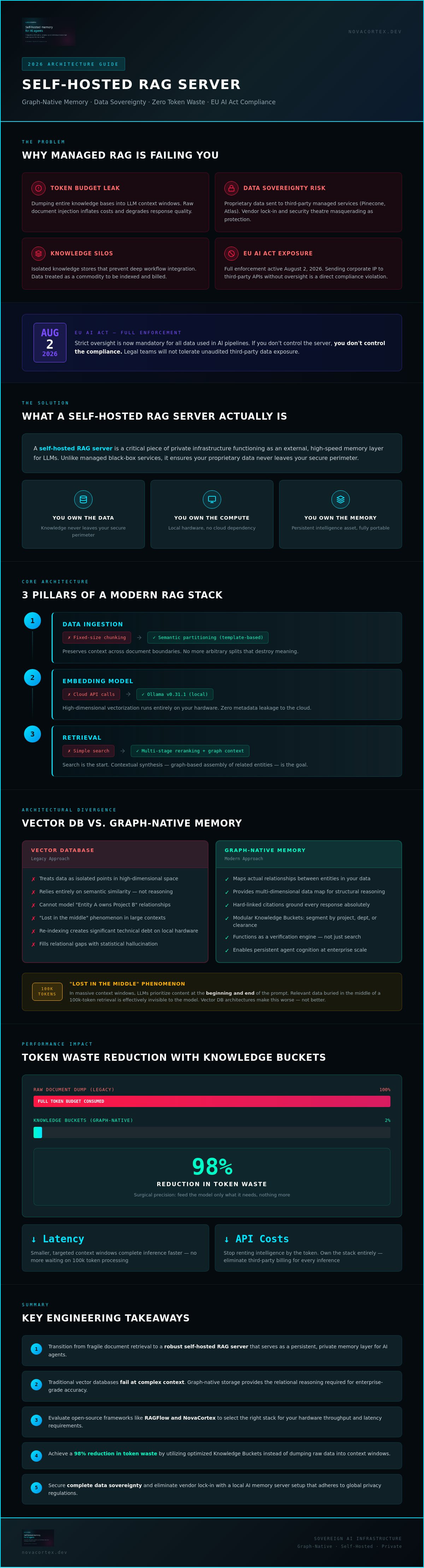
Engineering a private RAG environment requires three pillars. First, data ingestion has evolved. We've replaced primitive fixed-size chunking with template-based, semantic partitioning. This preserves context. Second, the embedding model must live locally. Using tools like Ollama v0.31.1, you can run high-dimensional vectorization without leaking metadata to the cloud. Finally, retrieval has moved past simple "search." It's now about multi-stage reranking and graph-based context assembly. Search is the start. Contextual synthesis is the goal.
Why 2026 Demands Local Knowledge Control
Regulatory pressure is the primary driver for this shift. The EU AI Act, which reached full enforcement on August 2, 2026, mandates strict oversight of data used in AI pipelines. Sending sensitive corporate IP to a third-party API is a compliance nightmare. It's a risk most legal teams won't tolerate. If you don't control the server, you don't control the compliance.
Efficiency is the second driver. Managed AI services suffer from massive token inflation. Dumping raw documents into a massive context window is expensive and slow. A self-hosted RAG server allows for surgical precision. You only feed the model what it needs. This reduces latency and slashes API costs. By owning the stack, you eliminate vendor lock-in and ensure your AI memory is as permanent as your own hardware. You stop renting intelligence and start building it.
Architectural Divergence: Vector DBs vs. Graph-Native Memory
Legacy RAG setups rely on "flat" vector databases. This is a fundamental engineering mistake. These systems treat your data as isolated points in a high-dimensional space, relying entirely on semantic similarity. Similarity is not reasoning. If you're building a self-hosted RAG server, you need more than just "nearness." You need the structural relationships that define your business logic. Vector-only architectures lack the connective tissue required for complex inference.
Vector databases search for keywords and semantic neighbors. They don't understand that "Entity A" owns "Project B" or that "Process C" is a prerequisite for "Result D." This structural blindness leads to hallucinations because the model fills relational gaps with statistical guesswork. Graph-native memory fixes this. It provides a multi-dimensional map of your data. It grounds every response in a hard-linked citation. This isn't just search; it's a verification engine that provides absolute groundedness.
The Limitations of Vector-Only Retrieval
Vector-only systems suffer from the "lost in the middle" phenomenon. In a massive context window, models prioritize the beginning and end of the prompt. Relevant data buried in the middle of a 100k token retrieval often disappears. Maintaining these massive vector indices also creates significant technical debt. The compute required for constant re-indexing is a drain on local hardware. Adhering to strict data sovereignty rules means optimizing this compute, not wasting it on inefficient search patterns that ignore data hierarchy.
Engineering Persistent Cognition with Graph-Native RAG
Graph-native RAG maps the actual relationships between entities. It enables the use of modular Knowledge Buckets. These buckets allow you to segment your memory by project, department, or security clearance without losing the relational links between them. This architecture transforms your self-hosted RAG server from a simple document store into a reasoning engine. It's the natural evolution of the self-hosted AI memory layer.
By treating knowledge as a graph, you give your agents a stable foundation for long-term cognition. You replace probabilistic "best guesses" with deterministic relationship mapping. If you're ready to move beyond flat indices and build a truly sovereign intelligence stack, you can explore the NovaCortex repository to see this architecture in action.
Comparative Analysis: Leading Open-Source RAG Frameworks
Selecting the right framework for a self-hosted RAG server is an exercise in resource allocation. You're balancing parsing depth against infrastructure overhead. A standard RAG architecture often hides hidden costs in the form of massive RAM requirements or complex container orchestration. In 2026, the market has bifurcated. On one side, you have document-heavy processing engines. On the other, you have lean, high-velocity memory layers designed for agentic reasoning. Your choice depends on whether you're indexing a library or engineering a brain.
Deployment models have also diverged. While many frameworks still rely on Docker-heavy stacks that require enterprise-grade clusters, the shift toward lean binary servers is accelerating. Developers are moving away from bloated, restrictive systems. They want digital sovereignty without the technical debt of maintaining a 20-container microservices architecture just to retrieve a single fact. Efficiency is the new benchmark for architectural superiority.
RAGFlow: The Enterprise Heavyweight
RAGFlow is the definitive choice for heterogeneous data. It excels at deep document parsing, handling complex PDFs and spreadsheets with high precision. However, it demands a significant infrastructure tax. You'll need serious RAM and multi-core CPU power to run its document engines effectively. It's an Apache-2.0 licensed powerhouse built for large-scale processing. It's ideal for enterprise clusters but overkill for edge deployment.
Dify: The Orchestration Layer
Dify focuses on the orchestration layer. It provides a UI-driven environment for rapid prototyping and internal tools. While it simplifies workflow automation, that abstraction comes with a loss of architectural control. It's a Docker-heavy stack that prioritizes ease of use over lean performance. It's excellent for teams that need to build agents quickly but don't mind the overhead of a managed-style experience running on local hardware.
NovaCortex: The Lean Memory Standard
NovaCortex represents the evolution of the memory layer. It's built on an MCP-native architecture and utilizes graph-native storage for high-velocity cognition. It avoids the search-only trap of traditional frameworks. By using Knowledge Buckets and the Portable Memory Format (PMF), it provides a zero-bloat deployment path for VPS and local hardware. It's the standard for privacy-first personal memory and high-performance agents. It offers a specialized NovaCortex Self-Hosted Edition for engineers who prioritize speed and relational groundedness over document-parsing bulk.
Hardware requirements vary wildly across these frameworks. RAGFlow requires enterprise-grade specifications. Dify sits in the middle. NovaCortex is designed to run efficiently on everything from a high-performance VPS down to local edge devices. You don't need a data center to achieve data sovereignty. You just need a better architecture.
Deployment Strategies for Private Infrastructure
Engineering a self-hosted RAG server is a discipline, not a configuration fluke. You don't just spin up a container and hope for the best. You build for throughput, low latency, and long-term data residency. Most failures in private AI infrastructure stem from underestimating the hardware overhead or overestimating the efficiency of default configurations. A professional deployment requires a structured approach to hardware selection and software orchestration.
Your first priority is throughput. Evaluate your concurrent user load before selecting silicon. Once the hardware is racked, focus on the AI memory server setup to ensure the context layer responds in milliseconds, not seconds. Interoperability is the next hurdle. By implementing the Model Context Protocol (MCP), you ensure your memory layer can talk to any model without custom glue code. Finally, use Knowledge Buckets to isolate sensitive data sets. This prevents cross-pollination between projects and maintains a clean security perimeter.
Optimizing for Token Efficiency
Token waste is the silent killer of AI performance. Standard RAG architectures often dump massive, irrelevant chunks into the context window, forcing the model to sift through noise. You can reduce token usage by up to 98% by moving to selective, relationship-based retrieval. This is why the portable memory format for AI is essential. It allows you to move your indexed knowledge between systems without re-vectorizing or losing the relational context. Graph-native retrieval minimizes context window bloat by delivering only the exact relational nodes required for an accurate response.
Security and Data Isolation
A shared self-hosted RAG server must handle multi-user access without compromising privacy. You need granular control over who can query specific Knowledge Buckets. Encryption at rest is the baseline. For high-security environments, air-gapped deployment is the only logical choice. This ensures that even if your external network is compromised, your core intelligence remains physically isolated. You aren't just building a database. You're building a fortress for your intellectual property.
Ready to deploy a high-velocity, private memory layer? Get started with the NovaCortex repository to implement these strategies on your own hardware.
NovaCortex: Engineering Sovereign AI Memory
NovaCortex Self-Hosted Edition is the definitive choice for engineers who refuse to compromise on architectural integrity. While traditional RAG implementations treat memory as a sidecar, we treat it as the core engine. By deploying a self-hosted RAG server powered by NovaCortex, you're not just storing data. You're building a persistent, relational knowledge graph that grows with your agents. The system achieves a 98% reduction in token usage compared to standard RAG by replacing brute-force context dumping with surgical node retrieval. You stop paying for noise and start investing in signal.
Transparency is non-negotiable. Our Apache-2.0 open-source core ensures that your infrastructure remains yours. There are no hidden backdoors and no proprietary black boxes. This foundation supports our MCP native memory server, which leverages the Model Context Protocol to provide a standardized interface for any AI agent. This isn't just interoperability. It's a firm rejection of the vendor lock-in that plagues the managed AI market. You own the code, the weights, and the memory.
Beyond Vector Search: The NovaCortex Advantage
Graph-native storage is the primary NovaCortex advantage. We map complex, relational agent memory that vector-only systems simply cannot see. Your data isn't a list of isolated numbers; it's a web of connected facts. Our hardware flexibility is unmatched. You can deploy the stack on a high-performance VPS or a local edge device. The Portable Memory Format (PMF) ensures true data ownership. If you decide to move your infrastructure, your memory moves with you. No re-indexing is required. No data is lost.
Getting Started with NovaCortex Self-Hosted
Deploying the memory layer takes minutes. We've stripped away the bloat to focus on high-velocity performance and lean operations. For enterprise teams, the self-hosted RAG server provides advanced management features to handle multi-tenant Knowledge Buckets and complex security requirements. You get the control of a custom build with the reliability of an engineered standard. It's time to stop renting context from proprietary clouds. Deploy NovaCortex Self-Hosted Edition on your infrastructure today and reclaim your digital sovereignty.
Reclaim Your Digital Sovereignty
Building a self-hosted RAG server is the only logical response to the data harvesting and vendor lock-in of the current AI market. You've seen how legacy vector databases fail to capture the relational nuance of your proprietary data. Engineering a persistent memory layer requires more than just semantic search; it demands a graph-native architecture that treats knowledge as a structured, deterministic asset. By choosing an Apache-2.0 open-source foundation, you ensure that your intelligence remains portable and private.
NovaCortex delivers a 98% reduction in token usage by optimizing retrieval precision. This isn't just about saving money. It's about building a leaner, faster, and more reliable intelligence stack that adheres to the strict data sovereignty requirements of 2026. You now have the architectural blueprint to move past the black-box cloud and start building on your own terms. Your data deserves a fortress, not a silo. It's time to own your compute and your context.
Get started with NovaCortex Self-Hosted Edition and deploy your private memory layer today.
Frequently Asked Questions
Is a vector database the same as a RAG server?
No. A vector database is a specialized storage engine for high-dimensional embeddings. A self-hosted RAG server is the complete orchestration pipeline that manages data ingestion, semantic chunking, retrieval logic, and prompt synthesis. Think of the database as the filing cabinet and the RAG server as the librarian who knows how to extract, verify, and summarize the files for the model.
Can I run a self-hosted RAG server on a Raspberry Pi?
You can run a lean self-hosted RAG server on a Raspberry Pi 5 if you avoid container-heavy frameworks. While enterprise clusters are necessary for massive document parsing, specialized architectures like NovaCortex are designed for high-velocity edge deployment. You won't run a massive LLM locally on a Pi, but you can certainly manage the memory layer and retrieval logic on low-power hardware.
How does a self-hosted RAG server reduce LLM token costs?
It reduces costs by eliminating context window bloat. Instead of dumping 50 pages of raw text into an LLM prompt, a high-performance RAG server retrieves only the specific relational nodes or document chunks required for the answer. This can reduce token usage by up to 98% compared to naive RAG implementations, ensuring you only pay for relevant signal rather than redundant noise.
What is the best open-source RAG framework for privacy?
The best framework is one that permits a fully air-gapped deployment with an Apache-2.0 license. NovaCortex Self-Hosted Edition is engineered specifically for this, providing graph-native memory without the telemetry or cloud dependencies found in many open-core managed services. True privacy requires a stack that doesn't phone home and allows for complete local control over every Knowledge Bucket.
Do I need a GPU to run a RAG server locally?
No, you don't strictly need a GPU to run the retrieval and memory server. Most vector and graph operations are CPU-bound and benefit more from high-speed RAM and NVMe storage. However, if you plan to run local embedding models or a local LLM alongside your RAG server, an NVIDIA GPU with sufficient VRAM is highly recommended to maintain acceptable latency during the inference phase.
How does graph-native RAG differ from traditional vector search?
Vector search identifies semantic neighbors based on mathematical proximity. Graph-native RAG identifies logical relationships. Traditional search might find "Apple" and "iPhone" because they're semantically related, but graph-native memory understands that "Apple" manufactures the "iPhone." This relational groundedness virtually eliminates the hallucinations caused by statistical guesswork, providing a much higher degree of factual accuracy for complex queries.
What is the Model Context Protocol (MCP) and why does it matter for RAG?
The Model Context Protocol (MCP) is an open standard that allows AI models to interact with external data sources through a unified interface. It matters for RAG because it breaks the cycle of custom glue code. By using an MCP-Native Memory Server, you ensure your private knowledge remains compatible with any model that supports the protocol, preventing vendor lock-in and simplifying architectural updates.
How do I migrate my data from a managed RAG service to a self-hosted server?
Migration involves exporting your raw data and relational metadata, then re-indexing it into your local stack. If you use the Portable Memory Format (PMF), this process is significantly faster because it preserves the structural integrity of your knowledge across different environments. Avoid proprietary formats that lock your data into a specific vendor's cloud ecosystem, as they often make extraction difficult and expensive.
FAQ
The Core Components of a Modern RAG Stack
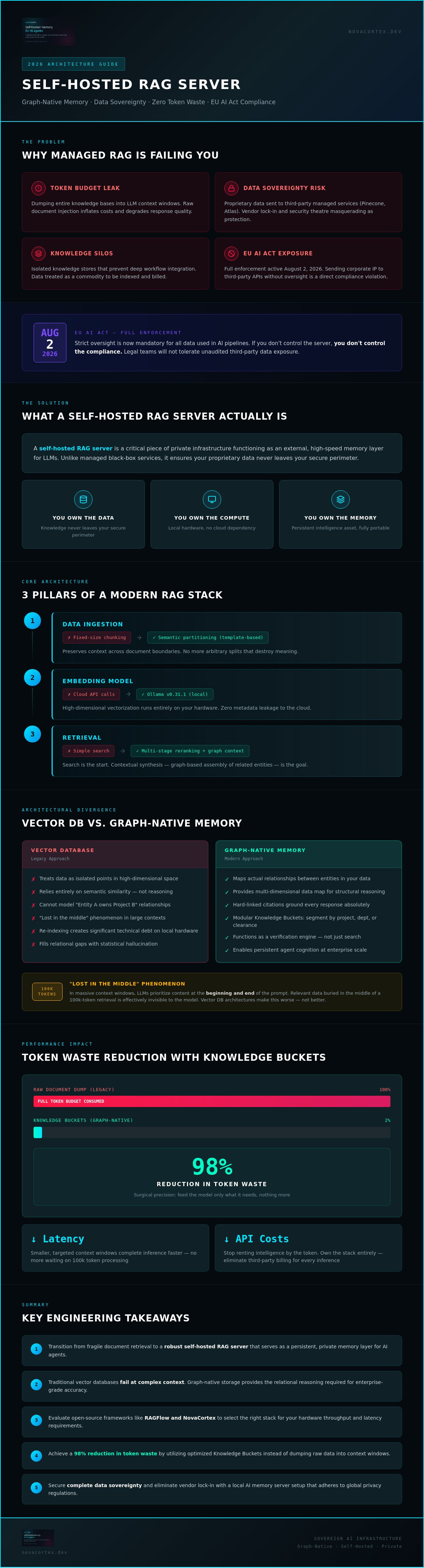
Engineering a private RAG environment requires three pillars. First, data ingestion has evolved. We've replaced primitive fixed-size chunking with template-based, semantic partitioning. This preserves context. Second, the embedding model must live locally. Using tools like Ollama v0.31.1, you can run high-dimensional vectorization without leaking metadata to the cloud. Finally, retrieval has moved past simple "search." It's now about multi-stage reranking and graph-based context assembly. Search is the start. Contextual synthesis is the goal.
Why 2026 Demands Local Knowledge Control
Regulatory pressure is the primary driver for this shift. The EU AI Act, which reached full enforcement on August 2, 2026, mandates strict oversight of data used in AI pipelines. Sending sensitive corporate IP to a third-party API is a compliance nightmare. It's a risk most legal teams won't tolerate. If you don't control the server, you don't control the compliance. Efficiency is the second driver. Managed AI services suffer from massive token inflation. Dumping raw documents into a massive context window is expensive and slow. A self-hosted RAG server allows for surgical precision. You only feed the model what it needs. This reduces latency and slashes API costs. By owning the stack, you eliminate vendor lock-in and ensure your AI memory is as permanent as your own hardware. You stop renting intelligence and start building it. Legacy RAG setups rely on "flat" vector databases. This is a fundamental engineering mistake. These systems treat your data as isolated points in a high-dimensional space, relying entirely on semantic similarity. Similarity is not reasoning. If you're building a self-hosted RAG server, you need more than just "nearness." You need the structural relationships that define your business logic. Vector-only architectures lack the connective tissue required for complex inference. Vector databases search for keywords and semantic neighbors. They don't understand that "Entity A" owns "Project B" or that "Process C" is a prerequisite for "Result D." This structural blindness leads to hallucinations because the model fills relational gaps with statistical guesswork. Graph-native memory fixes this. It provides a multi-dimensional map of your data. It grounds every response in a hard-linked citation. This isn't just search; it's a verification engine that provides absolute groundedness.
The Limitations of Vector-Only Retrieval
Vector-only systems suffer from the "lost in the middle" phenomenon. In a massive context window, models prioritize the beginning and end of the prompt. Relevant data buried in the middle of a 100k token retrieval often disappears. Maintaining these massive vector indices also creates significant technical debt. The compute required for constant re-indexing is a drain on local hardware. Adhering to strict data sovereignty rules means optimizing this compute, not wasting it on inefficient search patterns that ignore data hierarchy.
Engineering Persistent Cognition with Graph-Native RAG
Graph-native RAG maps the actual relationships between entities. It enables the use of modular Knowledge Buckets. These buckets allow you to segment your memory by project, department, or security clearance without losing the relational links between them. This architecture transforms your self-hosted RAG server from a simple document store into a reasoning engine. It's the natural evolution of the self-hosted AI memory layer. By treating knowledge as a graph, you give your agents a stable foundation for long-term cognition. You replace probabilistic "best guesses" with deterministic relationship mapping. If you're ready to move beyond flat indices and build a truly sovereign intelligence stack, you can explore the NovaCortex repository to see this architecture in action. Selecting the right framework for a self-hosted RAG server is an exercise in resource allocation. You're balancing parsing depth against infrastructure overhead. A standard RAG architecture often hides hidden costs in the form of massive RAM requirements or complex container orchestration. In 2026, the market has bifurcated. On one side, you have document-heavy processing engines. On the other, you have lean, high-velocity memory layers designed for agentic reasoning. Your choice depends on whether you're indexing a library or engineering a brain. Deployment models have also diverged. While many frameworks still rely on Docker-heavy stacks that require enterprise-grade clusters, the shift toward lean binary servers is accelerating. Developers are moving away from bloated, restrictive systems. They want digital sovereignty without the technical debt of maintaining a 20-container microservices architecture just to retrieve a single fact. Efficiency is the new benchmark for architectural superiority.
RAGFlow: The Enterprise Heavyweight
RAGFlow is the definitive choice for heterogeneous data. It excels at deep document parsing, handling complex PDFs and spreadsheets with high precision. However, it demands a significant infrastructure tax. You'll need serious RAM and multi-core CPU power to run its document engines effectively. It's an Apache-2.0 licensed powerhouse built for large-scale processing. It's ideal for enterprise clusters but overkill for edge deployment.
Dify: The Orchestration Layer
Dify focuses on the orchestration layer. It provides a UI-driven environment for rapid prototyping and internal tools. While it simplifies workflow automation, that abstraction comes with a loss of architectural control. It's a Docker-heavy stack that prioritizes ease of use over lean performance. It's excellent for teams that need to build agents quickly but don't mind the overhead of a managed-style experience running on local hardware.
NovaCortex: The Lean Memory Standard
NovaCortex represents the evolution of the memory layer. It's built on an MCP-native architecture and utilizes graph-native storage for high-velocity cognition. It avoids the search-only trap of traditional frameworks. By using Knowledge Buckets and the Portable Memory Format (PMF), it provides a zero-bloat deployment path for VPS and local hardware. It's the standard for privacy-first personal memory and high-performance agents. It offers a specialized NovaCortex Self-Hosted Edition for engineers who prioritize speed and relational groundedness over document-parsing bulk. Hardware requirements vary wildly across these frameworks. RAGFlow requires enterprise-grade specifications. Dify sits in the middle. NovaCortex is designed to run efficiently on everything from a high-performance VPS down to local edge devices. You don't need a data center to achieve data sovereignty. You just need a better architecture. Engineering a self-hosted RAG server is a discipline, not a configuration fluke. You don't just spin up a container and hope for the best. You build for throughput, low latency, and long-term data residency. Most failures in private AI infrastructure stem from underestimating the hardware overhead or overestimating the efficiency of default configurations. A professional deployment requires a structured approach to hardware selection and software orchestration. Your first priority is throughput. Evaluate your concurrent user load before selecting silicon. Once the hardware is racked, focus on the AI memory server setup to ensure the context layer responds in milliseconds, not seconds. Interoperability is the next hurdle. By implementing the Model Context Protocol (MCP), you ensure your memory layer can talk to any model without custom glue code. Finally, use Knowledge Buckets to isolate sensitive data sets. This prevents cross-pollination between projects and maintains a clean security perimeter.
Optimizing for Token Efficiency
Token waste is the silent killer of AI performance. Standard RAG architectures often dump massive, irrelevant chunks into the context window, forcing the model to sift through noise. You can reduce token usage by up to 98% by moving to selective, relationship-based retrieval. This is why the portable memory format for AI is essential. It allows you to move your indexed knowledge between systems without re-vectorizing or losing the relational context. Graph-native retrieval minimizes context window bloat by delivering only the exact relational nodes required for an accurate response.
Security and Data Isolation
A shared self-hosted RAG server must handle multi-user access without compromising privacy. You need granular control over who can query specific Knowledge Buckets. Encryption at rest is the baseline. For high-security environments, air-gapped deployment is the only logical choice. This ensures that even if your external network is compromised, your core intelligence remains physically isolated. You aren't just building a database. You're building a fortress for your intellectual property. Ready to deploy a high-velocity, private memory layer? Get started with the NovaCortex repository to implement these strategies on your own hardware. NovaCortex Self-Hosted Edition is the definitive choice for engineers who refuse to compromise on architectural integrity. While traditional RAG implementations treat memory as a sidecar, we treat it as the core engine. By deploying a self-hosted RAG server powered by NovaCortex, you're not just storing data. You're building a persistent, relational knowledge graph that grows with your agents. The system achieves a 98% reduction in token usage compared to standard RAG by replacing brute-force context dumping with surgical node retrieval. You stop paying for noise and start investing in signal. Transparency is non-negotiable. Our Apache-2.0 open-source core ensures that your infrastructure remains yours. There are no hidden backdoors and no proprietary black boxes. This foundation supports our MCP native memory server, which leverages the Model Context Protocol to provide a standardized interface for any AI agent. This isn't just interoperability. It's a firm rejection of the vendor lock-in that plagues the managed AI market. You own the code, the weights, and the memory.
Beyond Vector Search: The NovaCortex Advantage
Graph-native storage is the primary NovaCortex advantage. We map complex, relational agent memory that vector-only systems simply cannot see. Your data isn't a list of isolated numbers; it's a web of connected facts. Our hardware flexibility is unmatched. You can deploy the stack on a high-performance VPS or a local edge device. The Portable Memory Format (PMF) ensures true data ownership. If you decide to move your infrastructure, your memory moves with you. No re-indexing is required. No data is lost.
Getting Started with NovaCortex Self-Hosted
Deploying the memory layer takes minutes. We've stripped away the bloat to focus on high-velocity performance and lean operations. For enterprise teams, the self-hosted RAG server provides advanced management features to handle multi-tenant Knowledge Buckets and complex security requirements. You get the control of a custom build with the reliability of an engineered standard. It's time to stop renting context from proprietary clouds. Deploy NovaCortex Self-Hosted Edition on your infrastructure today and reclaim your digital sovereignty. Building a self-hosted RAG server is the only logical response to the data harvesting and vendor lock-in of the current AI market. You've seen how legacy vector databases fail to capture the relational nuance of your proprietary data. Engineering a persistent memory layer requires more than just semantic search; it demands a graph-native architecture that treats knowledge as a structured, deterministic asset. By choosing an Apache-2.0 open-source foundation, you ensure that your intelligence remains portable and private. NovaCortex delivers a 98% reduction in token usage by optimizing retrieval precision. This isn't just about saving money. It's about building a leaner, faster, and more reliable intelligence stack that adheres to the strict data sovereignty requirements of 2026. You now have the architectural blueprint to move past the black-box cloud and start building on your own terms. Your data deserves a fortress, not a silo. It's time to own your compute and your context. Get started with NovaCortex Self-Hosted Edition and deploy your private memory layer today.
Is a vector database the same as a RAG server?
No. A vector database is a specialized storage engine for high-dimensional embeddings. A self-hosted RAG server is the complete orchestration pipeline that manages data ingestion, semantic chunking, retrieval logic, and prompt synthesis. Think of the database as the filing cabinet and the RAG server as the librarian who knows how to extract, verify, and summarize the files for the model.
Can I run a self-hosted RAG server on a Raspberry Pi?
You can run a lean self-hosted RAG server on a Raspberry Pi 5 if you avoid container-heavy frameworks. While enterprise clusters are necessary for massive document parsing, specialized architectures like NovaCortex are designed for high-velocity edge deployment. You won't run a massive LLM locally on a Pi, but you can certainly manage the memory layer and retrieval logic on low-power hardware.
How does a self-hosted RAG server reduce LLM token costs?
It reduces costs by eliminating context window bloat. Instead of dumping 50 pages of raw text into an LLM prompt, a high-performance RAG server retrieves only the specific relational nodes or document chunks required for the answer. This can reduce token usage by up to 98% compared to naive RAG implementations, ensuring you only pay for relevant signal rather than redundant noise.
What is the best open-source RAG framework for privacy?
The best framework is one that permits a fully air-gapped deployment with an Apache-2.0 license. NovaCortex Self-Hosted Edition is engineered specifically for this, providing graph-native memory without the telemetry or cloud dependencies found in many open-core managed services. True privacy requires a stack that doesn't phone home and allows for complete local control over every Knowledge Bucket.
Do I need a GPU to run a RAG server locally?
No, you don't strictly need a GPU to run the retrieval and memory server. Most vector and graph operations are CPU-bound and benefit more from high-speed RAM and NVMe storage. However, if you plan to run local embedding models or a local LLM alongside your RAG server, an NVIDIA GPU with sufficient VRAM is highly recommended to maintain acceptable latency during the inference phase.
How does graph-native RAG differ from traditional vector search?
Vector search identifies semantic neighbors based on mathematical proximity. Graph-native RAG identifies logical relationships. Traditional search might find "Apple" and "iPhone" because they're semantically related, but graph-native memory understands that "Apple" manufactures the "iPhone." This relational groundedness virtually eliminates the hallucinations caused by statistical guesswork, providing a much higher degree of factual accuracy for complex queries.
What is the Model Context Protocol (MCP) and why does it matter for RAG?
The Model Context Protocol (MCP) is an open standard that allows AI models to interact with external data sources through a unified interface. It matters for RAG because it breaks the cycle of custom glue code. By using an MCP-Native Memory Server, you ensure your private knowledge remains compatible with any model that supports the protocol, preventing vendor lock-in and simplifying architectural updates.
How do I migrate my data from a managed RAG service to a self-hosted server?
Migration involves exporting your raw data and relational metadata, then re-indexing it into your local stack. If you use the Portable Memory Format (PMF), this process is significantly faster because it preserves the structural integrity of your knowledge across different environments. Avoid proprietary formats that lock your data into a specific vendor's cloud ecosystem, as they often make extraction difficult and expensive.