LLM Context Optimization Techniques: A Case Study in 98% Token Reduction

Dumping your entire knowledge base into an LLM context window isn't a strategy. It's an expensive architectural failure. Most developers treat a managed AI memory service as a simple bucket for vector embeddings, but this approach leads to skyrocketing API costs and crippling latency. You are paying to process noise while your agents still suffer from amnesia when relevant context is pruned by overactive filters.
We agree that the current RAG status quo is broken. It forces a false choice between data sovereignty and performance. This case study demonstrates how to reclaim control by slashing token usage by 98% while maintaining total precision. You'll learn how graph-native memory layers and the NovaCortex Self-Hosted Edition outperform traditional retrieval methods through surgical retrieval and Knowledge Buckets. We are moving past the bloat toward a future of lean, high-velocity engineering. This guide breaks down the transition from wasteful vector dumping to a surgical, graph-native memory strategy that secures your data and your budget.
Key Takeaways
- Shift from naive prompt engineering to architectural context engineering to prioritize reasoning precision over bloated, expensive context windows.
- Master the technical distinction between token pruning and compaction to surgically eliminate noise while maintaining the logical flow of agent interactions.
- Deploy a self-hosted managed AI memory service to ensure 100% data sovereignty and eliminate the latency overhead inherent in external API-based RAG.
- Implement modular Knowledge Buckets and the Portable Memory Format (PMF) to enable seamless, cross-environment synchronization of agent intelligence.
- Leverage graph-native memory layers to achieve a 98% reduction in token usage, turning API cost management into a solved engineering problem.
The Architecture of Context: Moving Beyond Naive Prompt Engineering
Prompt engineering has reached its logical limit. Begging a model to "think step-by-step" or tweaking system instructions is a superficial fix for a structural deficiency. We are witnessing a fundamental shift toward architectural context engineering. This discipline moves beyond transient prompt hacks to build persistent, high-precision memory layers that exist outside the model's temporary state. It's the difference between a sticky note and a database.
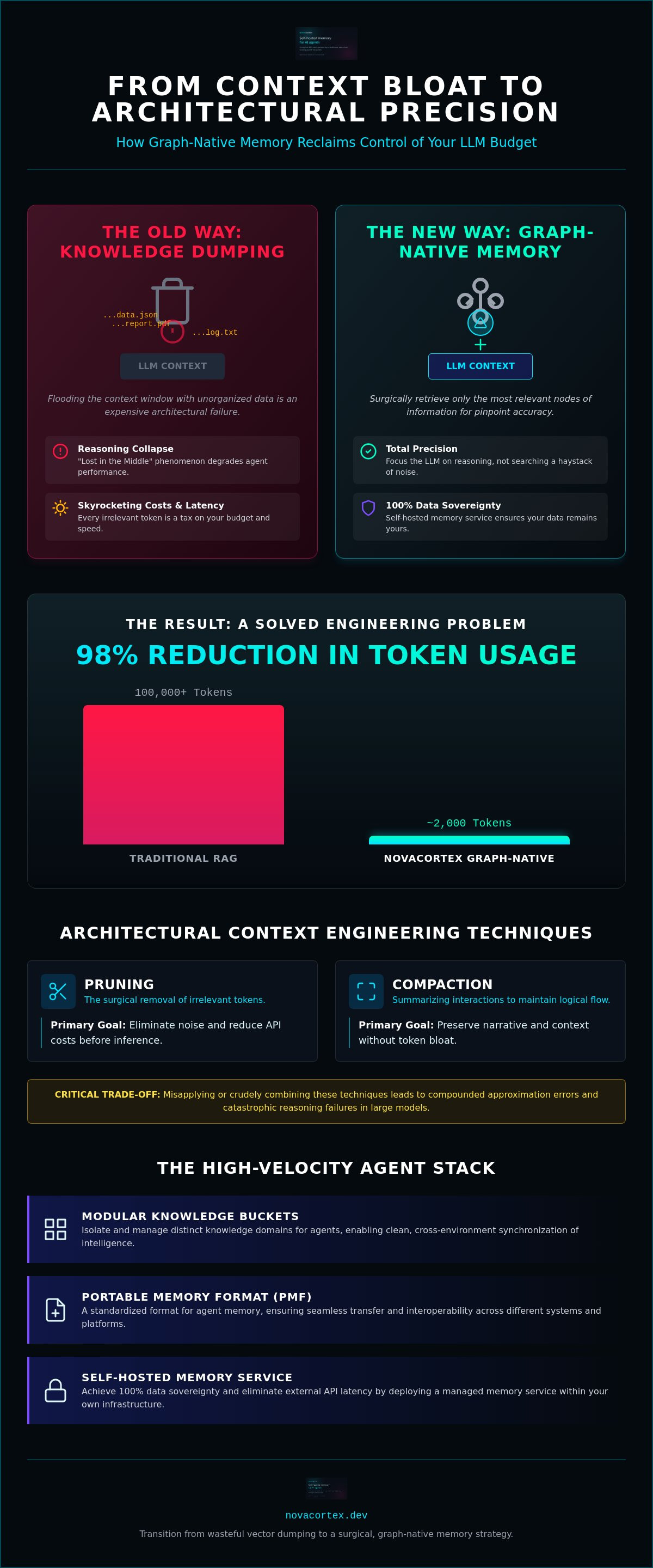
The industry is currently obsessed with the context window. More tokens, more capacity, more noise. This is a fallacy. Expanding the window doesn't necessarily improve intelligence; it often dilutes it. When you flood an LLM with 100,000 tokens of raw, unindexed data, reasoning precision collapses. The model loses the signal. High-performance agents require surgical data retrieval, not a massive, unorganized bucket of text.
The Hidden Cost of Knowledge Dumping
Dumping entire document libraries into a prompt is a technical debt trap. It's lazy engineering. Every irrelevant token sent to an API is a direct tax on your budget and a drag on system latency. The "Lost in the Middle" phenomenon is a documented reality. LLMs frequently fail to retrieve critical facts buried in the center of long-context prompts. You're effectively paying to degrade your agent's performance. To understand why this happens, read our analysis on The Context Window Fallacy: Myth-Busting LLM API Cost Reduction.
Efficiency requires a transition from stateless prompts to persistent, graph-native memory. By utilizing a managed AI memory service, developers can move away from wasteful knowledge dumping. This architectural choice replaces the "dump and pray" method with a structured system that identifies and retrieves only the most relevant nodes of information. The result is a leaner, faster, and more capable agent.
Context Engineering vs. Context Management
Context engineering is the act of curating tokens for a single inference call. Context management is the long-term orchestration of agent state across thousands of interactions. They aren't the same. Effective management requires a dedicated managed AI memory service to handle the cognitive load that usually breaks a standard RAG pipeline. Structured memory reduces the heavy lifting required by the LLM. It allows the model to focus on reasoning rather than searching through a haystack of poorly managed data. We're moving from a world of "more data" to a world of "better structure."
Evaluating LLM Context Optimization Techniques: Pruning vs. Compaction
Optimization is not a single toggle. It is a series of calculated engineering trade-offs. To scale an agent without collapsing your budget, you must choose between pruning and compaction. These aren't just different names for the same process. They represent fundamentally different approaches to managing the information density of your managed AI memory service.
Pruning is the surgical removal of irrelevant tokens before they ever reach the inference engine. It is a cost-saving measure designed to eliminate noise. Compaction, by contrast, involves summarizing previous conversation turns to maintain the logical flow without the associated token bloat. While pruning saves money, compaction saves the narrative. Both are necessary, but misapplying them leads to catastrophic reasoning failures.
For 70B+ parameter models, the risks of token dropping are particularly acute. These larger architectures are highly sensitive to approximation errors. If your optimization logic drops a seemingly minor token that actually holds a critical semantic link, the entire reasoning chain breaks. Quantization adds another layer of risk. Reducing embedding precision saves on memory and compute, but it can also muddy the vector space, making retrieval less accurate. You can't just throw every optimization technique at the wall and hope they stick.
The Risks of Naive Optimization Combinations
Complexity breeds failure. When you stack pruning, quantization, and compaction without a unified architecture, you trigger compounded approximation errors. These errors aren't just minor inaccuracies; they are logic breaks. In long-context question-answering tasks, the precision-recall trade-off becomes a zero-sum game. You might reduce your token count, but you'll do so at the cost of the agent's ability to recall specific facts or follow complex instructions. To see how a unified architecture handles these trade-offs, you can explore our open-source implementation.
When to Use Compaction vs. Note-Taking
Context management requires situational awareness. Use compaction for conversational flow when the agent needs to remember the general vibe of a discussion. It keeps the interaction feeling human without the weight of every past word. Use note-taking for iterative development milestones. Note-taking creates a persistent record of specific decisions or data points that must remain immutable. High-performance agents use a managed AI memory service to switch between these modes dynamically. This ensures that the model always has the right information in the right format at the right time.
Case Study: Achieving 98% Token Reduction via Surgical Memory Layers
Standard RAG is a blunt instrument. In our baseline test, a multi-agent system managing a complex software documentation project averaged 48,000 tokens per request. The system utilized naive vector similarity, pulling the top-20 most similar chunks and dumping them into the context window. This resulted in massive latency and frequent reasoning errors. The model often failed to synthesize information correctly because it was drowning in irrelevant noise. The intervention was a shift in architecture: we replaced the flat vector store with NovaCortex Knowledge Buckets.
Knowledge Buckets enable surgical retrieval. Instead of pulling a broad, unrefined chunk of text, the system identifies specific relational nodes. By implementing a graph-native managed AI memory service, the agent only receives the exact data points required for the current task. The results were undeniable. Token consumption dropped to an average of 960 tokens per request. That represents a 98% reduction in overhead without sacrificing a single relevant fact. Precision increased because the model was no longer forced to filter out the "knowledge dumping" debris we identified in section one.
Graph-native storage identifies the minimum viable context. It recognizes that data points don't exist in a vacuum; they exist in a web of dependencies. When the agent queries a specific project blocker, the system doesn't just return a keyword match. It returns the entire relevant branch of the knowledge graph. This precision slashes processing time. It eliminates the context bloat that typically kills agent performance in high-stakes environments.
Vector RAG vs. Graph-Native Memory
Vector search is insufficient for multi-step reasoning. It finds keywords but ignores logic. Graph-native memory retrieves the underlying relationships that drive agent decision-making. This is the core of The Self-Hosted AI Memory Layer: Engineering Persistent Agent Cognition. By moving from proximity-based search to relationship-based retrieval, you ensure the LLM receives a curated, high-density prompt every time. You aren't just searching for data; you are providing the agent with a structured map of reality.
Calculating the ROI of Context Optimization
The financial shift is dramatic. In this case study, monthly API costs dropped from approximately $1,000 to just $20. This wasn't achieved by switching to a smaller, less capable model. It was achieved by sending 98% fewer tokens to the same high-tier model. Beyond the direct savings, the reduction in time-to-first-token was measurable. Smaller prompts process faster. By minimizing context processing overhead, you aren't just saving money; you are building a more responsive, lower-latency agent that outperforms bloated, legacy RAG systems.
Implementing Modular Knowledge Buckets for High-Velocity Agents
Theory is cheap. Implementation is where architectural debt is either paid or compounded. To replicate the 98% token reduction seen in our case study, you must move from a monolithic vector store to a modular, bucketed architecture. This transition turns your managed AI memory service into a precision-guided intelligence asset. It requires a shift from passive storage to active, domain-aware memory management.
- Step 1: Segmenting Knowledge. Divide your data into domain-specific Knowledge Buckets. An agent handling legal compliance shouldn't be parsing marketing embeddings. Segmenting by task reduces the search space and eliminates irrelevant noise before it ever reaches the prompt.
- Step 2: Implementing PMF. Use the Portable Memory Format (PMF) to ensure your data remains model-agnostic. This ensures that your agent’s long-term intelligence isn't trapped within a single provider's proprietary ecosystem.
- Step 3: Deploying MCP-Native Servers. Utilize an MCP-Native Memory Server to minimize the distance between your agent and its context. High-velocity agents require low-latency fetching that standard API-based RAG cannot provide.
- Step 4: Automating State Sync. Configure automated state synchronization. In multi-agent workflows, every agent must have access to the shared state in real-time to prevent redundant processing and logic loops.
Surgical Retrieval via Knowledge Buckets
Knowledge Buckets aren't just folders. They are security and performance boundaries. By defining bucket boundaries based on specific agent tasks and security tiers, you prevent "Knowledge Bleed." This is a common failure where an agent accidentally retrieves sensitive or irrelevant data from an unrelated sub-task. Surgical retrieval ensures that the context provided to the LLM is both secure and highly relevant. If you're ready to build this, you can deploy the NovaCortex core now to start segmenting your agent memory.
Ending Vendor Lock-in with Portable Memory
A multi-model world is already here. Relying on a memory layer tied to a specific LLM provider is a strategic mistake. The importance of a portable memory format cannot be overstated. It gives you the freedom to swap models as performance or pricing shifts without losing years of agent training and interaction history. Read more on why this is critical in our guide to the Portable Memory Format for AI: Breaking the Vendor Lock-in Cycle. Your managed AI memory service should be the foundation of your sovereignty, not a cage.
The Managed AI Memory Service Alternative: Sovereign Context Optimization
Cloud-only infrastructure is a strategic vulnerability. Most vendors pitch a managed AI memory service as a black box that requires you to ship your most sensitive data to their servers. This model forces a trade-off between intelligence and security. We reject that compromise. Digital sovereignty is not a luxury; it is an architectural requirement for any enterprise-grade agent. Moving your memory layer to a self-hosted environment ensures that your data remains under your control while your agents maintain their high-velocity performance. For enterprises building these sovereign systems, you can learn more about eCircles LLC to access the high-performance GPU infrastructure required for high-velocity AI and HPC workloads.
Optimizing on the edge is the logical progression for lean engineering. By running the NovaCortex Self-Hosted Edition on a private VPS, local server, or even a Raspberry Pi, you eliminate the latency of external API round trips. You aren't just saving on token costs; you're securing your intellectual property. Your knowledge base stays local. Your agent stays intelligent. This is the only way to achieve 100% data sovereignty without sacrificing the precision of a graph-native memory layer.
Deploying NovaCortex for Private Optimization
The transition from a cloud-dependent prototype to an enterprise-ready memory server requires a modular approach. The NovaCortex architecture is designed for this specific evolution. It allows you to scale from single-agent experiments to massive, multi-agent knowledge networks without changing your underlying data structure. By managing your own memory server, you gain direct visibility into how your Knowledge Buckets are being utilized. You control the pruning. You control the compaction. You own the results.
Standardizing Memory Interoperability with MCP
Future-proofing your architecture requires more than just self-hosting. It requires standardization. The Model Context Protocol (MCP) provides the necessary framework to ensure your memory layer remains interoperable across different models and environments. Our MCP Native Memory Server: Engineering Persistent Context for AI Agents acts as the bridge between your private data and any LLM you choose to deploy. It ensures that your memory layer is a permanent asset rather than a temporary cloud service dependency.
The future of AI is lean, private, and graph-native. We have demonstrated that a 98% reduction in token usage is not just possible; it is the inevitable outcome of superior engineering. By moving away from bloated vector dumping and embracing surgical, sovereign memory management, you build agents that are faster, cheaper, and fundamentally more secure. The era of wasteful context is over. The era of architectural precision has begun.
Reclaim Your Architectural Sovereignty
The era of bloated context windows and runaway API costs is a choice, not a technical necessity. We have demonstrated that moving from naive knowledge dumping to a graph-native managed AI memory service fundamentally transforms agent performance. By utilizing Knowledge Buckets and the Portable Memory Format, you eliminate the noise that degrades reasoning precision. You don't just save tokens; you secure your data sovereignty. This architecture ensures your agents remain intelligent across any model or environment without the risk of vendor lock-in.
Engineering high-velocity agents requires a shift toward lean, structured architectures. We have benchmarked a 98% token reduction using these surgical retrieval techniques. This isn't just theory. It is a necessary correction to current industry inefficiencies. You can now implement these same patterns using our open-source Apache-2.0 core. It is time to stop paying for noise and start building for architectural precision. Your agents deserve a memory layer as capable as their reasoning engines.
Access the NovaCortex Open Source Repository on GitHub to deploy an MCP-native memory server today. Build something faster. Build something sovereign. Your infrastructure is ready for the upgrade.
Frequently Asked Questions
What is the difference between context engineering and prompt engineering?
Prompt engineering focuses on tweaking the linguistic instructions sent to a model; context engineering architectures the persistent data flow that feeds those instructions. Prompting is a superficial fix for the stateless nature of LLMs. Context engineering builds structured, graph-native memory layers that ensure the model only receives the highest-density information required for specific reasoning tasks.
How does graph-native storage reduce token usage compared to vector databases?
Graph-native storage retrieves exact relational nodes instead of broad, fuzzy semantic chunks. Vector databases often flood the context window with irrelevant "neighbor" tokens that happen to be mathematically similar but logically useless. By identifying specific dependencies within a graph, NovaCortex achieves the 98% token reduction benchmarked in our case studies by eliminating this vector noise.
Can I use NovaCortex with existing LLMs like GPT-4 or Claude?
NovaCortex is model-agnostic and integrates with any major LLM via standard API protocols. It functions as an external, sovereign memory layer that pre-processes and optimizes context before it reaches your chosen provider. This configuration allows you to maintain a high-performance managed AI memory service while leveraging the reasoning capabilities of top-tier models like GPT-4 or Claude.
What is the Portable Memory Format (PMF) and why does it matter for optimization?
The Portable Memory Format (PMF) is a standardized data structure that decouples agent intelligence from specific model providers. It ensures that your agent’s long-term memory remains interoperable across different environments and architectures. PMF optimizes context by recording state transitions in a lean format, which prevents redundant token processing and ends the cycle of vendor lock-in.
How much can I realistically save on LLM API costs with these techniques?
You can realistically reduce your LLM API costs by up to 98% depending on the complexity of your RAG pipeline. These savings are achieved by moving away from "knowledge dumping" and toward surgical retrieval. By sending significantly fewer tokens to the model for each inference call, you slash consumption costs while simultaneously improving the precision of the agent's output.
Does self-hosting a memory layer increase latency for my AI agents?
Self-hosting reduces latency by eliminating the round-trip overhead of external cloud-to-cloud API calls. Running the NovaCortex Self-Hosted Edition on your own VPS or local server puts the memory layer in close proximity to your application logic. This architectural choice provides faster context fetching than relying on a third-party managed AI memory service hosted in a remote data center.
What are Knowledge Buckets and how do they improve agent state management?
Knowledge Buckets are modular memory segments that define clear domain and security boundaries for an agent. They improve state management by preventing "Knowledge Bleed," where an agent retrieves irrelevant data from unrelated tasks. This modularity allows you to swap, update, or isolate specific memory sets without the need to re-index your entire knowledge base.
How does an MCP-native memory server improve context retrieval speed?
An MCP-native memory server utilizes the Model Context Protocol to standardize communication between the agent and the memory layer. This eliminates the need for heavy, custom middleware that typically adds processing time to every request. By providing a direct and standardized path for data retrieval, MCP-native architectures significantly reduce time-to-first-token for complex, multi-step queries.
FAQ
The Hidden Cost of Knowledge Dumping
Dumping entire document libraries into a prompt is a technical debt trap. It's lazy engineering. Every irrelevant token sent to an API is a direct tax on your budget and a drag on system latency. The "Lost in the Middle" phenomenon is a documented reality. LLMs frequently fail to retrieve critical facts buried in the center of long-context prompts. You're effectively paying to degrade your agent's performance. To understand why this happens, read our analysis on The Context Window Fallacy: Myth-Busting LLM API Cost Reduction. Efficiency requires a transition from stateless prompts to persistent, graph-native memory. By utilizing a managed AI memory service, developers can move away from wasteful knowledge dumping. This architectural choice replaces the "dump and pray" method with a structured system that identifies and retrieves only the most relevant nodes of information. The result is a leaner, faster, and more capable agent.
Context Engineering vs. Context Management
Context engineering is the act of curating tokens for a single inference call. Context management is the long-term orchestration of agent state across thousands of interactions. They aren't the same. Effective management requires a dedicated managed AI memory service to handle the cognitive load that usually breaks a standard RAG pipeline. Structured memory reduces the heavy lifting required by the LLM. It allows the model to focus on reasoning rather than searching through a haystack of poorly managed data. We're moving from a world of "more data" to a world of "better structure." Optimization is not a single toggle. It is a series of calculated engineering trade-offs. To scale an agent without collapsing your budget, you must choose between pruning and compaction. These aren't just different names for the same process. They represent fundamentally different approaches to managing the information density of your managed AI memory service. Pruning is the surgical removal of irrelevant tokens before they ever reach the inference engine. It is a cost-saving measure designed to eliminate noise. Compaction, by contrast, involves summarizing previous conversation turns to maintain the logical flow without the associated token bloat. While pruning saves money, compaction saves the narrative. Both are necessary, but misapplying them leads to catastrophic reasoning failures. For 70B+ parameter models, the risks of token dropping are particularly acute. These larger architectures are highly sensitive to approximation errors. If your optimization logic drops a seemingly minor token that actually holds a critical semantic link, the entire reasoning chain breaks. Quantization adds another layer of risk. Reducing embedding precision saves on memory and compute, but it can also muddy the vector space, making retrieval less accurate. You can't just throw every optimization technique at the wall and hope they stick.
The Risks of Naive Optimization Combinations
Complexity breeds failure. When you stack pruning, quantization, and compaction without a unified architecture, you trigger compounded approximation errors. These errors aren't just minor inaccuracies; they are logic breaks. In long-context question-answering tasks, the precision-recall trade-off becomes a zero-sum game. You might reduce your token count, but you'll do so at the cost of the agent's ability to recall specific facts or follow complex instructions. To see how a unified architecture handles these trade-offs, you can explore our open-source implementation.
When to Use Compaction vs. Note-Taking
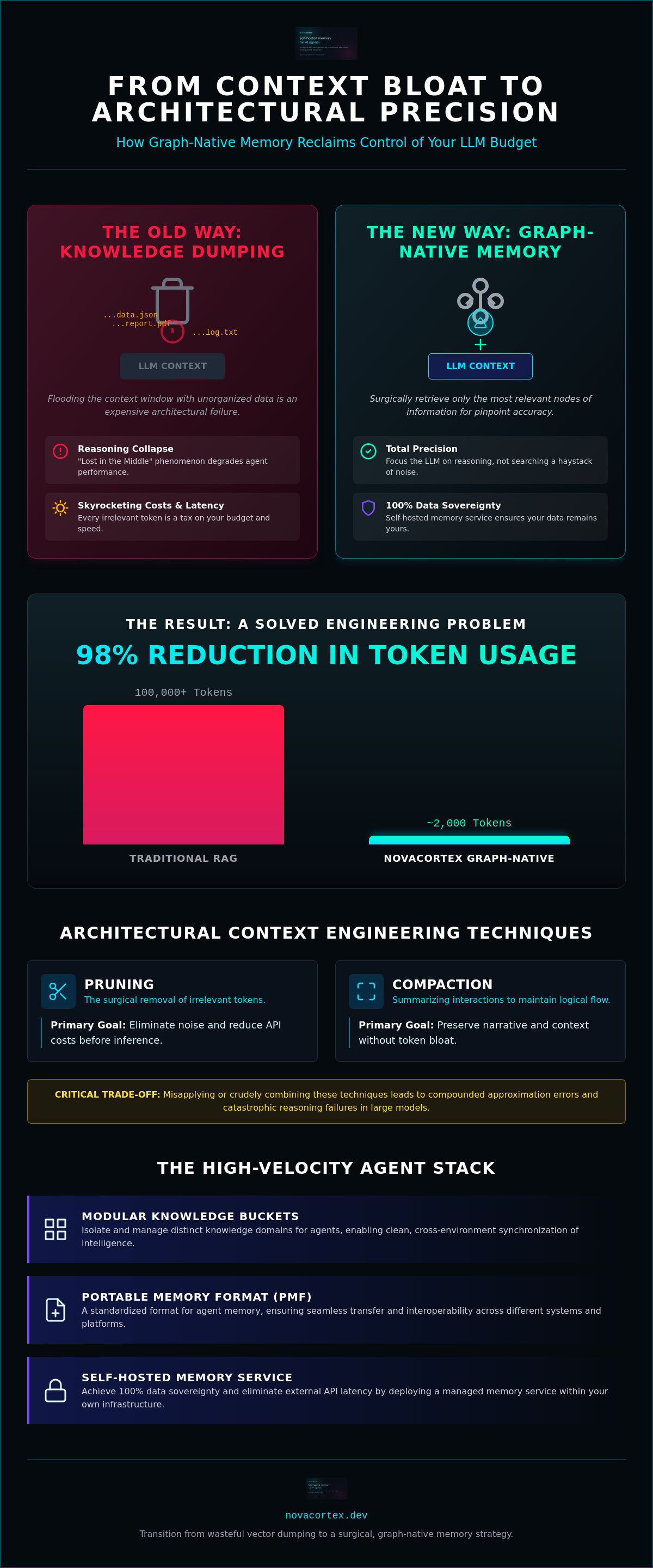
Context management requires situational awareness. Use compaction for conversational flow when the agent needs to remember the general vibe of a discussion. It keeps the interaction feeling human without the weight of every past word. Use note-taking for iterative development milestones. Note-taking creates a persistent record of specific decisions or data points that must remain immutable. High-performance agents use a managed AI memory service to switch between these modes dynamically. This ensures that the model always has the right information in the right format at the right time. Standard RAG is a blunt instrument. In our baseline test, a multi-agent system managing a complex software documentation project averaged 48,000 tokens per request. The system utilized naive vector similarity, pulling the top-20 most similar chunks and dumping them into the context window. This resulted in massive latency and frequent reasoning errors. The model often failed to synthesize information correctly because it was drowning in irrelevant noise. The intervention was a shift in architecture: we replaced the flat vector store with NovaCortex Knowledge Buckets. Knowledge Buckets enable surgical retrieval. Instead of pulling a broad, unrefined chunk of text, the system identifies specific relational nodes. By implementing a graph-native managed AI memory service, the agent only receives the exact data points required for the current task. The results were undeniable. Token consumption dropped to an average of 960 tokens per request. That represents a 98% reduction in overhead without sacrificing a single relevant fact. Precision increased because the model was no longer forced to filter out the "knowledge dumping" debris we identified in section one. Graph-native storage identifies the minimum viable context. It recognizes that data points don't exist in a vacuum; they exist in a web of dependencies. When the agent queries a specific project blocker, the system doesn't just return a keyword match. It returns the entire relevant branch of the knowledge graph. This precision slashes processing time. It eliminates the context bloat that typically kills agent performance in high-stakes environments.
Vector RAG vs. Graph-Native Memory
Vector search is insufficient for multi-step reasoning. It finds keywords but ignores logic. Graph-native memory retrieves the underlying relationships that drive agent decision-making. This is the core of The Self-Hosted AI Memory Layer: Engineering Persistent Agent Cognition. By moving from proximity-based search to relationship-based retrieval, you ensure the LLM receives a curated, high-density prompt every time. You aren't just searching for data; you are providing the agent with a structured map of reality.
Calculating the ROI of Context Optimization
The financial shift is dramatic. In this case study, monthly API costs dropped from approximately $1,000 to just $20. This wasn't achieved by switching to a smaller, less capable model. It was achieved by sending 98% fewer tokens to the same high-tier model. Beyond the direct savings, the reduction in time-to-first-token was measurable. Smaller prompts process faster. By minimizing context processing overhead, you aren't just saving money; you are building a more responsive, lower-latency agent that outperforms bloated, legacy RAG systems. Theory is cheap. Implementation is where architectural debt is either paid or compounded. To replicate the 98% token reduction seen in our case study, you must move from a monolithic vector store to a modular, bucketed architecture. This transition turns your managed AI memory service into a precision-guided intelligence asset. It requires a shift from passive storage to active, domain-aware memory management.
Surgical Retrieval via Knowledge Buckets
Knowledge Buckets aren't just folders. They are security and performance boundaries. By defining bucket boundaries based on specific agent tasks and security tiers, you prevent "Knowledge Bleed." This is a common failure where an agent accidentally retrieves sensitive or irrelevant data from an unrelated sub-task. Surgical retrieval ensures that the context provided to the LLM is both secure and highly relevant. If you're ready to build this, you can deploy the NovaCortex core now to start segmenting your agent memory.
Ending Vendor Lock-in with Portable Memory
A multi-model world is already here. Relying on a memory layer tied to a specific LLM provider is a strategic mistake. The importance of a portable memory format cannot be overstated. It gives you the freedom to swap models as performance or pricing shifts without losing years of agent training and interaction history. Read more on why this is critical in our guide to the Portable Memory Format for AI: Breaking the Vendor Lock-in Cycle. Your managed AI memory service should be the foundation of your sovereignty, not a cage. Cloud-only infrastructure is a strategic vulnerability. Most vendors pitch a managed AI memory service as a black box that requires you to ship your most sensitive data to their servers. This model forces a trade-off between intelligence and security. We reject that compromise. Digital sovereignty is not a luxury; it is an architectural requirement for any enterprise-grade agent. Moving your memory layer to a self-hosted environment ensures that your data remains under your control while your agents maintain their high-velocity performance. Optimizing on the edge is the logical progression for lean engineering. By running the NovaCortex Self-Hosted Edition on a private VPS, local server, or even a Raspberry Pi, you eliminate the latency of external API round trips. You aren't just saving on token costs; you're securing your intellectual property. Your knowledge base stays local. Your agent stays intelligent. This is the only way to achieve 100% data sovereignty without sacrificing the precision of a graph-native memory layer.
Deploying NovaCortex for Private Optimization
The transition from a cloud-dependent prototype to an enterprise-ready memory server requires a modular approach. The NovaCortex architecture is designed for this specific evolution. It allows you to scale from single-agent experiments to massive, multi-agent knowledge networks without changing your underlying data structure. By managing your own memory server, you gain direct visibility into how your Knowledge Buckets are being utilized. You control the pruning. You control the compaction. You own the results.
Standardizing Memory Interoperability with MCP
Future-proofing your architecture requires more than just self-hosting. It requires standardization. The Model Context Protocol (MCP) provides the necessary framework to ensure your memory layer remains interoperable across different models and environments. Our MCP Native Memory Server: Engineering Persistent Context for AI Agents acts as the bridge between your private data and any LLM you choose to deploy. It ensures that your memory layer is a permanent asset rather than a temporary cloud service dependency. The future of AI is lean, private, and graph-native. We have demonstrated that a 98% reduction in token usage is not just possible; it is the inevitable outcome of superior engineering. By moving away from bloated vector dumping and embracing surgical, sovereign memory management, you build agents that are faster, cheaper, and fundamentally more secure. The era of wasteful context is over. The era of architectural precision has begun. The era of bloated context windows and runaway API costs is a choice, not a technical necessity. We have demonstrated that moving from naive knowledge dumping to a graph-native managed AI memory service fundamentally transforms agent performance. By utilizing Knowledge Buckets and the Portable Memory Format, you eliminate the noise that degrades reasoning precision. You don't just save tokens; you secure your data sovereignty. This architecture ensures your agents remain intelligent across any model or environment without the risk of vendor lock-in. Engineering high-velocity agents requires a shift toward lean, structured architectures. We have benchmarked a 98% token reduction using these surgical retrieval techniques. This isn't just theory. It is a necessary correction to current industry inefficiencies. You can now implement these same patterns using our open-source Apache-2.0 core. It is time to stop paying for noise and start building for architectural precision. Your agents deserve a memory layer as capable as their reasoning engines. Access the NovaCortex Open Source Repository on GitHub to deploy an MCP-native memory server today. Build something faster. Build something sovereign. Your infrastructure is ready for the upgrade.
What is the difference between context engineering and prompt engineering?
Prompt engineering focuses on tweaking the linguistic instructions sent to a model; context engineering architectures the persistent data flow that feeds those instructions. Prompting is a superficial fix for the stateless nature of LLMs. Context engineering builds structured, graph-native memory layers that ensure the model only receives the highest-density information required for specific reasoning tasks.
How does graph-native storage reduce token usage compared to vector databases?
Graph-native storage retrieves exact relational nodes instead of broad, fuzzy semantic chunks. Vector databases often flood the context window with irrelevant "neighbor" tokens that happen to be mathematically similar but logically useless. By identifying specific dependencies within a graph, NovaCortex achieves the 98% token reduction benchmarked in our case studies by eliminating this vector noise.
Can I use NovaCortex with existing LLMs like GPT-4 or Claude?
NovaCortex is model-agnostic and integrates with any major LLM via standard API protocols. It functions as an external, sovereign memory layer that pre-processes and optimizes context before it reaches your chosen provider. This configuration allows you to maintain a high-performance managed AI memory service while leveraging the reasoning capabilities of top-tier models like GPT-4 or Claude.
What is the Portable Memory Format (PMF) and why does it matter for optimization?
The Portable Memory Format (PMF) is a standardized data structure that decouples agent intelligence from specific model providers. It ensures that your agent’s long-term memory remains interoperable across different environments and architectures. PMF optimizes context by recording state transitions in a lean format, which prevents redundant token processing and ends the cycle of vendor lock-in.
How much can I realistically save on LLM API costs with these techniques?
You can realistically reduce your LLM API costs by up to 98% depending on the complexity of your RAG pipeline. These savings are achieved by moving away from "knowledge dumping" and toward surgical retrieval. By sending significantly fewer tokens to the model for each inference call, you slash consumption costs while simultaneously improving the precision of the agent's output.
Does self-hosting a memory layer increase latency for my AI agents?
Self-hosting reduces latency by eliminating the round-trip overhead of external cloud-to-cloud API calls. Running the NovaCortex Self-Hosted Edition on your own VPS or local server puts the memory layer in close proximity to your application logic. This architectural choice provides faster context fetching than relying on a third-party managed AI memory service hosted in a remote data center.
What are Knowledge Buckets and how do they improve agent state management?
Knowledge Buckets are modular memory segments that define clear domain and security boundaries for an agent. They improve state management by preventing "Knowledge Bleed," where an agent retrieves irrelevant data from unrelated tasks. This modularity allows you to swap, update, or isolate specific memory sets without the need to re-index your entire knowledge base.
How does an MCP-native memory server improve context retrieval speed?
An MCP-native memory server utilizes the Model Context Protocol to standardize communication between the agent and the memory layer. This eliminates the need for heavy, custom middleware that typically adds processing time to every request. By providing a direct and standardized path for data retrieval, MCP-native architectures significantly reduce time-to-first-token for complex, multi-step queries.