Redis vs Graph Memory for AI Agents: Engineering Token-Efficient Context
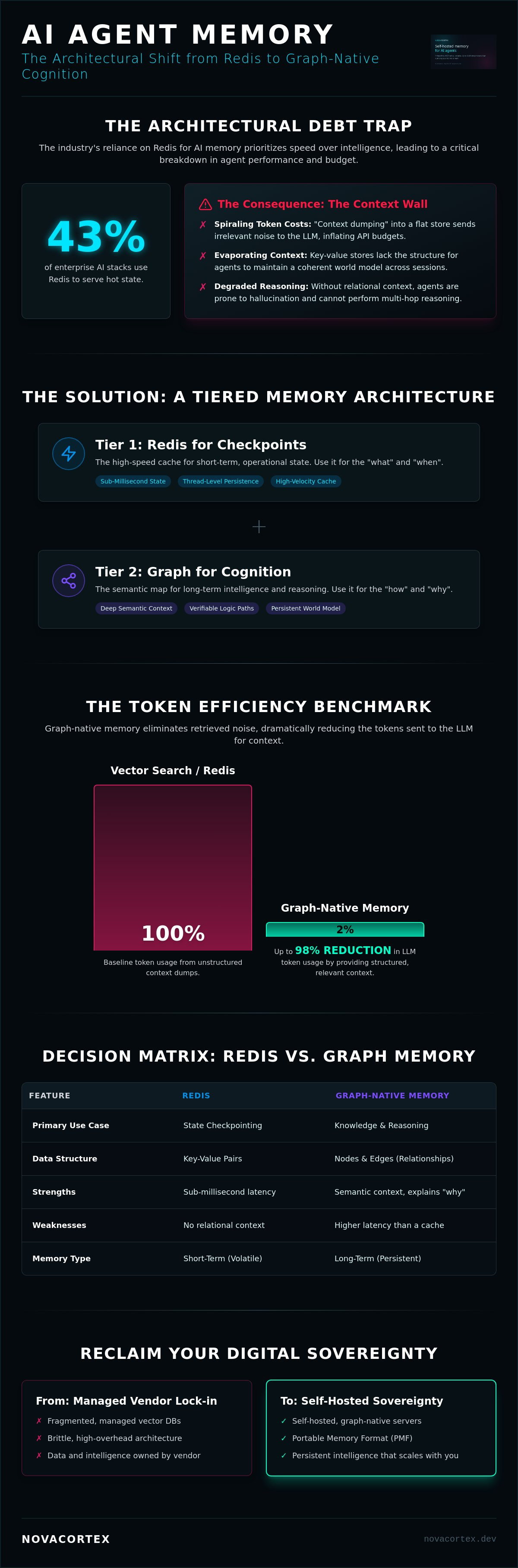
The industry's reliance on Redis for AI agent memory is an architectural debt trap that prioritizes raw speed over actual intelligence. While 43% of enterprise AI stacks use Redis to serve hot state, most developers eventually hit a wall where token costs spiral and context evaporates. The debate over Redis vs graph memory for AI agents isn't just about latency; it's about whether your agent can maintain a coherent world model across sessions without bankrupting your API budget.
Managing long-running threads shouldn't feel like a losing battle against shrinking context windows. You need a memory layer that scales semantically, not just linearly. This guide demonstrates how transitioning to graph-native memory can reduce your LLM token usage by up to 98% while ensuring 100% data sovereignty. We'll examine the structural failures of key-value stores for complex reasoning and explain why a Portable Memory Format (PMF) is the only way to escape vendor lock-in and build agents that truly remember.
Key Takeaways
- Define the architectural split: utilize Redis for sub-millisecond thread checkpointing and graph-native memory for deep semantic cognition.
- Expose the "Context Window Fallacy" to eliminate the retrieved noise that inflates LLM token usage and degrades agent reasoning.
- Evaluate the technical decision matrix for Redis vs graph memory for AI agents to determine which infrastructure best supports your data complexity and access patterns.
- Reclaim digital sovereignty by transitioning from managed vector databases to self-hosted, MCP-native memory servers.
- Leverage Knowledge Buckets and the Portable Memory Format to build persistent agent intelligence that scales across sessions without vendor lock-in.
The State of Agent Memory: Beyond Simple Key-Value Pairs
LLMs are fundamentally stateless. They process inputs in isolation; forgetting everything the moment the token generation stops. To evolve into a functional intelligent agent, a system requires a dedicated, persistent memory layer that exists outside the model's weights. The current industry standard involves dumping raw chat logs into a vector database or a key-value store like Redis. This is a legacy approach. It treats memory as a landfill rather than a library. The friction between real-time performance and deep semantic retrieval is where most agentic workflows break down. You can't build a sophisticated autonomous system on fragmented, unstructured data dumps.
The debate over Redis vs graph memory for AI agents often misses the point of architectural specialization. Redis is a high-speed cache for state; graph memory is a semantic map for intelligence. Redis serves as an exceptional state store, handling sub-millisecond checkpoints for active threads. However, it lacks the structural depth to act as a knowledge layer. When you "context dump" into a flat store, you're paying for noise. Every irrelevant token sent to the LLM increases latency and drains your budget. Efficiency requires pruning, not just persistence. We need systems that understand how data points connect, not just where they are stored. Without this relational context, agents remain expensive, forgetful, and prone to hallucination.
The Short-Term vs. Long-Term Memory Divide
Memory isn't monolithic. Short-term memory handles thread-level persistence, ensuring an agent doesn't lose the plot mid-conversation. Long-term memory involves cross-thread retrieval and learned preferences. While vector search facilitates RAG, it only provides semantic similarity. It can tell you things are related but can't explain the relationship. This is the gap graph-native memory fills; providing the structure needed for complex reasoning across sessions.
Why Traditional Databases Fail AI Agents
Relational schemas are too rigid for fluid agent knowledge. You can't predict every entity an agent will discover. Conversely, vector databases are black boxes; they lack the relational context needed to answer "why" or "how" questions. Stitching fragmented systems together creates massive architectural overhead. The result is a brittle system that loses context and locks you into managed vendors. Agents need a unified, flexible knowledge format that scales without losing the relational "connective tissue" of the data.
Redis for Checkpoints, Graph for Cognition: An Architectural Framework
Engineering a robust memory stack requires moving past the idea that databases are interchangeable. They aren't. In the context of Redis vs graph memory for AI agents, the distinction lies in the utility of the data stored. Redis is built for high-velocity state management. It handles sub-millisecond checkpointing for active agent threads, ensuring that if a process restarts, the agent knows exactly where it left off. It's the "scratchpad" of the AI stack. However, as thread history grows, Redis becomes a liability. Key-value stores lack the structural hierarchy to distinguish between a core fact and a transient conversational filler.
The architecture of AI agent memory requires a tiered approach: use Redis for the "what" and graph memory for the "how." Graph memory maps relationships that vector search and key-value stores miss entirely. While 43% of enterprise AI stacks currently use Redis to serve hot operational state, these systems often struggle with multi-hop reasoning. A graph-native layer prevents hallucinations by providing a verifiable path of logic through nodes and edges. It transforms a list of past interactions into a structured world model. To see how these layers integrate into a unified system, you can explore the implementation details in the NovaCortex repository.
Redis: The High-Velocity State Store
Redis excels at managing thread-level short-term memory. When an agent is in the middle of a complex task, low-latency read/writes are the only metric that matters. Checkpointing session state in Redis allows for near-instant recovery. The limitation is the decay of relevance. In a massive key-value store, retrieving the right context from a month ago is computationally expensive and semantically imprecise. Redis tells you what happened; it doesn't tell you why it matters in the broader context of the agent's mission.
Graph Memory: The Cognitive Map
Graph memory represents knowledge as a web of interconnected entities. This is essential for autonomous agent frameworks that need to perform complex reasoning across multiple sessions. Moving beyond semantic similarity, graph-native storage allows agents to understand semantic relationships. An agent using a graph can identify that "Project A" is related to "Client B" because of a specific "Contract C," even if those terms never appear in the same vector cluster. This structural persistence is what allows for the creation of Knowledge Buckets that scale without the bloat of traditional context dumping.
The Token Efficiency Benchmark: Why Graphs Beat Vector Search
The "Context Window Fallacy" is a primary driver of architectural waste in modern AI systems. Developers often assume that larger context windows solve the memory problem; they don't. They simply provide a larger landfill for irrelevant data. When evaluating Redis vs graph memory for AI agents, the core metric isn't just retrieval speed, but retrieval precision. Traditional vector search often retrieves large blocks of semantically similar text that contain 70% noise. This noise forces the LLM to process thousands of unnecessary tokens, which degrades reasoning performance and balloons operational costs. Citing foundational research on AI agent memory, it becomes clear that structural representation is the only sustainable path for autonomous cognition.
Standard vector-RAG systems suffer from the "lost in the middle" phenomenon, where LLMs struggle to identify critical facts buried in long context blocks. In contrast, NovaCortex reduces token usage by up to 98% by replacing these bloated blocks with precise, interconnected knowledge nodes. Instead of feeding the agent a 2,000-token transcript, a graph memory layer provides the specific 40-token relationship required for the current task. This isn't just optimization; it's a fundamental shift in how agents consume information. If you're building for scale, you can't afford to treat the context window as an infinite resource.
Calculating the Real Cost of Agent Context
Token bloat is a hidden tax on unoptimized knowledge bases. Every irrelevant sentence retrieved by a vector database is a dollar wasted on API fees. Understanding the mechanics of reducing LLM API costs requires a pivot toward high-precision extraction. Feeding an agent 50 pieces of "similar" data creates cognitive overhead that slows down execution and increases the likelihood of hallucination. Efficiency is the byproduct of structural clarity. Precision isn't just a feature; it's a requirement for economic viability in production environments.
Precision Retrieval through Graph-Native Structures
Graph nodes act as precise entry points for knowledge. Unlike Redis, which retrieves flat values, or vector stores, which retrieve proximity-based chunks, a graph allows for multi-hop reasoning with minimal token overhead. You retrieve the "minimum viable context" needed for the agent to act. This eliminates the noise that typically plagues long-running agent threads. By mapping specific semantic relationships, you ensure the agent receives the exact fact it needs without the surrounding fluff that drains budgets and degrades logic.
Architecting for Persistence: When to Choose Graph Over Redis
Choosing the right architecture for Redis vs graph memory for AI agents depends entirely on the lifecycle and complexity of your data. If your agent only needs to remember the last few messages in a single thread, Redis is a logical choice. It's built for speed. However, intelligence isn't just about the "now"; it's about the "always." Scaling agent state to millions of Knowledge Buckets requires a system that handles relational density without collapsing under its own weight. For developers building production-grade autonomous systems, ensuring data sovereignty is a non-negotiable requirement. Utilizing self-hosted AI memory layers ensures that sensitive enterprise data never leaves your controlled environment. This is where the MCP native memory server standard becomes critical; it provides a unified protocol for agents to interact with their memory without custom, brittle glue code.
The decision matrix for persistence should be driven by the "reasoning hop" requirement. Redis excels when access is frequent but the data is flat. Graph memory wins when the agent needs to synthesize information across disparate sessions. If an agent needs to know that a decision made in January affects a project launched in June, a key-value store will fail you. You'll end up with a fragmented mess of keys that provide no semantic continuity. A graph-native approach allows these connections to exist as first-class citizens in your database, ensuring that your agent's cognition remains coherent as it scales.
Building Interoperable Memory Systems
Proprietary memory formats are a trap. You shouldn't be locked into a specific cloud provider's managed database just because your agent's history is stored there. We advocate for the Portable Memory Format (PMF) to ensure your agent's cognition is as mobile as your code. Designing for sovereign memory means your agent's knowledge can move from a local development machine to a production VPS without losing a single edge or node. It's about building for the long term, not just for the current billing cycle.
Hybrid Architectures: The Best of Both Worlds
The most efficient AI stacks don't choose one or the other; they combine both. Use Redis for volatile state, such as transient tool outputs or session flags that don't need to survive the week. Use Graph for persistent knowledge that defines the agent's expertise. This requires a synchronization strategy that flushes relevant thread data into the graph memory layer once a task is complete. Managing memory decay ensures that outdated information doesn't clutter the cognitive map. This tiered approach keeps your hot cache lean and your long-term memory sharp. To start building this architecture today, deploy the NovaCortex memory server on your own hardware.
NovaCortex: The Self-Hosted Graph Memory Standard
The industry's obsession with managed cloud infrastructure has created a massive blind spot in AI engineering: the loss of digital sovereignty. NovaCortex is the architectural correction. It provides a privacy-first, graph-native memory layer designed specifically for autonomous agents. While managed vector databases prioritize recurring revenue, NovaCortex prioritizes engineering autonomy. This system allows you to deploy a high-performance memory layer on local hardware, a private VPS, or even a Raspberry Pi. The debate over Redis vs graph memory for AI agents ends where production requirements begin. You need more than a fast cache; you need a persistent, relational knowledge map that you own entirely.
NovaCortex utilizes an open-source (Apache-2.0) core to provide a transparent, enterprise-grade foundation for AI infrastructure. It replaces the "landfill" approach of traditional context dumping with Knowledge Buckets. These buckets allow you to organize agent state at scale, ensuring that retrieval is always scoped and relevant. This isn't just about storage; it's about structural intelligence. By mapping the connective tissue between data points, NovaCortex ensures your agents maintain a coherent world model without the bloat of unoptimized token usage.
Engineering Digital Sovereignty
Self-hosting is a non-negotiable requirement for sensitive enterprise data. Sending proprietary logic or client interactions to a third-party managed vector store is an unacceptable security risk. NovaCortex Self-Hosted Edition gives builders total control over their data lifecycle. It eliminates the "AI amnesia" problem by providing a persistent context that survives session restarts and hardware migrations. You aren't just storing data; you're building a sovereign knowledge asset that grows in value as the agent learns.
Getting Started with Graph-Native Memory
Setting up your first NovaCortex memory server is a straightforward process designed for developers. The system is built to be MCP-native, meaning it plugs directly into your existing agentic workflows without complex integration code. If you're currently using legacy vector stores, the migration to graph structures is the most effective way to improve reasoning accuracy. You move from proximity-based guessing to relationship-based facts. This transition is essential for any system that requires multi-hop logic or long-term planning. Deploy NovaCortex today to reclaim your data and slash your token costs.
Engineering Sovereign Intelligence
The architectural choice between Redis vs graph memory for AI agents defines the long-term viability of your autonomous systems. While Redis provides the necessary velocity for thread-level state, only a graph-native layer offers the semantic structure required for complex reasoning and multi-hop cognition. By shifting from proximity-based vector search to relationship-based graph retrieval, you eliminate the noise that typically bloats context windows and drains API budgets. This structural shift transforms your agent from a forgetful script into a persistent knowledge asset.
The path to enterprise-grade AI requires more than just intelligence; it demands total control over your data and infrastructure. Transitioning to a self-hosted, Apache-2.0 licensed memory layer ensures that your agent's knowledge remains private, portable, and precise. This isn't just an optimization; it's a foundational requirement for building leaner, faster, and more reliable agents that scale without vendor lock-in. You have the tools to move beyond the landfill approach of context dumping and toward a future of structured, sovereign cognition.
Deploy NovaCortex Self-Hosted Edition and reclaim your AI memory to reduce token usage by up to 98% on your own local infrastructure. Start building the future of sovereign AI today.
Frequently Asked Questions
Is Redis considered a vector database for AI agents?
Yes, Redis supports vector search and is used by 43% of enterprise AI stacks to serve hot operational state. However, it remains a key-value store at its core. While it handles embeddings efficiently, it lacks the native relational structures required for complex multi-hop reasoning. It is best used for high-velocity state rather than deep semantic cognition.
How does graph memory reduce LLM token usage compared to vector search?
Graph memory reduces token usage by up to 98% through high-precision retrieval. Vector search often retrieves large, noisy chunks of text that contain irrelevant data. Graph-native structures extract only the specific nodes and edges required for a task. This provides the minimum viable context, ensuring you don't waste your API budget on processing "semantic noise."
Can I use Redis and a graph memory layer together in one AI agent?
Yes, a hybrid architecture is the recommended engineering standard. Use Redis for volatile, thread-level checkpointing where sub-millisecond latency is the priority. Use a graph layer for persistent knowledge that needs to survive across sessions. This tiered approach provides the best of both worlds in the Redis vs graph memory for AI agents debate.
What is the Model Context Protocol (MCP) and why does it matter for memory?
The Model Context Protocol is an open standard that enables agents to interact with external data sources through a unified interface. It matters because it eliminates the need for brittle, custom glue code between your agent and its memory server. Using an MCP-native memory server ensures your infrastructure is interoperable and ready for production-scale autonomous workflows.
How do I prevent my AI agent from forgetting long-term context?
You prevent amnesia by moving away from stateless chat history and toward a persistent, graph-native world model. Graph memory stores information as interconnected entities rather than flat logs. This allows an agent to recall specific relationships and learned preferences from months ago without needing to re-process thousands of tokens from previous interactions.
Is graph-native memory slower than Redis for real-time applications?
Graph memory is slower for simple key-value lookups but significantly more efficient for relational queries. Redis is the undisputed king of sub-millisecond state retrieval. However, if your agent needs to understand how three different entities relate, a graph traversal is faster than performing multiple Redis lookups and stitching the data together in application logic.
What are Knowledge Buckets in the context of AI agent memory?
Knowledge Buckets are modular organizational units that prevent your agent's memory from becoming an unstructured data landfill. They allow you to scope retrieval to specific domains or projects. This organization ensures that the agent only searches through relevant information, which maintains high retrieval speed and reasoning accuracy as your data grows to enterprise scales.
Why is self-hosting important for an AI memory layer?
Self-hosting is the only way to achieve 100% data sovereignty and protect proprietary enterprise logic. Sending sensitive interaction data to managed cloud providers creates unnecessary security vulnerabilities and vendor lock-in. Running a self-hosted memory layer on your own hardware or VPS ensures that your agent's cognitive assets remain your exclusive intellectual property.
FAQ
The Short-Term vs. Long-Term Memory Divide
Memory isn't monolithic. Short-term memory handles thread-level persistence, ensuring an agent doesn't lose the plot mid-conversation. Long-term memory involves cross-thread retrieval and learned preferences. While vector search facilitates RAG, it only provides semantic similarity. It can tell you things are related but can't explain the relationship. This is the gap graph-native memory fills; providing the structure needed for complex reasoning across sessions.
Why Traditional Databases Fail AI Agents
Relational schemas are too rigid for fluid agent knowledge. You can't predict every entity an agent will discover. Conversely, vector databases are black boxes; they lack the relational context needed to answer "why" or "how" questions. Stitching fragmented systems together creates massive architectural overhead. The result is a brittle system that loses context and locks you into managed vendors. Agents need a unified, flexible knowledge format that scales without losing the relational "connective tissue" of the data. Engineering a robust memory stack requires moving past the idea that databases are interchangeable. They aren't. In the context of Redis vs graph memory for AI agents, the distinction lies in the utility of the data stored. Redis is built for high-velocity state management. It handles sub-millisecond checkpointing for active agent threads, ensuring that if a process restarts, the agent knows exactly where it left off. It's the "scratchpad" of the AI stack. However, as thread history grows, Redis becomes a liability. Key-value stores lack the structural hierarchy to distinguish between a core fact and a transient conversational filler. The architecture of AI agent memory requires a tiered approach: use Redis for the "what" and graph memory for the "how." Graph memory maps relationships that vector search and key-value stores miss entirely. While 43% of enterprise AI stacks currently use Redis to serve hot operational state, these systems often struggle with multi-hop reasoning. A graph-native layer prevents hallucinations by providing a verifiable path of logic through nodes and edges. It transforms a list of past interactions into a structured world model. To see how these layers integrate into a unified system, you can explore the implementation details in the NovaCortex repository.
Redis: The High-Velocity State Store
Redis excels at managing thread-level short-term memory. When an agent is in the middle of a complex task, low-latency read/writes are the only metric that matters. Checkpointing session state in Redis allows for near-instant recovery. The limitation is the decay of relevance. In a massive key-value store, retrieving the right context from a month ago is computationally expensive and semantically imprecise. Redis tells you what happened; it doesn't tell you why it matters in the broader context of the agent's mission.
Graph Memory: The Cognitive Map
Graph memory represents knowledge as a web of interconnected entities. This is essential for autonomous agent frameworks that need to perform complex reasoning across multiple sessions. Moving beyond semantic similarity, graph-native storage allows agents to understand semantic relationships. An agent using a graph can identify that "Project A" is related to "Client B" because of a specific "Contract C," even if those terms never appear in the same vector cluster. This structural persistence is what allows for the creation of Knowledge Buckets that scale without the bloat of traditional context dumping. The "Context Window Fallacy" is a primary driver of architectural waste in modern AI systems. Developers often assume that larger context windows solve the memory problem; they don't. They simply provide a larger landfill for irrelevant data. When evaluating Redis vs graph memory for AI agents, the core metric isn't just retrieval speed, but retrieval precision. Traditional vector search often retrieves large blocks of semantically similar text that contain 70% noise. This noise forces the LLM to process thousands of unnecessary tokens, which degrades reasoning performance and balloons operational costs. Citing foundational research on AI agent memory, it becomes clear that structural representation is the only sustainable path for autonomous cognition. Standard vector-RAG systems suffer from the "lost in the middle" phenomenon, where LLMs struggle to identify critical facts buried in long context blocks. In contrast, NovaCortex reduces token usage by up to 98% by replacing these bloated blocks with precise, interconnected knowledge nodes. Instead of feeding the agent a 2,000-token transcript, a graph memory layer provides the specific 40-token relationship required for the current task. This isn't just optimization; it's a fundamental shift in how agents consume information. If you're building for scale, you can't afford to treat the context window as an infinite resource.
Calculating the Real Cost of Agent Context
Token bloat is a hidden tax on unoptimized knowledge bases. Every irrelevant sentence retrieved by a vector database is a dollar wasted on API fees. Understanding the mechanics of reducing LLM API costs requires a pivot toward high-precision extraction. Feeding an agent 50 pieces of "similar" data creates cognitive overhead that slows down execution and increases the likelihood of hallucination. Efficiency is the byproduct of structural clarity. Precision isn't just a feature; it's a requirement for economic viability in production environments.
Precision Retrieval through Graph-Native Structures
Graph nodes act as precise entry points for knowledge. Unlike Redis, which retrieves flat values, or vector stores, which retrieve proximity-based chunks, a graph allows for multi-hop reasoning with minimal token overhead. You retrieve the "minimum viable context" needed for the agent to act. This eliminates the noise that typically plagues long-running agent threads. By mapping specific semantic relationships, you ensure the agent receives the exact fact it needs without the surrounding fluff that drains budgets and degrades logic. Choosing the right architecture for Redis vs graph memory for AI agents depends entirely on the lifecycle and complexity of your data. If your agent only needs to remember the last few messages in a single thread, Redis is a logical choice. It's built for speed. However, intelligence isn't just about the "now"; it's about the "always." Scaling agent state to millions of Knowledge Buckets requires a system that handles relational density without collapsing under its own weight. For developers building production-grade autonomous systems, ensuring data sovereignty is a non-negotiable requirement. Utilizing self-hosted AI memory layers ensures that sensitive enterprise data never leaves your controlled environment. This is where the MCP native memory server standard becomes critical; it provides a unified protocol for agents to interact with their memory without custom, brittle glue code. The decision matrix for persistence should be driven by the "reasoning hop" requirement. Redis excels when access is frequent but the data is flat. Graph memory wins when the agent needs to synthesize information across disparate sessions. If an agent needs to know that a decision made in January affects a project launched in June, a key-value store will fail you. You'll end up with a fragmented mess of keys that provide no semantic continuity. A graph-native approach allows these connections to exist as first-class citizens in your database, ensuring that your agent's cognition remains coherent as it scales.
Building Interoperable Memory Systems
Proprietary memory formats are a trap. You shouldn't be locked into a specific cloud provider's managed database just because your agent's history is stored there. We advocate for the Portable Memory Format (PMF) to ensure your agent's cognition is as mobile as your code. Designing for sovereign memory means your agent's knowledge can move from a local development machine to a production VPS without losing a single edge or node. It's about building for the long term, not just for the current billing cycle.
Hybrid Architectures: The Best of Both Worlds
The most efficient AI stacks don't choose one or the other; they combine both. Use Redis for volatile state, such as transient tool outputs or session flags that don't need to survive the week. Use Graph for persistent knowledge that defines the agent's expertise. This requires a synchronization strategy that flushes relevant thread data into the graph memory layer once a task is complete. Managing memory decay ensures that outdated information doesn't clutter the cognitive map. This tiered approach keeps your hot cache lean and your long-term memory sharp. To start building this architecture today, deploy the NovaCortex memory server on your own hardware. The industry's obsession with managed cloud infrastructure has created a massive blind spot in AI engineering: the loss of digital sovereignty. NovaCortex is the architectural correction. It provides a privacy-first, graph-native memory layer designed specifically for autonomous agents. While managed vector databases prioritize recurring revenue, NovaCortex prioritizes engineering autonomy. This system allows you to deploy a high-performance memory layer on local hardware, a private VPS, or even a Raspberry Pi. The debate over Redis vs graph memory for AI agents ends where production requirements begin. You need more than a fast cache; you need a persistent, relational knowledge map that you own entirely. NovaCortex utilizes an open-source (Apache-2.0) core to provide a transparent, enterprise-grade foundation for AI infrastructure. It replaces the "landfill" approach of traditional context dumping with Knowledge Buckets. These buckets allow you to organize agent state at scale, ensuring that retrieval is always scoped and relevant. This isn't just about storage; it's about structural intelligence. By mapping the connective tissue between data points, NovaCortex ensures your agents maintain a coherent world model without the bloat of unoptimized token usage.
Engineering Digital Sovereignty
Self-hosting is a non-negotiable requirement for sensitive enterprise data. Sending proprietary logic or client interactions to a third-party managed vector store is an unacceptable security risk. NovaCortex Self-Hosted Edition gives builders total control over their data lifecycle. It eliminates the "AI amnesia" problem by providing a persistent context that survives session restarts and hardware migrations. You aren't just storing data; you're building a sovereign knowledge asset that grows in value as the agent learns.
Getting Started with Graph-Native Memory
Setting up your first NovaCortex memory server is a straightforward process designed for developers. The system is built to be MCP-native, meaning it plugs directly into your existing agentic workflows without complex integration code. If you're currently using legacy vector stores, the migration to graph structures is the most effective way to improve reasoning accuracy. You move from proximity-based guessing to relationship-based facts. This transition is essential for any system that requires multi-hop logic or long-term planning. Deploy NovaCortex today to reclaim your data and slash your token costs. The architectural choice between Redis vs graph memory for AI agents defines the long-term viability of your autonomous systems. While Redis provides the necessary velocity for thread-level state, only a graph-native layer offers the semantic structure required for complex reasoning and multi-hop cognition. By shifting from proximity-based vector search to relationship-based graph retrieval, you eliminate the noise that typically bloats context windows and drains API budgets. This structural shift transforms your agent from a forgetful script into a persistent knowledge asset. The path to enterprise-grade AI requires more than just intelligence; it demands total control over your data and infrastructure. Transitioning to a self-hosted, Apache-2.0 licensed memory layer ensures that your agent's knowledge remains private, portable, and precise. This isn't just an optimization; it's a foundational requirement for building leaner, faster, and more reliable agents that scale without vendor lock-in. You have the tools to move beyond the landfill approach of context dumping and toward a future of structured, sovereign cognition. Deploy NovaCortex Self-Hosted Edition and reclaim your AI memory to reduce token usage by up to 98% on your own local infrastructure. Start building the future of sovereign AI today.
Is Redis considered a vector database for AI agents?
Yes, Redis supports vector search and is used by 43% of enterprise AI stacks to serve hot operational state. However, it remains a key-value store at its core. While it handles embeddings efficiently, it lacks the native relational structures required for complex multi-hop reasoning. It is best used for high-velocity state rather than deep semantic cognition.
How does graph memory reduce LLM token usage compared to vector search?
Graph memory reduces token usage by up to 98% through high-precision retrieval. Vector search often retrieves large, noisy chunks of text that contain irrelevant data. Graph-native structures extract only the specific nodes and edges required for a task. This provides the minimum viable context, ensuring you don't waste your API budget on processing "semantic noise."
Can I use Redis and a graph memory layer together in one AI agent?
Yes, a hybrid architecture is the recommended engineering standard. Use Redis for volatile, thread-level checkpointing where sub-millisecond latency is the priority. Use a graph layer for persistent knowledge that needs to survive across sessions. This tiered approach provides the best of both worlds in the Redis vs graph memory for AI agents debate.
What is the Model Context Protocol (MCP) and why does it matter for memory?
The Model Context Protocol is an open standard that enables agents to interact with external data sources through a unified interface. It matters because it eliminates the need for brittle, custom glue code between your agent and its memory server. Using an MCP-native memory server ensures your infrastructure is interoperable and ready for production-scale autonomous workflows.
How do I prevent my AI agent from forgetting long-term context?
You prevent amnesia by moving away from stateless chat history and toward a persistent, graph-native world model. Graph memory stores information as interconnected entities rather than flat logs. This allows an agent to recall specific relationships and learned preferences from months ago without needing to re-process thousands of tokens from previous interactions.
Is graph-native memory slower than Redis for real-time applications?
Graph memory is slower for simple key-value lookups but significantly more efficient for relational queries. Redis is the undisputed king of sub-millisecond state retrieval. However, if your agent needs to understand how three different entities relate, a graph traversal is faster than performing multiple Redis lookups and stitching the data together in application logic.
What are Knowledge Buckets in the context of AI agent memory?
Knowledge Buckets are modular organizational units that prevent your agent's memory from becoming an unstructured data landfill. They allow you to scope retrieval to specific domains or projects. This organization ensures that the agent only searches through relevant information, which maintains high retrieval speed and reasoning accuracy as your data grows to enterprise scales.
Why is self-hosting important for an AI memory layer?
Self-hosting is the only way to achieve 100% data sovereignty and protect proprietary enterprise logic. Sending sensitive interaction data to managed cloud providers creates unnecessary security vulnerabilities and vendor lock-in. Running a self-hosted memory layer on your own hardware or VPS ensures that your agent's cognitive assets remain your exclusive intellectual property.